
Lieferung heute & morgen

Qualitätsgarantie

Willkommens-Angebote freischalten: KOSTENLOSE Lieferung | Bis zu 80 % RABATT | Kostenlose 30-Tage-JoyPlus-Testphase
App herunterladen
A highchair for babies and children should do more than bring your child up to table height. It needs to stand securely, suit your child’s size, be easy to clean in everyday use and fit in with your existing dining area. At the same time, models can differ significantly in terms of harness systems, adjustability, materials and the space they require.
Three common buying misconceptions particularly often lead to poor decisions:
A baby highchair from 6 months is only suitable if your child can already sit upright independently. Age alone is therefore not enough. Before first use, parents should read the instructions and check that the seat insert, crotch strap or 5-point harness has been fitted correctly.
Also pay attention to the maximum weight capacity for each configuration. For example, a chair may be approved for up to 15 kg in highchair mode, but have a different weight limit later when used as a children’s chair. These figures must not be confused. With a highchair that grows with your child, such as the Hauck Alpha+ or roba Sit Up Flex, long-term use is an advantage, provided the relevant setting is suitable for your child’s size.
A highchair with a 5-point harness keeps your child’s pelvis and upper body in a defined position. The harness must fit snugly without digging in, and should be used at every meal for as long as specified by the manufacturer. A 3-point harness may also be provided, depending on the design, but offers a different level of restraint and should not be treated as equivalent to a 5-point system.
A wide or structurally stable base, adjustments that lock securely into place and a level floor are all important. With an adjustable-height highchair, parents should check after every adjustment that all locks are fully engaged. Some wooden models have floor glides that allow the chair to slide back slightly when pressure is applied. This does not automatically eliminate every risk of tipping: children must never be left unattended in the chair or allowed to climb onto the seat or tray.
The stated EN 14988 safety standard can provide an additional point of reference. For example, the roba Folding High Chair is listed as complying with EN 14988-1:2006+A1:2012. However, such standards information is no substitute for checking the assembly, condition and instructions for use yourself.
Food quickly gets onto seat padding, harnesses, gaps and trays. A highchair with a tray should therefore have a removable or easy-to-wipe surface. Washable covers can make care easier. With wooden models, a damp cloth is usually sufficient; the wood should not be soaked and should be dried immediately afterwards.
A wooden highchair often offers a durable construction and can blend attractively into the dining area. FSC-certified wood may be important to environmentally conscious buyers, but on its own says nothing about seating comfort or safety features. For small homes or visits to grandparents, however, a folding highchair that takes up little storage space can be especially practical.

Why this product suits this profile: This folding highchair is ideal for families looking for a straightforward solution for mealtimes and occasional transport. According to the product information, it is intended for children from 6 to 36 months or up to 15 kg.
The age and weight limits are clearly specified. The 5-point harness, the folding lock that must be checked and the adjustable seat position help avoid typical poor purchases caused by unclear product information.
One-handed folding function, XL tray with cup holder, storage basket and a seat cover that is washable at 40 °C.
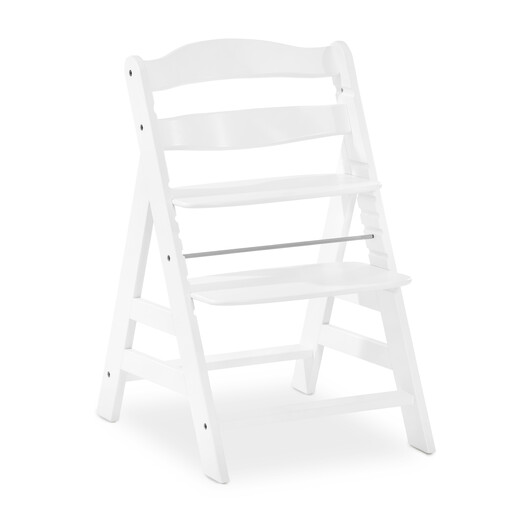
Why this product suits this profile: This highchair that grows with your child is made from FSC-certified European beechwood and is designed for families looking for a long-term seating solution at the dining table.
The seat and footrest can be adjusted. This means the chair offers more than a general claim that it “grows with your child”; it provides specific adjustment options. The tray is available separately and should be taken into account when planning your budget.
5 seat heights, 3 footrest positions and a stated maximum load of 90 kg; 5-point harness included.
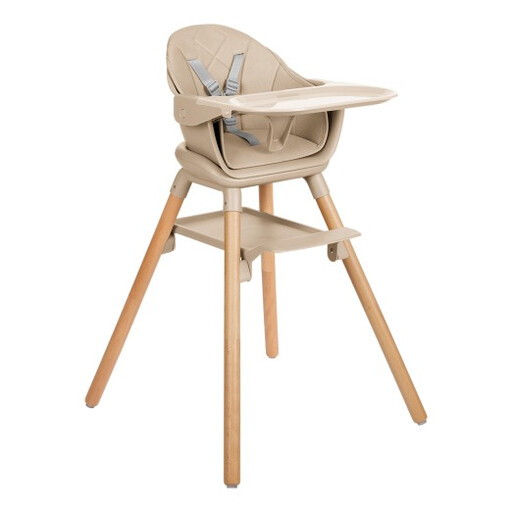
Why this product suits this profile: The 6-in-1 model is ideal for families who want one product to cover several stages of use – from baby highchair to junior chair.
The individual configurations and weight limits are listed separately: up to 15 kg in highchair mode and up to 25 kg as a junior chair. This makes it easier to assess the actual period of use realistically.
6-in-1 design, 5-point harness, adjustable footrest, double removable tray and wipe-clean cover.

Why this product suits this profile: This wooden model folds away and can be moved using the handle in the backrest. That is practical when the dining area is regularly used for other purposes.
Before every use, the chair must be fully unfolded and checked for stability. The product information states that it is suitable from 6 months, has a 3-point harness and a maximum load of 70 kg.
Folding wooden construction, permanently fitted wipe-clean eating tray and delivery in a folded state.
We have compiled a complete, regularly updated list of products that fully meet these strict selection criteria and the safety regulations applicable in the EU.
Many models are intended for use from around 6 months. However, the key requirement is that your child can sit independently without support. The manufacturer’s specifications regarding age, body weight and harness use must always be followed.
This depends on the design and weight limit. A basic children’s highchair with a 15 kg capacity is typically designed for the early toddler stage. Models such as the roba Sit Up Flex or Hauck Alpha+ may be used for longer thanks to their adjustable seat and foot boards. Check the permitted configuration for each age group.
A tray provides a separate surface and can make cleaning easier. For shared meals at the family table, an adjustable-height highchair without a permanently fitted tray is often more flexible. The key considerations are table height, footprint, seating position and whether the tray can be removed.