Stock-up shoppers looking for fibre
If you shop for several people and specifically want a high-fibre product, you need comparable nutrition information and a pack size that suits how much your household uses.


For a large household, it’s worth checking the fibre content of the specific muesli or cereal first. Under EU Regulation (EC) No 1924/2006, a product can be described as “high fibre” if it contains at least 6 g of fibre per 100 g or 3 g per 100 kcal. Sugar, allergens, taste and a pack size that suits your household’s consumption will then help you decide which variety is right for everyone.
If you shop for several people and specifically want a high-fibre product, you need comparable nutrition information and a pack size that suits how much your household uses.
If not everyone enjoys traditional muesli, compare the sugar per serving and the ingredients in the specific variety you’re considering, as well as its fibre content.
If you need to consider ingredients such as gluten-containing cereals, nuts or soya, check the ingredients and allergen information on the specific pack. A brand name alone isn’t enough.
Start by checking the fibre content if “high fibre” is one of your buying criteria. Then compare the variety and pack size with the needs of the people who will actually eat it.
| What to consider | What to check | Who it matters most to |
|---|---|---|
| Fibre content | Fibre per 100 g; to claim “high fibre”, a product must contain at least 6 g per 100 g or 3 g per 100 kcal, in line with EU Regulation (EC) No 1924/2006. | If I’m specifically looking for a high-fibre breakfast product for several people, I want to check the figure rather than rely on “wholegrain” alone. For around 50% of consumers, this evidence of fibre content comes first. |
| Amount to stock up on | Pack weight and number of packs, best-before date and space for dry storage. | If you regularly shop for a large household, you need an amount that can be used before the best-before date. Around 30% of consumers prioritise planning their food stocks. |
| Taste and ingredients | Sugar per 100 g and per serving, as well as the ingredients and allergen information for the specific variety. | If several people are going to eat the same variety, a taste everyone enjoys and ingredients that take everyone’s needs into account matter to me. This is a priority for around 20% of consumers. |
Wholegrain content alone doesn’t tell you whether a product meets the requirements for a “high fibre” claim.
Check the fibre figure in the nutrition information. EU Regulation (EC) No 1924/2006 sets the minimum at 6 g per 100 g or 3 g per 100 kcal.
Sugar can affect your choice even in a cereal product that provides fibre. Nestlé Cerealien lists 1.9 g of fibre and 7.2 g of sugar per 30 g serving for CINI MINIS.
Compare both figures using the same basis, and bear in mind how large the portion you actually serve is.
A large quantity isn’t very practical if not everyone likes the variety or some people need to avoid certain ingredients. Seitenbacher also sells “Müsli Ballaststoff & Frucht” in a box of nine 750 g packs; the mix contains gluten-containing cereals, soya and almonds, among other ingredients.
Before buying a box, check the ingredients, best-before date, storage space and how quickly you expect to use it.
“Müsli Ballaststoff & Frucht” is a specific option for households looking to compare nutrition information and a bulk-buying option.
CINI MINIS are a cinnamon-flavoured cereal option if taste is an important factor when choosing a variety for everyone.
Bircher muesli from familia is an option if the type of muesli and the make-up of its cereal ingredients are your main considerations.
The brand offers a range of cereals and granola products that you can compare variety by variety.
This selection includes two mueslis and cinnamon-flavoured cereal for households weighing up taste, ingredients and pack size. Check the current nutrition information for each variety before classifying it as a high-fibre product.
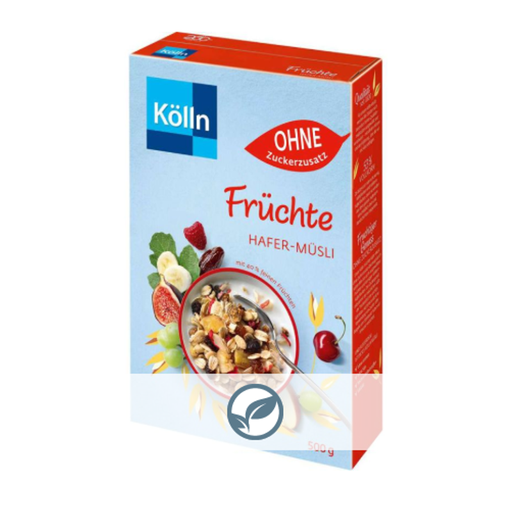 No image available
If you’re looking for a fruit muesli for several people, compare the nutrition information and ingredients on the specific pack before stocking up.
Pack size: 500 g. Check the current allergen information if you need to consider wheat, oats and barley, or possible traces of milk and nuts.
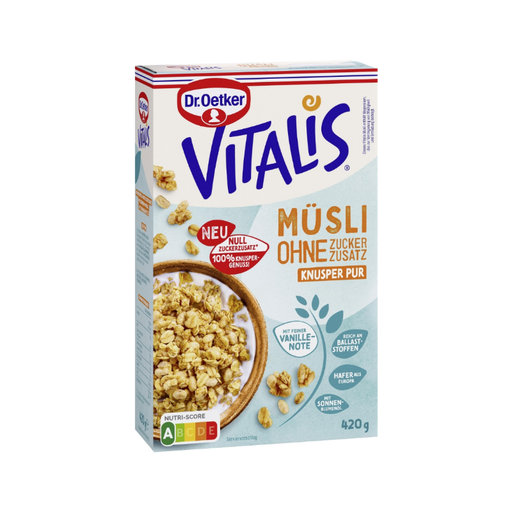 No image available
If you’re considering crunchy muesli for the household breakfast cupboard, compare sugar and fibre using the nutrition information for the specific variety.
Pack size: 420 g. Before buying, think about how many packs suit your household’s consumption.
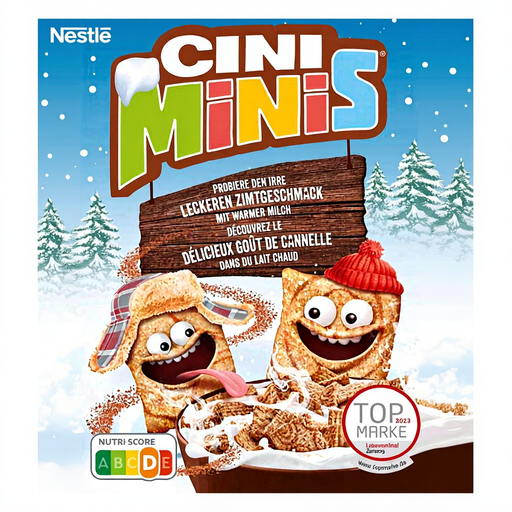 No image available
If people in your household are more likely to eat cinnamon-flavoured cereal than muesli, consider sugar, fibre and serving size as well as taste when choosing.
Pack size: 375 g. If you need to consider gluten or possible traces of milk and nuts, check the allergen information on the current pack.
EU Regulation (EC) No 1924/2006 allows this claim when a product contains at least 6 g of fibre per 100 g or at least 3 g per 100 kcal. A wholegrain claim alone doesn’t prove that either of these requirements has been met.
The figure per serving shows how much fibre you’ll get from the stated portion; the figure per 100 g is also useful when comparing different products. The German Nutrition Society recommends at least 30 g of fibre a day for adults aged 19 and over as a guideline for their overall diet, not for a single breakfast.
Yes. Wholegrain doesn’t tell you whether a variety is suitable for everyone in your household. Check the ingredients and allergen information on the specific pack. The Federal Ministry of Agriculture, Food and Regional Identity explains that certain ingredients that can cause allergies must be declared on packaged foods.
No. A bulk pack only makes sense if everyone will eat the variety and the quantity suits how much your household actually uses. Compare pack weights and check the best-before date, storage space and ingredients before buying several packs.