Keeping an eye on fibre
You want an easy breakfast in your holiday let and are looking for flakes with a stated fibre content that meets the threshold for a “high fibre” claim.


If high fibre is a priority at breakfast in your holiday let, check the fibre content rather than relying on terms such as “wholegrain” or “unsweetened”. Under EU Regulation (EC) No 1924/2006, a “high fibre” claim requires at least 6 g of fibre per 100 g or 3 g per 100 kcal. Nestlé Cereals lists 9.4 g per 100 g for FITNESS wholegrain cornflakes, while REWE lists 7.5 g per 100 g for Kölln wholegrain oat flakes Klassik. REWE’s unsweetened REWE Bio cornflakes contain 4.1 g per 100 g, according to REWE, which is below the threshold. Whichever you choose, check the ingredients, allergens and pack size too.
You want an easy breakfast in your holiday let and are looking for flakes with a stated fibre content that meets the threshold for a “high fibre” claim.
You want a simple cornflake base with little sugar, while bearing in mind that “unsweetened” does not mean high in fibre.
You’re shopping for several people and need to check the current pack for the types of grain, allergens and possible traces before eating.
For breakfast in your holiday let, start by comparing fibre and sugar separately per 100 g. Then check whether the ingredients, allergen information and pack size suit your fellow travellers and the length of your stay.
| Criterion | What to check | What shoppers need |
|---|---|---|
| Fibre content | Check the fibre per 100 g. For a “high fibre” claim, EU Regulation (EC) No 1924/2006 sets a minimum of 6 g per 100 g or 3 g per 100 kcal. | If I’m buying flakes specifically because they’re high in fibre, I need a stated figure rather than a wholegrain claim alone. Around 50% of shoppers prioritise this. |
| Sugar | Compare sugar and fibre separately per 100 g. A low sugar figure does not prove that a product is high in fibre. | For a simple breakfast, I mainly want unsweetened cornflakes, even if they don’t meet the fibre threshold. Around 30% of shoppers prioritise this. |
| Ingredients and storage | Check the current ingredients and allergen information, as well as the pack size and any instructions for resealing. | If several people are sharing the same flakes, I need to check the ingredients suit everyone and be able to store an opened pack properly. This is the top priority for around 20% of shoppers. |
REWE lists less than 0.5 g of sugar and 4.1 g of fibre per 100 g for REWE Bio unsweetened cornflakes. The sugar figure doesn’t tell you how much fibre they contain.
Read both figures separately in the nutritional information. Under EU Regulation (EC) No 1924/2006, a “high fibre” claim requires at least 6 g per 100 g or 3 g per 100 kcal.
Wholegrain content is no substitute for comparing nutritional values. REWE lists 7.5 g of fibre per 100 g for Kölln wholegrain oat flakes Klassik; sugar and salt are separate considerations.
Compare the nutritional values that matter to you per 100 g and read the ingredients list, rather than assuming one claim tells you everything about the product.
The wheat cornflakes and oat flakes mentioned here have different grain ingredients, and possible traces may also be relevant depending on the product. Previous packs aren’t a reliable guide when shopping now.
Before eating, check the ingredients, highlighted allergens and trace warnings on every current pack.
A large pack may be handy for several breakfasts. For a short stay, though, you may be left with an opened bag that needs to be kept dry.
Choose a pack size to suit the number of people and the length of your stay. REWE recommends resealing the bag well after opening Kölln wholegrain oat flakes Klassik.
Wholegrain cornflakes for shoppers who want to stick with flakes and check the stated fibre content.
Wholegrain oat flakes as an alternative if you don’t need your breakfast to be classic cornflakes.
Unsweetened cornflakes for shoppers who value a simple cornflake base more than a “high fibre” claim.
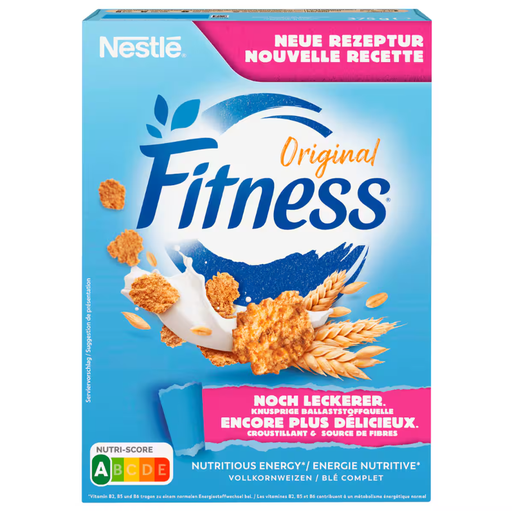
This selection includes Nestlé FITNESS Original wholegrain cereals, as well as fine and coarse oats. Oats are a different kind of breakfast from cornflakes, so choose them only if that alternative suits you.
 No image available
A handy option for an easy breakfast in your holiday let if you’d rather have wholegrain cereal than oats.
Pack size: 375 g. Check the nutritional and allergen information for this exact variety on the current pack.
 No image available
A good option if you’d like to make oats in your holiday let and aren’t looking for cornflakes.
Fine, tender rolled oats in a 500 g pack. Check the current pack for ingredients, allergens and nutritional values.
 No image available
A suitable choice for a breakfast with coarse oats if you’d like a different type of grain instead of cornflakes.
Coarse rolled oats in a 500 g pack. Check the current ingredients, allergen information and nutritional values before buying.
For a “high fibre” claim, or any wording with the same meaning, the annex to EU Regulation (EC) No 1924/2006 requires at least 6 g of fibre per 100 g or 3 g per 100 kcal. So compare the stated fibre content rather than relying only on claims such as “wholegrain” or “organic”.
No. A low sugar figure doesn’t tell you whether a product meets the threshold for a “high fibre” claim. REWE lists less than 0.5 g of sugar and 4.1 g of fibre per 100 g for its unsweetened organic cornflakes.
Follow the storage instructions on the pack and seal the bag well again after opening. REWE specifically recommends resealing the bag for Kölln wholegrain oat flakes Klassik. When choosing a pack size, take the length of your stay into account too.
Yes. If allergens matter to you or anyone travelling with you, check the information on the pack you’re buying now. Nestlé notes that recipes for FITNESS may change, and ingredients and possible traces also vary between the products mentioned here.