Shoppers keeping an eye on fibre
You want to find a reliably high-fibre option for your holiday breakfast, so you compare the figures per 100 g rather than relying on the front of the pack alone.


For breakfast in your holiday apartment, choose a muesli with a clear fibre value. Under EU Regulation (EC) No 1924/2006, a food can be described as ‘high fibre’ if it contains at least 6 g of fibre per 100 g or 3 g per 100 kcal. You can customise a basic mix with ingredients of your choice. With ready-made fruit and crunchy mueslis, you should also compare sugar, allergens and pack size.
You want to find a reliably high-fibre option for your holiday breakfast, so you compare the figures per 100 g rather than relying on the front of the pack alone.
You’re looking for a dry base that you can combine with fruit, milk, yoghurt or plant-based alternatives in your holiday apartment, as needed.
For them, the ingredients and allergen information for the specific variety matter: you can’t rule out cereals, nuts, sesame, soya or milk just by looking at the brand name.
First, check the fibre content of the variety you’re interested in. Then decide whether a base you can customise or a ready-made mix is a better fit for your breakfast plans and fellow travellers.
| Criterion | What to check when buying | Who it matters most to |
|---|---|---|
| Fibre content | Under EU Regulation (EC) No 1924/2006, a food can be described as ‘high fibre’ if it contains at least 6 g of fibre per 100 g or 3 g per 100 kcal. Compare the nutrition information for the specific variety. | If fibre content is my main shopping priority, I want to be able to compare it independently of claims on the pack. Around 42% of consumers put this first. |
| Flexible breakfast base | Compare the ingredients and pack size. With a basic mix, you can add fruit or other ingredients yourself. | When breakfast plans vary, I want to choose what goes in my bowl. Around 33% of consumers prioritise this. |
| Ingredients and allergens | Read the ingredients list, highlighted allergens and any ‘may contain’ statements on each specific pack. | If fellow travellers need to avoid certain ingredients, checking the specific variety is my priority. Around 25% of consumers put this first. |
Wholegrain and ‘no added sugar’ describe different qualities from fibre content. Even with a suitable base mix, it’s the nutrition information for the specific variety that counts.
To check whether a product qualifies as ‘high fibre’, look for the threshold set by EU Regulation (EC) No 1924/2006: at least 6 g of fibre per 100 g or 3 g per 100 kcal.
Different serving sizes make comparisons tricky. For example, Seitenbacher lists 5 g of fibre per 40 g serving and 12 g per 100 g for its Müsli Ballaststoff & Frucht.
First compare fibre and sugar per 100 g, then look at the portion you’re planning to have for breakfast.
A mix may contain several ingredients that are relevant to people with allergies. REWE Bio 5-Korn-Müsli, for example, lists cereals containing gluten and sesame.
Read the ingredients list and any ‘may contain’ statements on the pack rather than relying on terms such as ‘organic’ or ‘wholegrain’.
If you’re staying for a short time, you may have muesli left over after your last breakfast. According to Lebensmittelverband Deutschland, the best-before date relates to the quality of unopened food when stored appropriately.
Choose a quantity that suits the number of breakfasts you’ve planned and follow the storage instructions on the pack. Keep any opened leftovers dry and tightly sealed.
Müsli Ballaststoff & Frucht is a specific variety you can use to compare fibre figures.
Basis-Müsli is an option for shoppers who want to add their own ingredients to breakfast.
Mühlenklassiker Vollkorn Basis-Müsli is aimed at shoppers who want to choose their own breakfast toppings.
5-Korn-Müsli is a 1 kg base mix without dried fruit.
Brüggen is worth considering when comparing traditional muesli mixes with crunchy varieties.
This Joybuy selection includes two crunchy mueslis, a fruit muesli and oats for creating your own mix. Oats aren’t a ready-made muesli mix, so compare the nutrition and ingredients information on the pack for every product.
 Image unavailable
A crunchy muesli option for your holiday breakfast; the pack contains 600 g. Compare sugar and fibre per 100 g, and check the allergen information on the specific pack.
 Image unavailable
For shoppers who want crunchy oat muesli rather than a base to customise; the pack contains 750 g. Check the sugar, fibre and allergen information before buying.
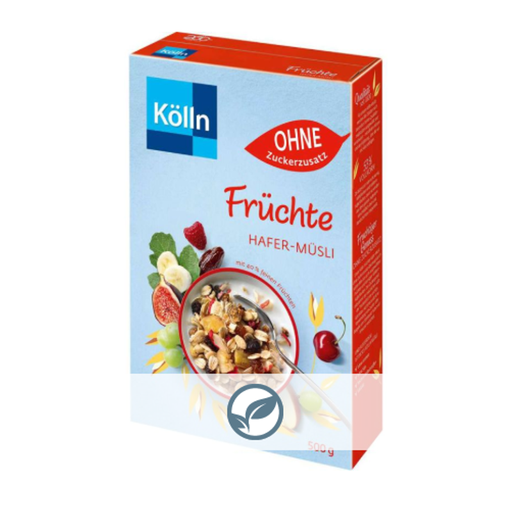 Image unavailable
A ready-made fruit muesli rather than a mix you put together yourself; the pack contains 500 g. The ‘No Added Sugar’ label doesn’t replace checking the sugar per 100 g and the ingredients list.
 Image unavailable
If you want to make your own muesli, these oats can be used as a base. The 500 g pack isn’t a ready-made muesli mix, so you’ll need to add any other ingredients you want yourself.
Under EU Regulation (EC) No 1924/2006, it must contain at least 6 g of fibre per 100 g or 3 g per 100 kcal. This claim alone tells you nothing about the sugar or allergens in the variety.
The German Nutrition Society (DGE) recommends that adults aim for at least 30 g of fibre a day. A serving of muesli is just one possible part of your overall diet and won’t necessarily provide this amount on its own.
Read the ingredients list and highlighted allergens on the specific pack. If relevant, also check for ‘may contain’ statements: these flag possible accidental traces, not necessarily an ingredient in the muesli.
Follow the storage instructions on the pack, seal the muesli tightly after opening and keep it somewhere dry. According to Lebensmittelverband Deutschland, the best-before date refers to the quality of unopened food when stored appropriately.