
Lieferung heute & morgen

Qualitätsgarantie

Willkommens-Angebote freischalten: KOSTENLOSE Lieferung | Bis zu 80 % RABATT | Kostenlose 30-Tage-JoyPlus-Testphase
App herunterladen
A highlighter should make important passages easy to spot without obscuring the text or smudging when pages are turned. In practice, however, weaknesses often become apparent only after a few weeks: the tip becomes uneven, the ink dries out or the colour bleeds through thin paper. Even an extensive highlighter set is not automatically the right choice if the line width, ink type and grip do not suit the intended use.
This buying guide explains what pupils, students, teachers, professionals, parents and bullet-journal enthusiasts should look for when making a purchase. The product features mentioned are based on the available manufacturer and product information.
Neon colours look vibrant in product images, but on white paper they can obscure the text. For longer study or work sessions, transparency and an even ink flow are therefore just as important as colour intensity. With sensitive printouts, you should also check whether the manufacturer specifies suitability for inkjet prints, fax paper or carbonless copy paper.
Classic chisel tips are well suited to larger blocks of text, but they are less precise for individual words or small footnotes. A highlighter with a soft tip and variable line width can offer greater flexibility in these situations. It is important that the specification gives an actual measurement in millimetres, such as 1–4 mm or 1–5 mm, rather than relying solely on vague terms like “multifunctional”.
Depending on the formulation and fabric, water-based ink is often easier to wash out than solvent-based ink. It is not, however, a guarantee for every surface. When choosing children’s pens or using them on clothing, look for specific claims such as “washable”. Staining can also depend on the material, washing temperature and contact time.
The following options are common for marking schoolbooks, lecture notes and office documents:
A soft round tip adapts to the angle and, to some extent, the pressure of the hand. A chisel tip, by contrast, produces clearly defined edges. For fibre-tip pens and children’s felt-tip pens, rounded, pressure-resistant tips are practical because they are less likely to deform quickly when pressed firmly.
A water-based highlighter is a popular choice for paper, notes and many creative applications. For printed documents, the product description should include information such as “suitable for inkjet prints” or “smudge-resistant on inkjet prints”. Such claims apply only to the specified materials and do not replace testing on particularly sensitive paper.
A quick-drying highlighter can be useful for left-handed users and densely written pages. Nevertheless, “quick-drying” should not be confused with completely smudge-proof. Drying time depends, among other things, on the paper, the amount of ink applied and the room climate.
An ergonomic highlighter often features a triangular barrel or a shaped grip zone. Triangular casings can also prevent the pen from rolling off the desk. For longer study sessions, it is worth considering the material and cap closure. Polypropylene casings are described in several product specifications as durable and resistant to evaporation.
For children, also pay attention to ventilated safety caps and age recommendations. According to the available product information, certain models meet safety requirements such as ISO 11540 and BS 7272-1/2. Always check the specific labelling directly on the individual product.
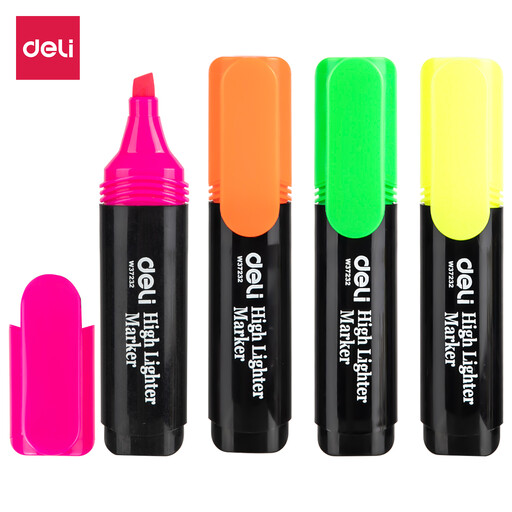
Why it’s a good fit: Four colours in one set cover essential highlighting tasks at school, university and in the office, without requiring a large selection from the outset.
According to the product information, the chisel tip enables different line widths by changing the angle. The water-based fluorescent ink is intended for use on paper.
Four colours, a specified 1.5 mm tip and a clip for attaching the pen to books or notebooks.
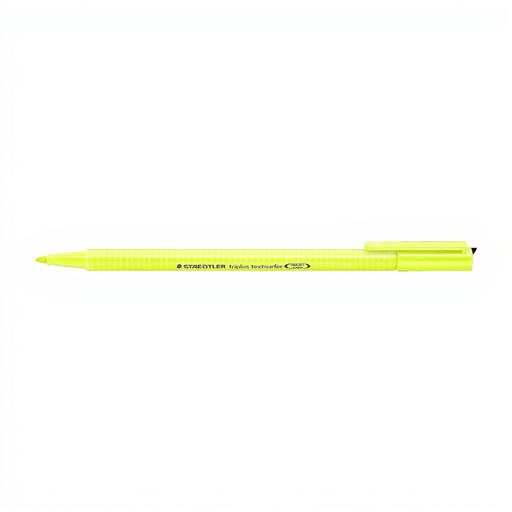
Why it’s a good fit: The combination of a triangular casing and soft round tip is ideal for people who highlight frequently and switch between fine underlining and broader areas.
The specified variable line width reduces the need for multiple tips. According to the product description, the ink is intended for inkjet prints and dries quickly.
1–4 mm tip, triangular barrel and water-based, vivid ink for paper.
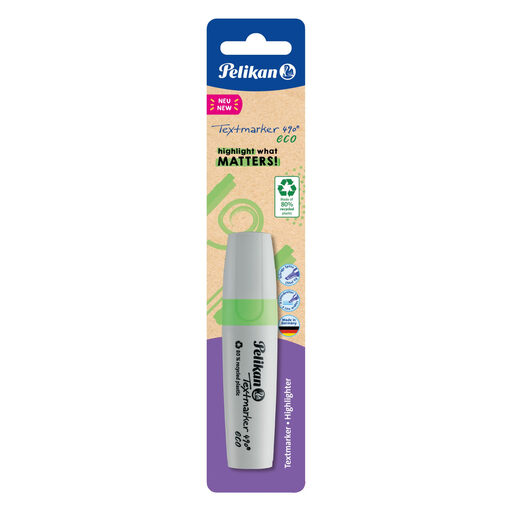
Why it’s a good fit: For regular highlighting in the office or at university, this single highlighter offers several specified line widths and a grip area designed for extended use.
The product information lists 1, 2 and 5 mm, allowing fine underlining and broad highlighting with a single pen. The ink is water-based.
According to the product description, the casing is made from 80% recycled materials; it also specifies protection against drying out for up to eight hours.
Not every highlighting task calls for a classic highlighter. For colourful headings, journaling and drawings, coloured gel pens with fine tips are a great choice. According to the product information, the WRITECH sets feature 0.5 mm tips, retractable refills and quick-drying gel ink. For children, possible options include the STAEDTLER Noris Junior with six colours and the Faber-Castell Connector series with 80 fibre-tip pens. Both product descriptions specify washable ink; care instructions should still be followed when using them on textiles.
If you need a marker for transparencies, glass or whiteboards, choose a model designed specifically for that purpose rather than a highlighter. According to the product information, the STAEDTLER Lumocolor Non-Permanent B Yellow features water-soluble ink and a 1.0/2.5 mm chisel tip. Suitability depends on the particular surface.
Discover a curated selection of coloured gel pens for notes, journaling, drawings and creative projects.
For thin paper, models with controlled ink flow are a sensible choice. A gel highlighter or a fine 1 mm tip may release less ink at a time than a broad chisel tip. Before using one regularly, it is advisable to test it on an inconspicuous page, as paper thickness and absorbency can vary.
Its service life depends on line width, writing pressure, ink reservoir and cap seal. A large ink supply, a durable tip and a tightly closing cap can extend its practical lifespan. Manufacturer claims such as “DRY SAFE” or protection against drying out for several hours should be attributed to the specific product and not applied indiscriminately to all highlighters.
Water-based ink is commonly used in children’s pens and fibre-tip markers. The decisive factors are the specific age recommendation, a ventilated cap and the manufacturer’s instructions. For the STAEDTLER Noris Junior fibre-tip pens, use from the age of three is specified, subject to the safety instructions. Pens and caps should not be put in the mouth; small parts may pose a choking hazard.