
Lieferung heute & morgen

Qualitätsgarantie

Willkommens-Angebote freischalten: KOSTENLOSE Lieferung | Bis zu 80 % RABATT | Kostenlose 30-Tage-JoyPlus-Testphase
App herunterladen
HiPP organic baby food is available in many varieties: vegetable purée for babies, complete HiPP baby meals, meat preparations or fruit and cereal purées. The choice may initially seem straightforward, but some information on packaging can lead to poor decisions when shopping. What matters is not eye-catching advertising claims, but the recommended age, ingredients list, consistency, allergens and pack size.
A jar marked “from 5 months” is not automatically suitable for every child at this stage of development. Some products are finely puréed and suitable when starting complementary feeding, while others already contain small pieces. From 8 months, finely textured meals can help support learning to chew, provided the child is comfortable with this consistency.
The manufacturer’s recommended age should therefore always be considered alongside the child’s individual development. If you are unsure, advice from a paediatrician or midwife may be helpful.
Fruit naturally contains sugar. A fruit purée can therefore be labelled no added sugar and still list sugar in the nutritional information. In HiPP Organic Fruit and Cereal Plum in Pear, for example, the carbohydrates and sugars come from fruit and cereals. The ingredients list includes 75% fruit as well as wheat and oats.
Organic certification relates to production requirements and does not replace checking the specific recipe. Likewise, “no added salt” does not mean that the product is completely salt-free. The information on the label, including the nutritional table, is what matters.
Also look out for ingredients such as milk, wheat, oats, celery, mustard or egg. Potential allergens must be considered individually, even in organic baby food.
First, match the product to its intended use:
Check whether the jar meets your own requirements. Relevant information may include no added salt, no added sugar, gluten-free, vegetarian or dairy-free. “Gluten-free” should be checked particularly carefully for recipes containing wheat, oats, bulgur or couscous. A fruit purée with wholegrain wheat and oats contains gluten, while certain vegetable and rice meals are described as gluten-free according to the product information.
For meat meals for babies, the type of meat and its percentage should also be listed in the ingredients. This makes it easier to compare a pure meat preparation with a complete meal.
Baby food jars in multipacks are suitable for families who want to use the same variety regularly. However, six jars of 190, 220 or 250 g differ significantly in total weight and portion planning. After opening, only the required amount should be heated. Unheated leftovers should be sealed and stored in the fridge, then consumed according to the pack instructions, often on the following day.
Before buying, it is also worth checking the best-before date, the condition of the lid and the storage conditions. Jars should be undamaged before opening.
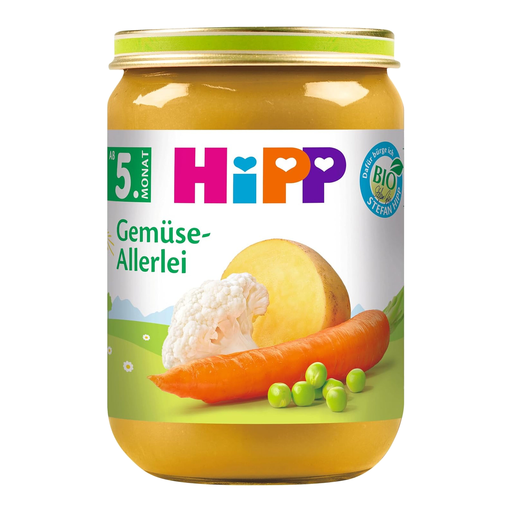
Why this product suits this profile: A simple vegetable jar for families starting complementary feeding with a manageable number of ingredients and wanting to stock up on six portions.
According to the product information, the recipe contains no added salt. The ingredients list remains short, making it easy to check which vegetables are included.
73% vegetables according to the product description; listed as gluten- and lactose-free; 6 x 190 g.
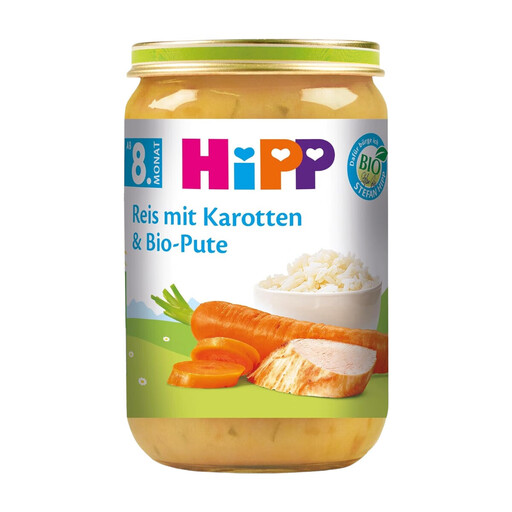
Why this product suits this profile: Suitable for parents looking for a complete HiPP baby meal made with organic ingredients and an age-appropriate texture.
The from-8-months age recommendation and fine pieces are clearly stated. The meal contains no added salt; allergens and ingredients can be checked on the label.
Carrots, rice and 8% organic turkey according to the ingredients information; 6 x 220 g; free from the 14 major allergens listed in EU regulations according to the product description.
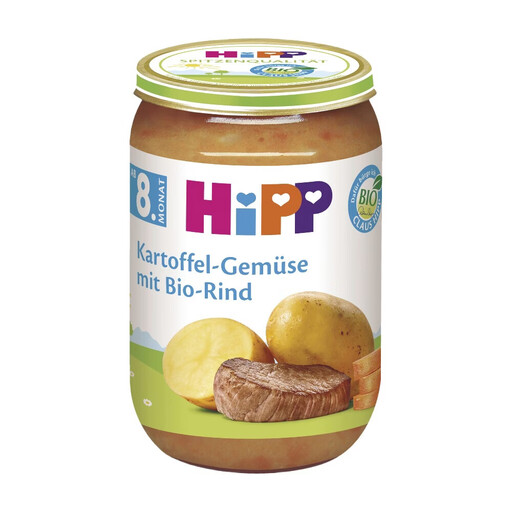
Why this product suits this profile: A multipack for households that regularly need a savoury main meal from 8 months.
According to the product information, the recipe contains no added salt, dairy products, flavourings, preservatives, colourings or thickeners. The texture is specifically intended to help babies learn to chew.
Potatoes and carrots account for 65% of the ingredients; 8.2% organic beef and 1.6% rapeseed oil according to the product data; listed as gluten-free.
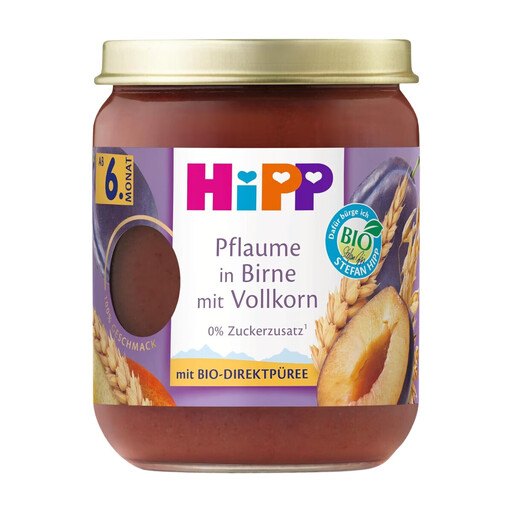
Why this product suits this profile: Practical as a snack or supplement for families wanting to keep fruit and cereal purée in a multipack.
The no-added-sugar labelling is explained by the ingredients list: the sugar comes from fruit and cereals. Wheat and oats are listed as gluten-containing ingredients.
75% fruit, wholegrain wheat and oats according to the product information; suitable from the 6th month; 6 x 160 g.
We have put together a complete, regularly updated list of products that fully meet these strict selection criteria and the safety regulations applicable in the EU.
Only heat the portion you need in a bain-marie or in the microwave. Stir the purée thoroughly and check the temperature before feeding. Metal spoons can be avoided with delicate jars; a clean plastic or baby spoon is practical.
Unheated leftovers should be sealed and stored in the fridge. Leftovers that have already been heated or touched by the child should not be used again. The exact shelf life after opening may vary depending on the product and must be checked on the label.
For starting complementary feeding, finely puréed vegetable jars or simple meals that are specifically labelled as suitable from the 5th month may be considered. Examples from the selection include mixed vegetables, vegetable and rice with organic chicken, or sweetcorn with potatoes and organic turkey. New ingredients should be introduced gradually.
“No added sugar” means that no additional sugar has been added. The sugar naturally present in fruit remains and is listed in the nutritional information. For fruit purées, you should also check whether cereals, and therefore gluten, are included.
This depends on the information provided for the particular product. For many HiPP meals, an unheated leftover can be sealed and kept in the fridge until the following day. Fruit purées may have a longer shelf life. The label, storage instructions and hygienic handling should always be treated as definitive.