Who is this PC for?

Anyone checking for duplicates

If you’re cataloguing adverts that are already readable, you’ll need a clear method for distinguishing identical records from ones that only appear to match. The application you use, the fields you compare and having backups before deleting anything are all crucial. Microsoft Support distinguishes between temporarily filtering duplicate values and permanently removing them.

Anyone working with scans and OCR

If you’re starting with digitised newspaper pages, first work out whether you need to carry out text recognition yourself and which software you plan to use. The German Union Catalogue of Serials treats digital page images and full-text OCR as distinct levels of access.

Anyone planning an archive workstation

For a workstation that will be used over the long term or has limited space, the monitor, existing peripherals, connections, upgrade options and backup arrangements all need to work together. The Federal Office for Information Security explains why backups are important in case of a fault or accidental deletion.

What should you look for when buying?

Mini PC with a separate monitor

A good fit if: you have limited desk space or already own a suitable monitor, and the specific PC configuration meets your software and connectivity needs.

Consider: you may also need to buy a monitor and input devices; a small PC won’t identify and resolve duplicates on its own.

Larger desktop or tower

A good fit if: you have room and internal drives or future upgrades are important for your workflow.

Consider: this form factor takes up more space. On its own, it offers no guarantee of faster OCR or better recognition accuracy.

All-in-one desktop

A good fit if: you also need a monitor, and the size, connections and position work for your cataloguing area.

Consider: choosing this PC ties you more closely to the included monitor. Check the actual specification rather than assuming the form factor means it has the software features you need.

Buying priority What to check Who should consider this?
Check for duplicates with care Decide which fields to compare in your chosen application and back up the original data before removing anything. Microsoft Support notes that removing duplicate values is permanent. When I compare adverts, I want to distinguish identical entries from those that only appear to match, while keeping their source references. Around 31% of consumers place particular importance on carefully checking for duplicates.
Process scans using OCR Check the operating system, memory, available storage and scanner compatibility against the requirements of your specific OCR application. ABBYY specifies Windows 10 or 11 (64-bit) and at least 2 GB of RAM, with 4 GB recommended, for FineReader PDF 16. If I want to turn historical pages into searchable text myself, I’ll choose a PC specification that suits the actual scale of the work and the software I’ve selected. Around 31% of consumers make scan and OCR processing their top priority.
Back up project files Estimate how much storage you’ll need for your scans and work in progress, and plan for a separate backup drive. The Federal Office for Information Security recommends keeping backups to protect against faults and accidental deletion. If I want to keep my scans, metadata and corrected versions safe, I’ll plan for a separate copy and maintain it regularly. Around 23% of consumers prioritise keeping their project files safe.
Set up a suitable workstation Make sure the video outputs match your existing monitor. For the exact model, check the operating system, storage, and whether a keyboard and mouse are included. If space is limited or I want to reuse my existing equipment, the PC, monitor and peripherals need to work together. Around 15% of consumers focus mainly on having a suitable, compact workstation.

Common buying mistakes

  • Confusing extra processing power with reliable duplicate detection

    Whether records count as duplicates depends on the fields you compare and the rules you set. A faster PC can’t make that decision for you.

    Copy the original data, decide which fields to compare and check the results before removing any entries.

  • Assuming a large internal SSD is a backup

    If your scans, corrections and source references are all on the same PC, they won’t be protected by a separate copy if the device fails or something is accidentally deleted.

    Plan for a separate backup drive, check that you have the connections you need and schedule regular backups.

  • Assuming a mini PC, barebone and fully equipped desktop are all the same

    What’s included and the specification can vary by model and configuration. COMPUTER BILD notes that the GEEKOM A5 Pro it tested came without input devices, while the Intel NUC 13 it tested was missing components. These findings don’t necessarily apply to other configurations.

    Check the full model number and everything included, including RAM, storage, operating system, monitor, keyboard and mouse.

Key brands at a glance

GEEKOM

The A5 Pro range is worth considering as a compact desktop with a separate monitor for a workstation where space is limited.

  • GEEKOM offers an A5 Pro 2026 Edition configuration with a Ryzen 5 7530U, 16 GB RAM and a 1 TB SSD.
  • COMPUTER BILD describes the model it tested as compact, with upgradeable storage, but notes that it doesn’t include a keyboard or mouse. Its verdict and specification don’t necessarily apply to every configuration.

MSI

The Cubi NUC 1M family is an option for a compact office workstation with a range of connections.

  • MSI lists HDMI, Thunderbolt and two SO-DIMM slots among the family’s features.
  • The processor, RAM and drive depend on the specific configuration. COMPUTER BILD notes that the SSD access on the model it tested was somewhat slow.

HP

The Pro Mini 400 G9 is a range of business mini PCs designed for compact workstations.

  • COMPUTER BILD describes the D6B240EA it tested as offering fast performance, with upgradeable RAM and SSD.
  • The separately listed CP9G3EA#ABD configuration has a different specification; it shouldn’t be assumed to match the D6B240EA tested.

Lenovo

The ThinkCentre M70q Gen 5 is a range of compact Tiny business desktops.

  • For the 12TD0083EZ configuration, Lenovo lists Windows 11 Pro, 16 GB RAM and a 512 GB SSD. It also describes service and upgrade access for the memory and drive.
  • These details apply to the model number shown; other configurations may differ.

Acer

The Veriton 2000 Mini is a compact business option for a workstation with a separate monitor.

  • For the VN2595GT, part number DT.R50EG.003, Acer lists Windows 11 Pro, 16 GB RAM, a 512 GB SSD, HDMI and DisplayPort.
  • These details apply to the specified configuration and don’t indicate OCR speed or the quality of duplicate detection.

Joybuy products

The following Joybuy products are mini PCs for use with a separate monitor. Check that the operating system, connections and included items are suitable for your cataloguing and OCR software.

BMAX B6 mini PC with Intel Core i3-8109U, 12 GB RAM and 256 GB SSD

BMAX B6 mini PC, Intel Core i3-8109U, 12 GB RAM, 256 GB SSD

The mini PC form factor is worth considering for a compact workstation with a separate monitor.

The listed specification includes an Intel Core i3-8109U processor running at up to 3.6 GHz, 12 GB RAM, a 256 GB SSD, HDMI and DisplayPort.

View at Joybuy
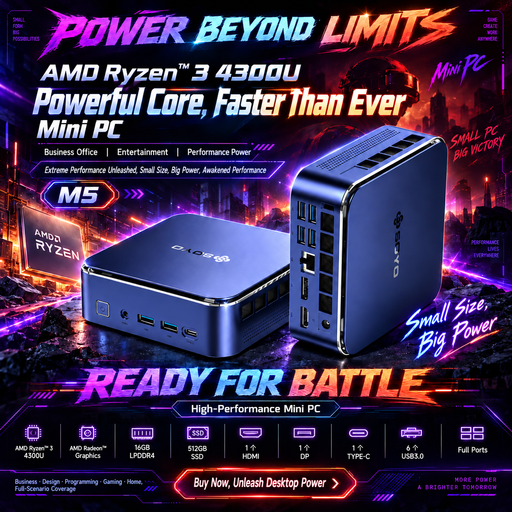
SOYO M5 mini PC with AMD Ryzen 4300U, 16 GB RAM and 512 GB SSD

SOYO M5 mini PC, AMD Ryzen 4300U, 16 GB RAM, 512 GB SSD

This compact PC is designed for use with a separate monitor. The application you use will still need to check for identical or duplicate records according to the rules you’ve set.

The product title lists Windows 11, 16 GB LPDDR4, a 512 GB SSD, HDMI, Type-C and DP 1.4.

View at Joybuy

FIREBAT F1 mini PC with AMD Ryzen 5 7640HS, 24 GB RAM and 512 GB SSD

FIREBAT F1 mini PC, AMD Ryzen 5 7640HS, 24 GB RAM, 512 GB SSD

This mini PC could suit a workstation with limited space and a separate monitor.

The product title lists 24 GB LPDDR5, a 512 GB PCIe 4.0 SSD, HDMI 2.1 and USB 4.0, plus support for three displays.

View at Joybuy

FIREBAT R3 mini PC with AMD Ryzen 5 7430U, 16 GB RAM and 512 GB SSD

FIREBAT R3 mini PC, AMD Ryzen 5 7430U, 16 GB RAM, 512 GB SSD

This compact PC is an option if there’s limited desk space in your cataloguing area.

The product title lists 16 GB LPDDR4, a 512 GB SSD and support for three displays.

View at Joybuy

Apple Mac Mini with Apple M6, 24 GB unified memory and 512 GB SSD

Apple Mac Mini, Apple M6, 24 GB unified memory, 512 GB SSD

This compact desktop is designed for use with a separate monitor. Before choosing it, check that the cataloguing and OCR software you need works with macOS.

The product title lists HDMI, Thunderbolt 4 and macOS. ABBYY specifies Windows 10 or 11 (64-bit) for FineReader PDF 16, so this particular application isn’t compatible with the listed macOS setup.

View at Joybuy

Frequently asked questions

Can I simply delete duplicate advert entries automatically?

Only if you’ve defined clear rules for what counts as a duplicate. Microsoft Support distinguishes between temporarily filtering and permanently removing entries in Excel, so back up the original data and check the fields you’re comparing first. Repeat appearances of the same advert may have their own distinct source references.

Do I need OCR for historical adverts?

No, not if you’re working with existing text or digital page images. The German Union Catalogue of Serials distinguishes between images, full-text OCR and other levels of access. Decide based on the data you have and how you want to search. If you’re carrying out OCR yourself, check the requirements of the specific software and, where relevant, scanner compatibility.

How should I back up the data I’ve catalogued?

Keep an up-to-date copy of your scans and work in progress separately from your PC. The Federal Office for Information Security recommends backups to protect against faults and accidental deletion; the capacity you need will depend on your files.

What should I check about the specification and my rights after buying a PC?

Check whether a monitor, input devices, operating system and, where relevant, OCR software are included. If you’re buying as a consumer in Germany, statutory rights against the seller are distinct from a voluntary guarantee. If you’re buying for business use, check the applicable terms separately. The Verbraucherzentrale explains the difference.

Can I publish historical adverts online once I’ve indexed them?

Not simply because they’re old. If texts or images are protected, you’ll need to check the rights and permissions for your intended use. Section 64 of the German Copyright Act (UrhG) gives the general rule that copyright expires 70 years after the author’s death. If you’re processing personal data, you’ll also need to check the relevant data protection basis; the Federal Commissioner for Data Protection and Freedom of Information explains the requirements. Whether a particular advert can be published depends on factors including its author, the material and how you intend to use it.