
Lieferung heute & morgen

Qualitätsgarantie

Willkommens-Angebote freischalten: KOSTENLOSE Lieferung | Bis zu 80 % RABATT | Kostenlose 30-Tage-JoyPlus-Testphase
App herunterladen
A new hob needs to suit your kitchen, cookware and available power connection. When choosing one, wattage and design are not the only things that matter. Unclear installation dimensions, unsuitable pans or a lack of suitable installation options often lead to unnecessary additional costs.
Figures such as 3,000, 5,600 or 7,200 watts describe the maximum connected or total power. They do not automatically indicate how much electricity the hob will use in everyday operation. Actual consumption depends on how long the cooking zones are used and which power level is selected.
When several zones are used at the same time, a connection with suitable protection may also be required. Before buying, the details of voltage, connection type and fuse rating should be checked against the instruction manual and the existing electrical installation.
A hob approximately 60 cm wide will not automatically fit every existing worktop cut-out. The crucial measurements are the cut-out dimensions, not just the appliance’s external dimensions.
Examples from the selection:
An induction hob requires pots and pans with a magnetic base. A simple magnet test on the base of the pan provides an initial indication: if the magnet sticks, the cookware is generally suitable for induction cooking. Aluminium, copper and ceramic cookware will only work if the base also has a magnetic layer.
A ceramic hob, also known as a glass-ceramic hob, is usually more flexible when it comes to cookware materials. However, the base of the pan should be smooth, clean and ideally suited to the size of the cooking zone, so that heat is transferred evenly.
Induction heats the cookware using an electromagnetic field. As a result, the cooking zones generally respond quickly when you change the power level. Features such as pan detection, residual heat indicators and automatic switch-off may also be available.
A ceramic hob uses electrically heated elements beneath a glass-ceramic surface. The surface remains hot for a while after the hob is switched off, making a residual heat indicator particularly useful. Suitable cookware that is not magnetic can also be used.
For one person, an office or as an additional cooking surface, a single hotplate is often sufficient. A double hotplate offers greater flexibility for cooking with two pots, but naturally requires more space.
A compact 2-zone hob is suitable for small kitchens or households with limited space. A 4-zone hob makes sense if you regularly prepare several parts of a meal at the same time. Pay attention to the diameter of the zones: a large frying pan needs a sufficiently large heating area.
A hob with touch controls is easy to wipe clean, but can be sensitive to water or grease on the control panel. Rotary controls are often straightforward on portable hotplates and can also be used easily with damp hands.
Useful features include:
For built-in appliances without a mains plug, connection must be carried out by a qualified electrician. Portable appliances with a plug require a stable, heat-resistant and sufficiently sturdy surface. Ventilation openings must not be blocked.
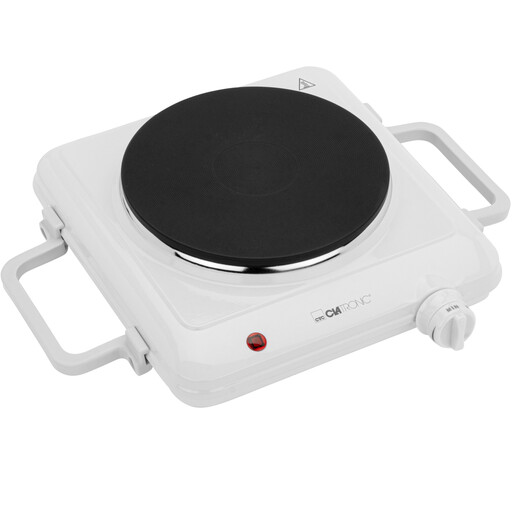
Why this product suits this profile: With a diameter of around 180 mm and 1,500 watts, this electric hotplate is designed for small kitchens, student rooms, camping or as an additional cooking surface.
The infinitely variable thermostat makes operation easy to understand. The indicator light, overheating protection and high stability are clearly stated features.
1,500 watts, an infinitely variable thermostat and attachable cool-touch handles for flexible use.
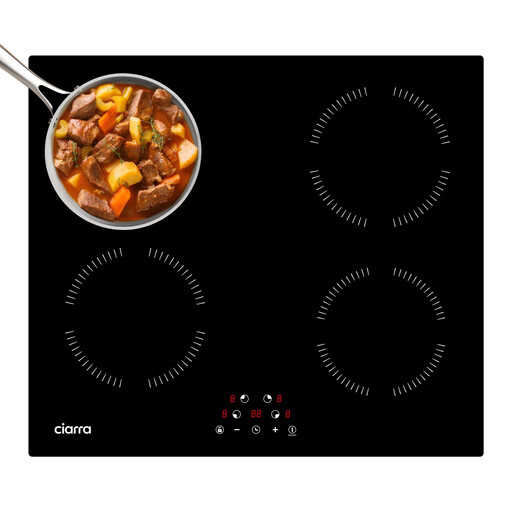
Why this product suits this profile: This 60-cm built-in hob offers four cooking zones, nine power levels and touch controls for households that regularly use several pots at once.
The 560 × 490 mm cut-out dimensions and the required 32 A fuse rating are clearly specified. This allows you to check the worktop and electrical connection in advance.
Four zones, 6,000 watts total power, an individual timer of up to 99 minutes, plus a child lock and residual heat indicator.
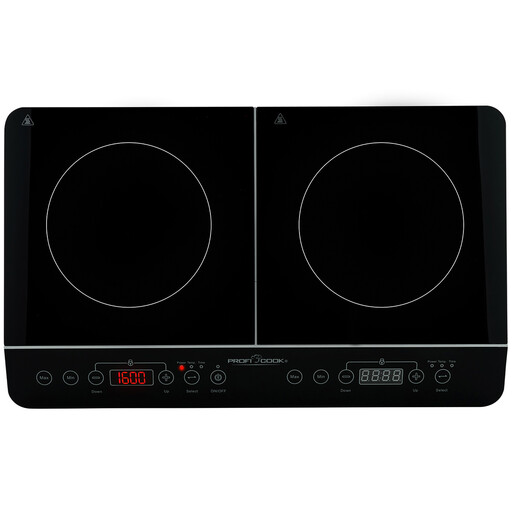
Why this product suits this profile: This portable double hotplate is suitable for campers, small flats or as a flexible additional cooking surface. Two cooking zones allow you to prepare food in parallel.
The specifications state a maximum power of 3,500 watts, pan detection, overheating protection and automatic switch-off. This makes key safety and connection data easy to verify.
Two plates, 16 function levels per cooking zone and a timer of up to 180 minutes with a switch-off signal.
We have put together a complete, regularly updated list of products that fully meet these strict selection criteria and the safety regulations applicable in the EU.
An induction hob requires magnetic cookware and typically responds quickly to changes in the power level. A ceramic hob heats the glass-ceramic surface using electric heating elements and is therefore generally less restrictive when it comes to pan materials. With both types, the surface remains hot after use and should only be cleaned after checking the residual heat indicator.
For appliances with a fixed connection or no mains plug, installation should be carried out by a qualified electrician. Beforehand, the cut-out dimensions, ventilation clearance, mains voltage and fuse rating must be checked against the manufacturer’s specifications. A portable hob with a suitable plug, on the other hand, is used on an appropriate surface and is not permanently installed in the worktop.
Multiply the power in kilowatts by the operating time in hours and the price per kilowatt-hour. For example, an appliance rated at 2,000 watts corresponds to 2 kW; after 30 minutes of operation, the calculated consumption is 1 kWh, provided the full power is continuously applied. In practice, the thermostat or power control may reduce the energy supply at times. Wattage alone is therefore not a reliable basis for comparing costs.