Which radio is right for you?

Listeners of a particular science programme

First, check how your chosen programme is broadcast and whether you can receive it where you plan to listen. The number of stations available doesn’t tell you whether the programme you want is actually receivable.

Hobby room listeners who mainly listen to speech

If you listen while crafting or doing another activity, clear voices where you usually sit and simple station selection are key. A headphone socket can be useful if you prefer to listen on your own.

Listeners who move their radio around

If you move your radio around the room or occasionally take it with you, check whether it runs from mains power, replaceable batteries or a built-in rechargeable battery. Battery life figures apply only under the conditions specified for each model.

What matters when choosing a radio for your hobby room?

Portable DAB+/FM radio

A good choice if: you want to listen live without an internet connection and the station you want is available over the air where you plan to listen.

The trade-off: DAB+ doesn’t need an internet connection, but walls and the radio’s position can affect reception in the room.

FM radio without DAB+

A good choice if: the programme you want is actually broadcast on FM in your area.

The trade-off: you won’t be able to receive Deutschlandfunk Nova via the digital terrestrial route listed by Deutschlandradio. According to the consumer advice centre, a working FM radio doesn’t need to be replaced solely because of DAB+.

Internet radio or audio streamed from another device

A good choice if: you want to listen to programmes later or receive a particular live broadcast via a suitable internet connection.

The trade-off: you’ll need a suitable connection or an external playback device. Bluetooth alone doesn’t turn a radio into a standalone podcast player.

What you need What to check before buying Who should pay particular attention?
Reception for the programme you want Check the station and how it is broadcast; consult the DAB+ station map and indoor coverage forecast for your location. If you want to listen to a particular science programme live in your hobby room, reception where you’ll actually be sitting is what counts. Around 36% of consumers prioritise reception of the programme they want.
Speech clarity and ease of use Check how voices sound at your usual listening volume; try selecting stations and, if relevant, check for a headphone socket. If you listen while doing something else, you’ll want clear speech and an easy way to tune in to your chosen station. Around 29% of consumers prioritise speech clarity and straightforward controls.
Power and portability Check whether the radio uses a mains adapter, rechargeable battery or replaceable batteries. Compare battery life only for the same reception mode and battery type. If you often move your radio or want to use it away from a plug socket, the power options are crucial. Around 21% of consumers put portability and power first.
Listening to programmes later Check whether the radio has a podcast or internet feature, rather than just Bluetooth playback from an external device. If you want to catch up on a programme you missed, check that the radio can actually access it and what connection you’ll need. Around 14% of consumers prioritise time-shifted listening.

What should you look out for when buying?

  • Don’t assume DAB+ means guaranteed reception in your hobby room

    An indoor coverage forecast indicates reception for a particular location, but not necessarily every spot in the room. Walls and the radio’s position can make a difference.

    First, check coverage for the programme you want, then test the radio where you plan to listen. If needed, try another spot, such as near a window.

  • Don’t mistake Bluetooth for standalone podcast access

    Bluetooth can play audio from another device, but it doesn’t automatically mean the radio can access online programmes or podcasts itself.

    If you want to catch up on programmes, check the specific internet or podcast features. For Bluetooth playback, you’ll need a suitable external device to play the programme.

    You’ll need a suitable playback device to listen via Bluetooth, and an appropriate connection for internet features.

  • Don’t compare battery life figures or battery operation without checking the details

    Manufacturers’ figures may be based on specific reception types, speaker use or battery types, so they aren’t directly comparable unless you take these conditions into account.

    Check which power source the radio uses away from a plug socket and whether batteries are included. If it uses replaceable batteries, consider keeping spares to hand.

Brands to help guide your choice

Sony

The XDR-S41D is one example of a portable DAB+/FM radio with battery and mains power options, plus a headphone output.

  • Sony lists station presets and a telescopic aerial. The 25-hour figure is for DAB playback through the speaker using Sony LR6 batteries.
  • These features don’t guarantee reception in the specific place where you plan to listen, or show that the radio can access podcasts on its own. Source: Sony.

MEDION

The range includes everything from the compact LIFE S66822 to a separate site radio.

  • MEDION lists DAB+/FM, Bluetooth and a built-in rechargeable battery for the LIFE S66822, and an IP54 rating for the LIFE E66050.
  • These features apply to the models listed, not to the entire brand. Source: MEDION.

Philips

The portable TAR5505/10 combines DAB+/FM and Bluetooth with mains and battery power.

  • Bluetooth on the TAR5505/10 lets you play audio from another device.
  • It doesn’t access podcasts on its own. Internet radio is a feature of the separate TAR8805/10 model and shouldn’t be attributed to the TAR5505/10. Source: Philips.

Nubert

The nuGo! ONE+ combines a DAB+/FM tuner with Bluetooth and a built-in rechargeable battery.

  • Nubert quotes up to 24 hours of battery life and a weight of 1.6 kg.
  • The ‘up to’ battery life figure isn’t a guarantee at every volume level. It also doesn’t guarantee reception in every spot in your hobby room. Source: Nubert.

Panasonic

The RF-D10 is one example of a portable DAB+/FM radio with a handle and mains power or four size C batteries.

  • Panasonic lists direct station buttons, a ‘Vocal’ equaliser mode and a headphone socket.
  • According to the manufacturer, battery life depends on the battery type and reception mode. Panasonic marks the RF-D10 and RF-D10EG-K variants as unavailable. Source: Panasonic.

Radios available at Joybuy

The models below include portable DAB+/FM radios for live broadcasts, as well as an internet radio for listening to programmes later.
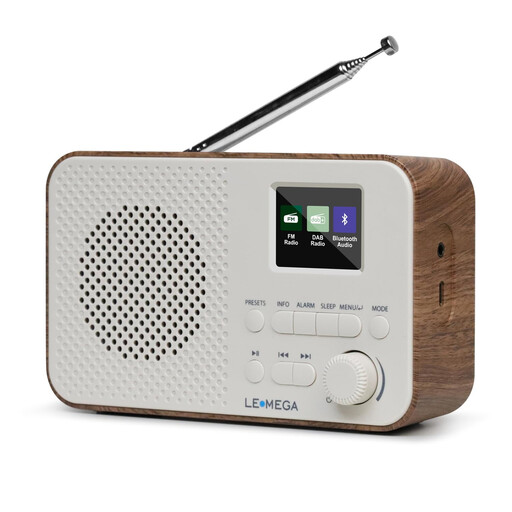
LEMEGA DAB Go portable DAB+/FM radio in walnut finish

LEMEGA DAB Go, walnut finish

For live broadcasts via DAB+/FM, with a choice of battery or mains power.

Built-in 2200-mAh battery, USB-C charging, headphone socket, Speech EQ and 40 station presets.

View at Joybuy
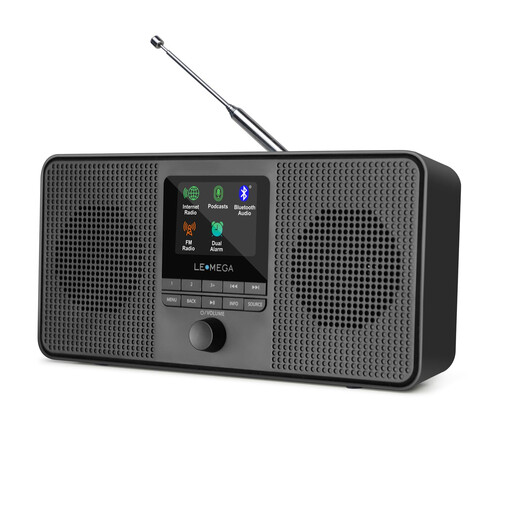
LEMEGA IR4S internet radio with podcasts and Bluetooth

LEMEGA IR4S Internet Radio

For listening later using its listed internet and podcast features; a Wi-Fi connection is required.

FM station presets, Bluetooth, stereo speakers and a headphone socket. Runs on mains power or four AA batteries; batteries are not included.

View at Joybuy
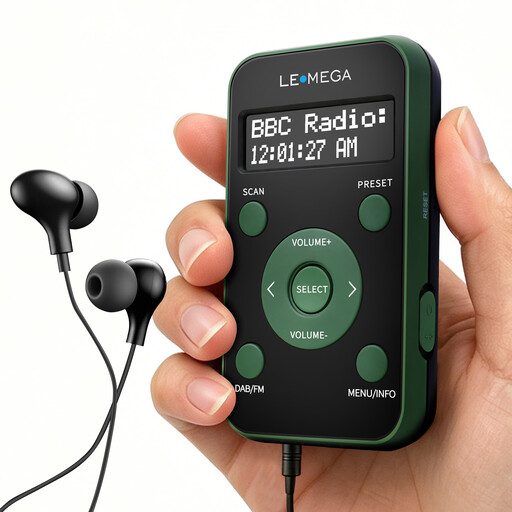
LEMEGA PR1 Pocket DAB/DAB+ and FM radio, green and black

LEMEGA PR1 Pocket DAB/DAB+ & FM

For portable live radio and private listening with the supplied earphones.

Rechargeable battery, USB-C charging and 20 station presets. According to the description, the earphones also act as the aerial.

View at Joybuy
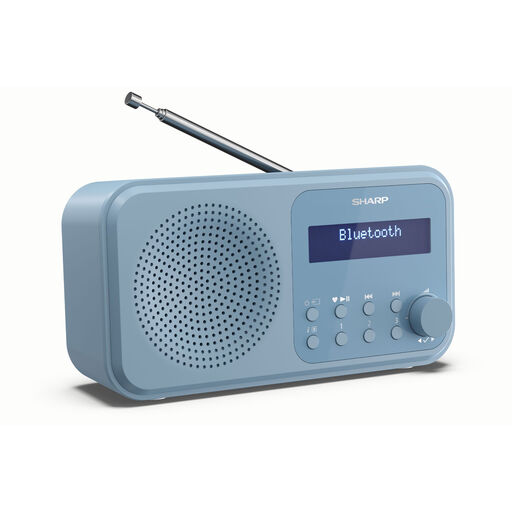
SHARP DR-P420(BL) Tokyo DAB+ and FM radio in steel blue

SHARP DR-P420(BL) Tokyo, steel blue

For live DAB+/FM reception through the speaker or via the headphone socket.

Bluetooth 5.3, retractable aerial and 40 station presets. Runs via USB cable or four AA batteries; batteries are not included.

View at Joybuy
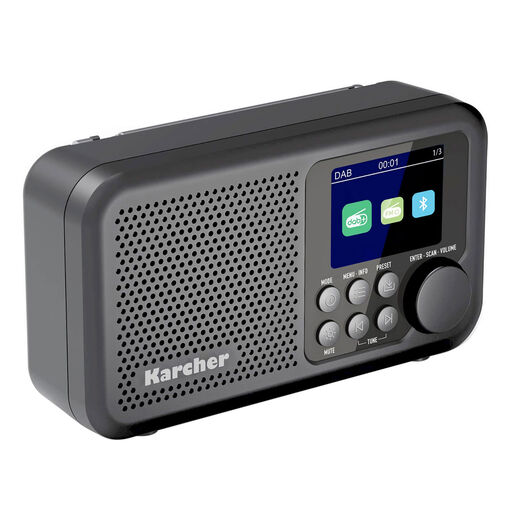
Karcher DAB 2415 portable DAB+ radio with colour display

Karcher DAB 2415

For portable DAB+/FM radio with a built-in rechargeable battery and Bluetooth playback.

Colour display and headphone socket. Bluetooth lets you play audio from another device; it doesn’t automatically provide standalone access to podcasts.

View at Joybuy

Frequently asked questions

Is an FM radio enough for Deutschlandfunk Nova?

Not for the terrestrial reception route listed by Deutschlandradio: it lists Deutschlandfunk Nova as available via digital radio and other digital or internet-based routes. For another science programme, check how that particular station is available in your area.

What can I do if DAB+ reception keeps cutting out in my hobby room?

Check the indoor coverage forecast for your location, position the aerial as described in the radio’s instructions and try another spot, such as near a window. A forecast can’t guarantee reception everywhere in the room. Your only alternative is another way of receiving the programme you want that’s actually available there.

Will having another radio mean paying an extra broadcasting fee?

As a general rule, a private home is charged one broadcasting fee, regardless of how many devices or residents it has. The contribution service lists the fee as 18,36 Euro per month for each home; different rules may apply to other living or usage arrangements.

Do newly marketed radios have to include DAB+, and has FM been switched off?

Section 75(4) of the German Telecommunications Act (TKG) requires radios covered by the provision and newly made available on the market that can display programme names to include a receiver for digital radio services; the provision also specifies exceptions. This does not amount to a general ban on existing FM radios, nor does it mean FM has been switched off across Germany.

What should I check if a radio stops working?

Check the specific product listing to see who provides support and which warranty details and manufacturer documents apply. Sony directs XDR-S41D owners to its support and repair services; the same terms cannot be assumed for other brands or sellers.