Making a nut roast in a loaf tin you already own
You’d like to use your tin in the holiday cottage, so check that it fits in the oven with its rim and enough clearance above it.


Use the oven already in the holiday cottage if your loaf tin fits and you can select the heating mode and temperature your recipe calls for. If there’s no suitable oven, a freestanding countertop oven may be an option. First, compare the tin’s dimensions with the oven’s interior, rack and door opening, then check the recipe settings and the space you have available. A litre capacity alone doesn’t prove that the tin will fit.
You’d like to use your tin in the holiday cottage, so check that it fits in the oven with its rim and enough clearance above it.
You’re looking for a freestanding oven with heating modes to suit your recipe and external dimensions to fit your available worktop space.
You’d like to make a larger nut roast or other oven dishes, so you’ll need to weigh up the oven capacity against the worktop space required.
| What matters | What to look for when buying | Who should consider this? |
|---|---|---|
| Will the loaf tin fit? | Compare the tin, including its rim and handles, with the model’s usable interior height, rack surface and door opening. | If I want to use my loaf tin in the holiday cottage, it needs to fit through the door and on the rack. Around 36% of consumers rank fit as their top priority. |
| Recipe settings | Check that the appliance’s selectable heating modes, temperature and cooking time match your recipe. | If you want to follow the recipe settings as closely as possible, check the heating mode and temperature first. Around 29% of consumers put recipe settings first. |
| A safe place to set it up | Compare the appliance’s dimensions and door area with the available surface, and follow the set-up and connection instructions in the manual. | If worktop space is limited in your holiday cottage, you’ll need a suitable spot with the required clearance from the wall and an appropriate power connection. Around 21% of consumers prioritise where to place the oven. |
| Effort and electricity use | Take any appliances you already own into account, and compare energy-use figures only when they’re based on the same conditions. | If you’ll only use an oven occasionally, weigh the extra space and electricity use against how often you’ll use it. Around 14% of consumers see the effort involved and electricity use as their top buying priorities. |
Vegan.at’s chestnut nut roast recipe uses a loaf tin and calls for fan-assisted cooking at 200 °C. That setting applies to this recipe; it isn’t a general rule for every nut roast.
The capacity won’t tell you whether the tin will fit through the door or sit on the rack provided.
Measure the tin, including its rim, and compare it with the specific model’s interior, rack surface and door opening.
Verbraucherzentrale explains that energy-use figures for ovens are based on a standard baking cycle. The wattage and oven capacity alone don’t tell you how much electricity your particular recipe will use.
Compare energy-use figures only when they’re based on the same conditions, rather than using them alone to estimate the electricity needed for one nut roast.
The freestanding BGE 1580/E is a 30-litre baking and grilling oven with several selectable heating modes.
With a 42-litre capacity, the TO 2058 is a larger countertop oven option.
The KB M19 is a 19-litre countertop oven for a small tin and limited worktop space.
The Bake & Style 26 Touch is a freestanding 26-litre oven with digital controls.
The CBG7341B1 is a built-in compact oven for a holiday cottage kitchen that’s already equipped for one or designed to accommodate one.
The Joybuy products below are freestanding countertop ovens for baking and oven-cooked dishes. Check that their settings suit your recipe, and make sure your loaf tin will fit through the door and on the usable rack surface.
 No image available
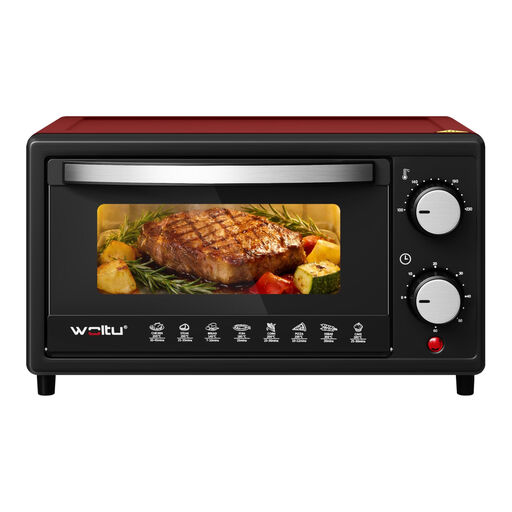
The temperature range includes 200 °C, making it suitable for a recipe that calls for this setting.
 No image available
The temperature range includes 200 °C; separately, check whether your tin will fit inside the oven.
 No image available
It’s described as a countertop convection oven; check that its available settings suit your recipe.
 No image available
It’s described as a countertop convection oven with several shelf positions. When choosing where to put it, allow for its external dimensions and follow the appliance instructions.
 No image available
This multi-function appliance is described as offering several cooking methods. Check the usable dimensions separately to make sure it can accommodate a loaf tin.
Follow your recipe. Vegan.at’s chestnut nut roast recipe uses a loaf tin and calls for fan-assisted cooking at 200 °C for one hour. Other recipes may differ.
Compare the tin’s external dimensions, including its rim, with the usable interior height, rack surface and door opening of the specific model. The stated capacity in litres alone doesn’t confirm that it will fit.
Not just because its external dimensions fit. Follow the manual for the specific model: Steba explicitly describes the KB M19 as unsuitable for built-in installation, specifies a 10 cm gap between the back of the appliance and the kitchen wall, and requires an earthed, easily accessible socket.
Use the oven already there if your tin fits and you can select the settings your recipe calls for. A freestanding countertop oven may be an option if there’s no suitable oven and the tin, appliance settings and available space are all a good match.