Holiday home with a small kitchen
If space is limited and you usually have smaller amounts of everyday crockery to wash, the design, room for the door to open and suitable connections are key.


Choose based on the space available, suitable connections and how much crockery actually builds up between washes. A countertop model is an option if there’s no suitable floor space; a 45 cm model works if there’s room for a freestanding or integrated appliance; and a 60 cm model makes sense when larger loads build up regularly. Also compare the Eco label values and check what to do about the water supply when you’re away for a longer period. The appliance’s width alone won’t tell you how much it uses or how well it cleans.
If space is limited and you usually have smaller amounts of everyday crockery to wash, the design, room for the door to open and suitable connections are key.
If you need crockery ready again between meals or guest stays, the programme duration, capacity and ability to build up a full load should suit the way you use it.
When several people are eating together, what matters is the usable space in the racks and whether you can regularly fill the machine with larger loads.
The key question is whether space, having clean crockery ready quickly, the size of your group or longer periods away will have the greatest impact on day-to-day life in your holiday home.
A good fit if: there’s no suitable floor space, but you have a worktop and the right connections.
Consider: the appliance still needs worktop space, and you’ll also need room for the door to open and for the connections.
A good fit if: you have a narrow space on the floor and suitable connections, and want to wash more crockery at a time than a countertop model can hold.
Consider: the appliance takes up floor space; check the dimensions and door clearance for the specific model.
A good fit if: you regularly have larger loads, have enough space and can actually fill the machine.
Consider: if you rarely fill it, size alone shouldn’t be the deciding factor. The German Environment Agency recommends running the Eco programme only with a full load.
A good fit if: your kitchen has a suitable space for an integrated appliance and, where required, a compatible furniture door.
Consider: the dimensions of the space, door fixing and installation requirements must suit the specific model.
| Buying priority | What to check | Who it matters most to |
|---|---|---|
| Space and connections | Check the available space or recess, height, door clearance, and water inlet and outlet for the specific appliance. | If the kitchen is short on space, I want to know whether the appliance and its open door will fit. For around 33% of consumers, space for the appliance is their top buying priority. |
| Having clean crockery ready quickly | Compare programme duration and consumption for the programmes you actually plan to use, using the model specifications. | With frequent guest changes, I need crockery ready in time for the next meal or stay. Around 25% of consumers put having clean crockery ready quickly first. |
| Capacity and consumption | Compare typical and largest loads, rack layout, and Eco electricity and water figures. | For shared meals, I want enough rack space without choosing an appliance that rarely gets full in everyday use. For around 25% of consumers, capacity for larger loads is their top priority. |
| Water supply when you’re away | Check the instructions and the conditions for any model-specific water protection; keep the stop tap accessible. | If the holiday home will be empty for a long time, I want to know what to do about the water supply before I leave. Around 17% of consumers prioritise how to manage a connected appliance when they’re away for longer periods. |
The depth with the door open, the height and the route to the connections all affect whether you can use the appliance in the space you have in mind. Exquisit gives a depth of up to 81 cm with the door open for its GSP206-030D countertop model.
Using the dimensions of the specific model, measure the available space, height, door swing and route to the water and drainage connections.
Label figures refer to the Eco programme and shouldn’t be taken as a direct indication of consumption on another programme. The German Environment Agency explains that the electricity, water and programme duration figures are based on Eco.
Compare Eco figures on a like-for-like basis, and check the manufacturer’s information for any other programmes you use regularly.
A Miele manual consulted for this article lists correct installation and turning off the tap when away for a long time among the requirements for the water protection it describes. These conditions don’t automatically apply to other models.
Check the instructions for the appliance you choose and keep the stop tap accessible.
The examples below relate to specific product ranges or models. Check the features and suitability of the particular appliance for your holiday home kitchen.
A brand to consider for compact countertop models when floor space is limited.
An option to compare for freestanding models in slimline or wider designs.
An option to compare across freestanding, integrated and compact designs.
An option to compare for slimline integrated models if your kitchen has a suitable space.
An option to compare for slimline freestanding and integrated models.
The appliances below include countertop models, freestanding dishwashers in 45 or 60 cm widths, and an integrated model. Before choosing, check that the design, space, connections and capacity suit your kitchen.
 No image available
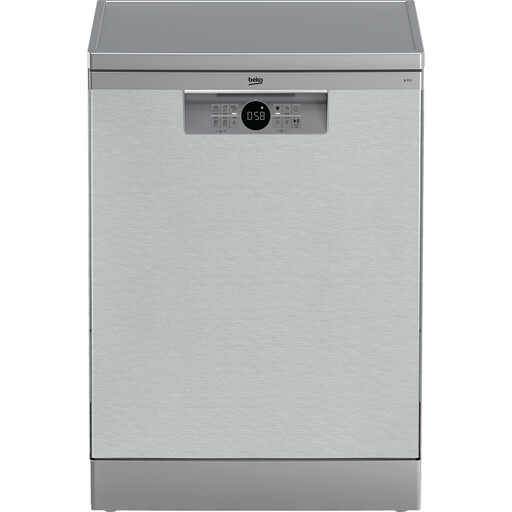
An option if you have suitable floor space for a freestanding 45 cm appliance.
The product title lists 10 place settings, energy class C and a stainless steel finish.
 No image available
An option if you regularly have larger loads and enough floor space.
The product title lists 14 place settings, Quick&Shine, SelfDry, HomeWhiz, 44 dB and energy class B. A half-load function is also specified.
 No image available
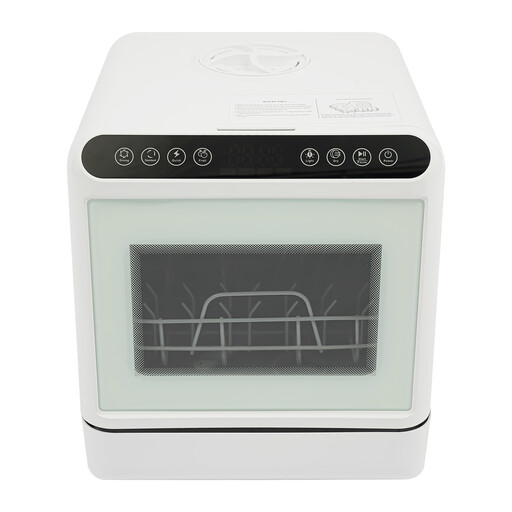
An option if you’d rather use worktop space than a floor recess.
The product title lists a built-in 6 L water tank and touch controls.
 No image available
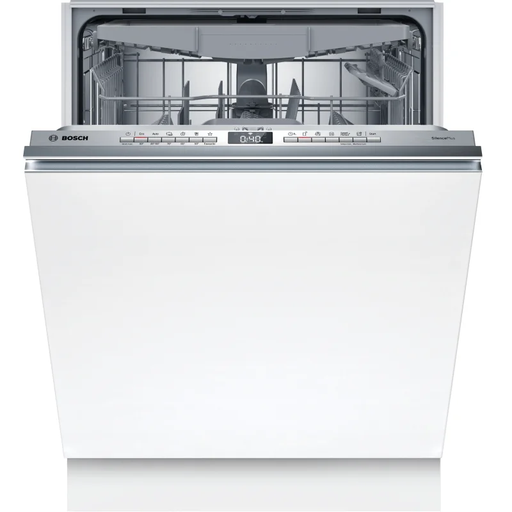
An option if you have a suitable integrated space and regularly have larger loads.
The product title lists 14 place settings, 44 dB and energy class B. According to the product information, installation requires a suitable space and a furniture door; the door is not included.
 No image available
An option for limited space if a compact countertop model works with your kitchen layout.
The product title lists a 5 L water tank, 6+3 programmes and energy class D.
If you usually have small loads, start by comparing countertop and 45 cm models against the space available and the racks they come with. A 60 cm model is more likely to suit you if larger loads build up regularly and you can run it full. The German Environment Agency’s recommendation for a 60 cm model in households of two or more people specifically assumes a full load; it isn’t a hard-and-fast rule for every holiday home.
Compare the figures on the EU energy label, which are based on the Eco programme for each model. The German Environment Agency explains that the label shows electricity consumption for 100 Eco cycles, as well as water consumption and programme duration. These figures don’t guarantee the consumption of a quick programme.
Check the instructions for the specific model. The Miele manual consulted says that turning off the tap when you’re away for a longer period is one of the requirements for the water protection it describes; this isn’t a general rule for other appliances. If your holiday home isn’t frost-free, also check the instructions for your chosen appliance in those conditions.
Check the instructions for your appliance regarding water hardness and dishwasher salt. The German Environment Agency notes that limescale deposits can reduce efficiency and shorten the appliance’s lifespan. It recommends running the Eco programme with a full load; this is operating advice, not a legal requirement.