The decision to choose a home cinema projector as an alternative or supplement to a television is based on an analysis of specific technical parameters. Factors such as image size, flexibility, and immersive viewing experiences are key arguments. To make an informed choice, it is necessary to understand the core specifications like resolution, brightness, projection technology, and connectivity. This article highlights the technical criteria relevant for selecting a suitable device.
Buyer's Guide: What to Look for in a Home Cinema Projector
The selection of a projector should be based on an objective assessment of its technical features in relation to the intended use and the room's conditions.
1. Resolution: Full HD vs. 4K
Resolution determines the level of detail in the projected image.
- Full HD Projector (1920 x 1080 pixels): A 1080p projector delivers high image sharpness, which is sufficient for most applications such as watching Blu-rays or high-quality streaming. This resolution is an established standard for home cinema applications.
- 4K Projector (3840 x 2160 pixels): Devices with native 4K resolution offer four times the pixel density of Full HD, resulting in a visibly sharper and more detailed image. It is important to distinguish between native 4K resolution and 4K support (decoding). The latter means the projector can process 4K signals but may output them at a lower native resolution (e.g., 1080p).
2. Brightness (ANSI Lumens)
Brightness, measured in ANSI lumens, is a crucial factor for image quality in various lighting conditions.
- Under 1000 ANSI Lumens: Suitable for completely darkened rooms to create a cinema-like atmosphere.
- 1000 - 2000 ANSI Lumens: Flexible for use in rooms with low to moderate ambient light. This brightness level is adequate for most living room setups.
- Over 2000 ANSI Lumens: Necessary for use in brighter environments or as an outdoor projector at dusk.
3. Projection Technology and Light Source
The type of light source affects lifespan, colour accuracy, and maintenance requirements.
- LED: Offers a long lifespan (often over 20,000 hours) and low energy consumption. LED projectors are often more compact.
- Laser: A laser projector is characterised by a very long lifespan, high colour accuracy, consistent brightness over time, and fast power-on and power-off capabilities.
- Lamp (UHP): The traditional technology. Lamps have a limited lifespan (typically 2,000 - 5,000 hours) and must be replaced periodically.
4. Throw Ratio
The throw ratio indicates the distance from which the projector can produce a specific image width.
- Standard-Throw Projector: Typically require several metres of distance from the screen to create a large image.
- Short Throw Projector: Can project a large image from a short distance (approx. 1-1.5 metres). This reduces the risk of shadows being cast by people in the room.
- Ultra Short Throw (UST) Projector: Are placed directly in front of or below the projection surface and are particularly suitable for small rooms.
5. Connectivity and Smart Features
Modern projectors offer a wide range of connection and usage options.
- Ports: HDMI (with ARC for Audio Return Channel), USB, and 3.5 mm audio outputs are standard.
- Wireless Connectivity: A projector with Wi-Fi and Bluetooth allows for streaming content from mobile devices and connecting external speakers or headphones wirelessly.
- Smart Projector: Devices with an integrated operating system (e.g., Google TV) provide direct access to streaming apps like Netflix, YouTube, or Prime Video without needing an external device.
6. Portability
For flexible use, the following features are relevant:
- Mobile Projector: Compact design and low weight.
- Projector with Battery: An integrated battery allows for operation without a direct power supply, ideal for use outdoors or in different rooms.
Top Home Cinema Projectors
Based on an analysis of technical specifications, here are some models that cover different user profiles.
Yaber T2 Plus GTV Outdoor Projector
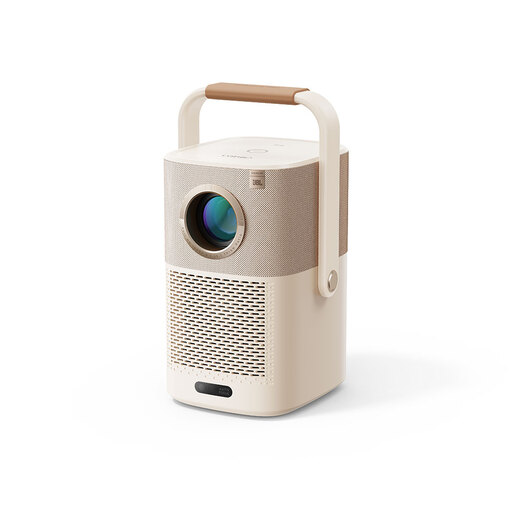
Why we recommend this product: The Yaber T2 Plus GTV combines portability with smart features. Its integrated battery and handle-stand design allow for flexible use as an outdoor projector or a mobile projector. The integration of Google TV makes it a self-contained entertainment solution.
Pros:
- Integrated Battery: Provides up to 2.5 hours of video playback without a power connection, according to the manufacturer.
- Smart TV System: A built-in Google TV dongle offers access to over 7,000 apps, including Netflix and YouTube.
- Automatic Image Adjustment: Features like AI autofocus and automatic keystone correction simplify the setup process.
- Integrated Sound: JBL speakers with Dolby Audio provide a solid audio foundation.
- Flexible Projection: The handle and stand design allows for projection at various angles, including onto the ceiling.
Who it's for: Users looking for a versatile and easily portable projector with a battery for use in various locations (indoors and outdoors) who appreciate the convenience of an integrated smart TV system.
View Product: Yaber T2 Plus GTV Outdoor Projector
Yaber K300s Multimedia Laser RGB FullHD 1080p Projector
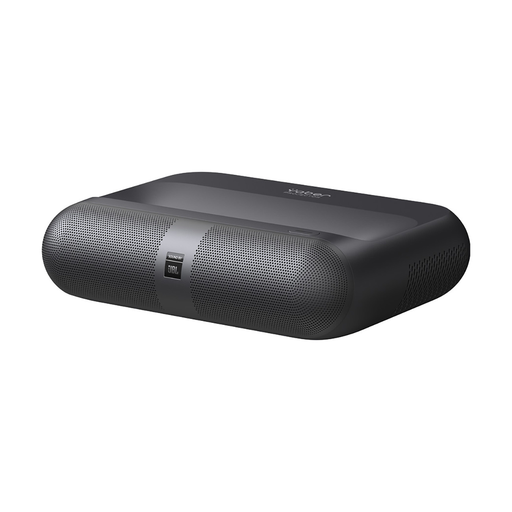
Why we recommend this product: The Yaber K300s is a short-throw projector featuring Triple RGB Laser technology. It projects a 100-inch image from a distance of just 23 cm, making it ideal for rooms with limited space. The laser light source ensures high colour gamut coverage and brightness.
Pros:
- Ultra-Short Throw Technology: Creates a large image with minimal distance from the wall (throw ratio of 0.18:1).
- Triple RGB Laser: According to the manufacturer, the light source achieves over 150% coverage of the NTSC colour gamut.
- Brightness: 1000 ANSI lumens allow for a clear display, even in daylight.
- Gaming Projector Mode: A dedicated mode reduces latency to under 40 ms, which is advantageous for video gaming.
- Connectivity: Equipped with Wi-Fi 6 and Bluetooth 5.1 for fast and stable wireless connections.
Who it's for: Users in smaller apartments or rooms who want a large screen size without the need for complex ceiling mounting. It is also an interesting option for gamers due to its low latency.
View Product: Yaber K300s Multimedia Laser RGB FullHD 1080p Projector
Ultimea Poseidon E100 Projector
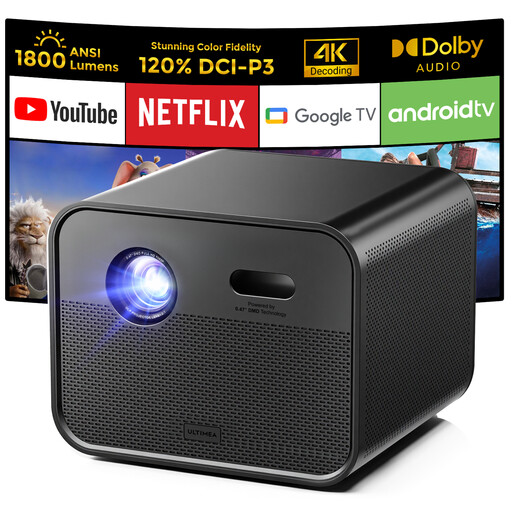
Why we recommend this product: The Ultimea Poseidon E100 stands out with its high brightness of 1800 ANSI lumens and a wide colour gamut (120% DCI-P3, according to the manufacturer). With native 1080p resolution and 4K decoding, it is designed for demanding home cinema applications in rooms that are not completely dark.
Pros:
- High Brightness: 1800 ANSI lumens ensure a clear and vibrant image, even with ambient light.
- Expanded Colour Gamut: Coverage of 120% of the DCI-P3 colour space enables cinema-grade colour reproduction.
- Integrated Smart Features: Google TV and voice control via "Hey Google" are built-in.
- MEMC Technology: MEMC technology ensures smooth motion during fast-paced scenes in sports broadcasts or action films.
- Advanced Image Correction: Real-time autofocus and 6D keystone correction of ±50° allow for flexible placement.
Who it's for: Home cinema enthusiasts who value high image brightness and colour quality and want to use the projector in living rooms with some ambient light.
View Product: Ultimea Poseidon E100 Projector
Discover More Options
The models presented cover specific use cases. If your requirements differ, a wider selection of devices with various specifications is available. You can find more models in our full hd projector category.
Frequently Asked Questions (FAQ)
1. Can a projector completely replace a TV? A projector can replace a TV, especially when a large screen size is desired. However, the room's lighting conditions must be considered, as most projectors perform best in darkened environments. Additionally, the lifespan of the light source (lamp, LED, laser) becomes a relevant factor with daily, multi-hour use comparable to a television.
2. How many lumens does a home cinema projector need? For a dedicated, dark home cinema room, 800 to 1,500 ANSI lumens are sufficient. In a living room with controlled ambient light, 1,500 to 2,500 ANSI lumens are recommended to ensure a high-contrast image. For use in daylight or outdoors, models with over 2,500 ANSI lumens are preferable.
3. What is the difference between a short-throw and a standard projector? The main difference is the throw ratio. A standard projector needs a greater distance from the projection surface (e.g., 3-4 metres for a 100-inch image). A short-throw projector produces the same image size from a much shorter distance (often under 1.5 metres). This minimises shadows and simplifies installation in smaller rooms.


