
Lieferung heute & morgen

Qualitätsgarantie

Willkommens-Angebote freischalten: KOSTENLOSE Lieferung | Bis zu 80 % RABATT | Kostenlose 30-Tage-JoyPlus-Testphase
App herunterladen
Switching from a bean-to-cup machine to a home espresso machine is a decisive step for anyone wanting full control over their espresso. But the market is flooded with devices whose marketing promises often suggest more than the technology can deliver. Before you make a decision, it's crucial to know the most common pitfalls that can lead to an unsatisfying coffee experience.
As your Joybuy Product Recommendation Officer, I'll help you correctly interpret technical specs and identify the features that truly matter.
To avoid these pitfalls, you should focus on three core parameters. These features separate a good semi-automatic espresso machine from a device that only brings disappointment.
A pressure gauge is not merely a design element; it's your most important diagnostic tool. It displays the pressure being applied directly to the coffee grounds during extraction.
The brewing temperature has an enormous impact on the taste of the espresso. A solid construction and an efficient heating system are essential for this.
For lovers of cappuccino and latte macchiato, a powerful espresso machine with a milk frother is indispensable. Look for a steam wand that allows for manual control.
Here are some models that, based on their objective features, are suitable for different user profiles.

Why This Fits Their Persona: Ideal for users seeking professional features like pressure control and a powerful steam wand in a compact device optimised for home use, without breaking the budget.
The integrated real-time pressure gauge bypasses the 'blind' extraction trap. The brushed stainless steel housing is robust and not just a thin facade.
A combination of a 1350W rapid heating system, pressure gauge, and a flexible steam wand for creating microfoam. Its compact design also fits into smaller kitchens.
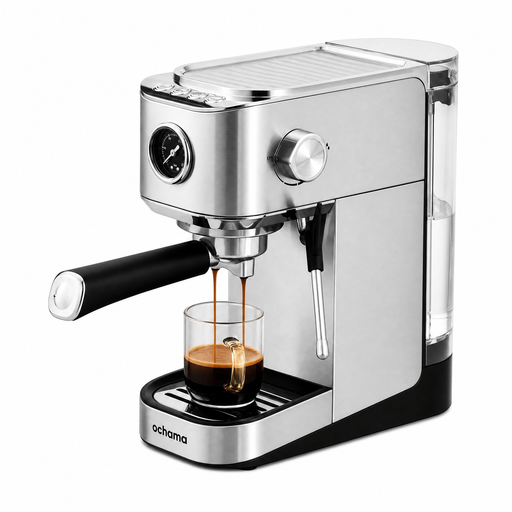
Why This Fits Their Persona: Perfect for users who value solid construction, durability, and a high-quality feel. The all-metal housing is not just a visual highlight but also supports thermal stability.
The all-metal housing is a clear statement against the 'stainless steel look' trap. It provides the necessary mass for a stable brewing temperature.
The robust construction ensures longevity. The integrated cup warmer feature is a practical detail that keeps the espresso in the cup at a stable temperature for longer.
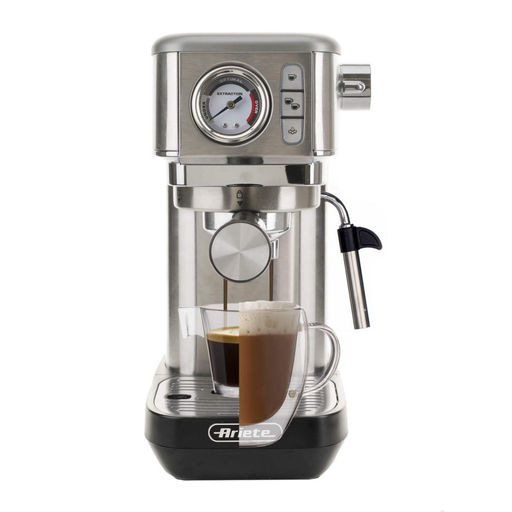
Why This Fits Their Persona: Suitable for users with limited space who are looking for a slim, functional device with an Italian design. Compatibility with E.S.E. pods offers added flexibility for quick coffee moments.
Although the pump operates at 15 bars, the integrated pressure gauge provides the necessary control over the brewing process and helps achieve consistent results.
The extremely slim design (approx. 14 cm wide) fits into any kitchen. The additional compatibility with E.S.E. pods makes the machine highly versatile.
We have compiled a complete, real-time list of products that fully meet these strict selection criteria and German safety regulations.
The crucial pressure for extraction at the coffee puck is ideally around 9 bars. A pump with a nominal rating of 15 bars or 20 bars delivers more than enough pressure to reach this value, even with very finely ground and firmly tamped coffee. An over-pressure valve (OPV) in the machine regulates the pressure down to the optimal level. A 20-bar espresso machine therefore offers a higher performance reserve, but in practice, the difference compared to a 15-bar machine is often not decisive for the final result, as long as the brew pressure is stably maintained at around 9 bars.
The lifespan heavily depends on the build quality and maintenance. Models with a robust metal housing and high-quality internal components often last for many years with regular cleaning and descaling. Cheaper models with a high plastic content can be more susceptible to wear and tear, especially on gaskets and the pump. Consistent maintenance is the key to maximising its lifespan.
Daily cleaning involves rinsing the portafilter and the brew group after each use. Weekly, you should perform a backflush with a blind basket (if supported by the manufacturer) to remove coffee oils from the brew group. Descaling should be done every 1 to 3 months, depending on water hardness, using a descaler suitable for espresso machines. Always follow the manufacturer's specific instructions to avoid damaging the machine.