
Lieferung heute & morgen

Qualitätsgarantie

Willkommens-Angebote freischalten: KOSTENLOSE Lieferung | Bis zu 80 % RABATT | Kostenlose 30-Tage-JoyPlus-Testphase
App herunterladen
The decision to invest in home fitness equipment is the first step towards more flexibility and consistency in your training. But the market is confusing and full of products that promise more than they deliver. Many buyers soon find their expensive new machine sitting unused in a corner. This is often not due to a lack of motivation, but to fundamental flaws in the product itself.
As your Joybuy Product Recommendation Officer, I see it as my duty to provide you with objective criteria to make an informed decision. We will highlight the most common pitfalls and show you what really matters when making your choice.
Before diving into models and brands, it's crucial to understand the typical problems that lead to frustration and, ultimately, a halt in your training.
To avoid these mistakes, you should carefully examine three core areas before buying. These objective criteria will help you separate the wheat from the chaff.
The durability and safety of a fitness machine depend directly on its materials. Pay attention to specifications like the steel gauge of the frame. A solid foundation for a multi-gym or an adjustable weight bench consists of alloy steel with an adequate wall thickness.
An indispensable value is the maximum load capacity. This figure must always include the user's body weight plus the weight of the dumbbells being used. A weight bench with a load capacity of only 150 kg is already unsuitable and unsafe for an 80 kg user who wants to bench press 80 kg.
A good full-body workout machine is characterized by its versatility. Check how many different exercises can actually be performed effectively. For a weight bench, the adjustability of the backrest (flat, incline, decline) is crucial. On multi-function machines, the individual stations (e.g., lat pulldown, leg curler) should be ergonomically sound and usable without complex conversions. For beginners, a specialized device like an ab trainer for beginners or a hand gripper set may be more sensible than an overloaded but poorly designed all-in-one machine.
Modern equipment goes beyond pure mechanics. A Smart Home Gym with digital weights offers precisely controllable resistance that can be adjusted at the touch of a button. Such systems often enable AI fitness training, where a virtual coach analyzes and corrects your exercise form and creates training plans based on your progress. Even a foldable wooden rowing machine or a fitness trampoline can send training data to an app via Bluetooth connectivity, boosting motivation through trackable progress.
Based on these criteria, we have identified some products that represent a suitable solution for specific requirements and user groups.

Why This Fits Their Persona: Ideal for beginners and seniors who want to specifically strengthen their core muscles and prevent back pain. The device focuses on the safe and correct execution of abdominal exercises.
This device is highly specialized, avoiding the trap of limited versatility by performing one task exceptionally well. Its simple yet robust construction prevents instability during its intended use.
The ergonomic design guides the movement and reduces the risk of neck and back strain, making it a safe entry-level device. Its compact dimensions make storage easy.
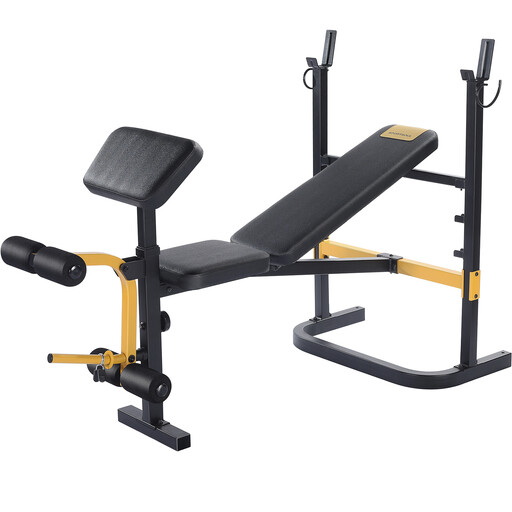
Why This Fits Their Persona: For advanced users seeking a solid foundation for serious at-home strength training. This combination of a weight bench and rack enables a wide range of barbell exercises.
The alloy steel construction and a high static load capacity of 544 kg (1200 lbs) directly address the instability pitfall. Its versatility (adjustable bench, leg and bicep curlers) prevents the device from going unused.
The integrated safety hooks on the rack increase safety when training without a partner. The 4-level adjustable backrest and 3-level adjustable preacher curl pad offer high flexibility.
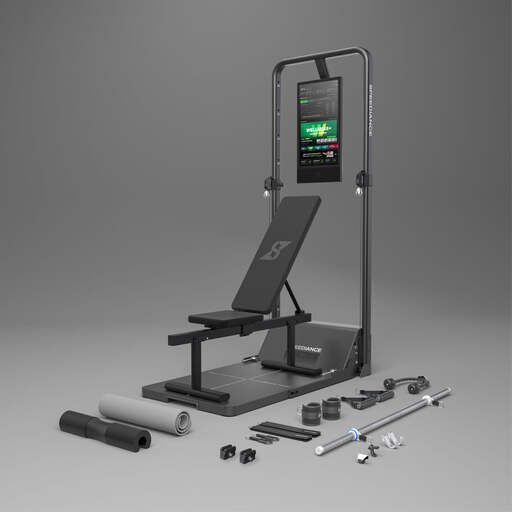
Why This Fits Their Persona: For users seeking an all-in-one solution for a data-driven full-body workout machine. This Smart Home Gym replaces a multitude of individual devices and offers a guided training experience.
It solves the problem of limited versatility and space requirements by combining hundreds of exercises into one compact system. The guided workouts and safety mechanisms minimize the risk of injury from improper form.
The system offers digital weights and AI fitness training. Resistance can be adjusted mid-set via the handles, and the AI provides personalized recommendations to optimize your training.
We have compiled a complete, up-to-date list of products that fully meet these strict selection criteria and German safety regulations.
The space required depends heavily on the type of equipment. An ab trainer for beginners or a fitness trampoline often only needs 1-2 square meters and can be easily stored. An adjustable weight bench with a rack requires at least 4-6 square meters of free space for safe use. A Smart Home Gym like the Speediance model is very compact when not in use (less than 1 sqm) but requires a clear area of about 2x2 meters to perform the exercises. Measure your available space accurately before buying and plan for freedom of movement.
Digital weights provide constant, precisely controlled resistance throughout the entire range of motion, which can vary with free weights due to gravity. They also enable safety features like automatic weight reduction when muscle fatigue is detected. For pure muscle growth (hypertrophy), the mechanical resistance provided by both systems is what matters. Digital systems also offer advantages in workout management, data tracking, and safety, making them an effective alternative for many users.
With foldable equipment like a foldable wooden rowing machine, two aspects are critical: the folding mechanism and the stability when unfolded. The mechanism should be simple and operable without tools. Check the folded dimensions to ensure it fits in its intended storage space. When assembled, the device must not have any play in the joints or hinges. A solid locking mechanism is essential for safety during your workout.