
Lieferung heute & morgen

Qualitätsgarantie

Willkommens-Angebote freischalten: KOSTENLOSE Lieferung | Bis zu 80 % RABATT | Kostenlose 30-Tage-JoyPlus-Testphase
App herunterladen
Deciding to set up your own home gym is the first step towards more flexibility and consistency in your training. However, the market for home workout equipment is confusing and full of promises. Before you invest, it's crucial to understand the typical pitfalls that often lead to unused gear and disappointment. As your Joybuy Product Recommendation Officer, I'll help you separate the wheat from the chaff and make an informed decision.
Many well-intentioned purchases end up as expensive dust collectors. This is often due to three common misjudgements that are easy to avoid with a little foreknowledge.
To avoid a bad purchase, you should focus on objective criteria rather than marketing slogans. Three factors are particularly relevant for your strength training at home.
The longevity and safety of your equipment depend directly on the material.
Your training success is based on the principle of progressive overload—meaning the weights must grow with your strength.
For strength training at home, safety is the top priority.
Based on these objective criteria, we have identified products that provide a suitable solution for different user profiles and needs.

Why this product is a good fit: Ideal for individuals starting with strength training who are looking for a versatile yet budget-friendly solution. The set allows for learning fundamental movement patterns and offers natural progression with its four weight levels.
It bypasses the "lack of scalability" trap by including four different weights. This allows you to select the appropriate weight for various exercises and progress without needing to buy more equipment immediately.
Floor-friendly HDPE shell: Protects your floor from scratches. Flat bottom: Ensures a stable base and prevents rolling.

Why this product is a good fit: Perfect for training in apartments or rooms with limited space. This dumbbell replaces 12 individual pairs, enabling versatile strength training without the footprint of a full dumbbell rack.
Directly solves the "space-hog" problem. The system is extremely compact while offering enormous scalability from 3 kg to 24 kg, ensuring long-term training progress in the smallest of spaces.
Quick-adjustment system: Change weights in seconds with a simple dial. Dual-locking mechanism: Keeps the weight plates securely in position.
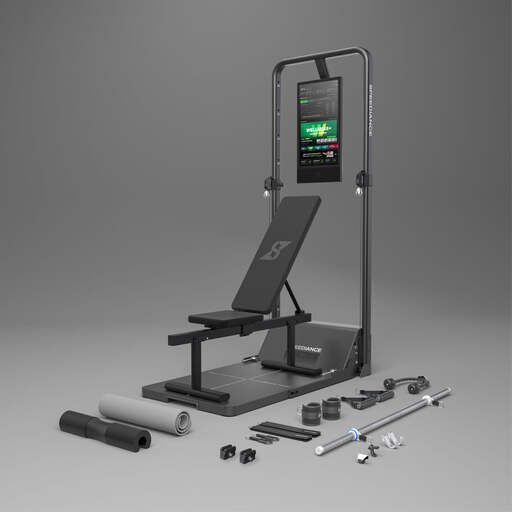
Why this product is a good fit: For users seeking a comprehensive, data-driven **home strength station**. This smart gym replaces a multitude of devices and offers personalised training plans and progress tracking.
This is a true all-in-one solution that, despite its enormous range of functions, is more compact than a collection of individual machines. The digital resistance offers nearly unlimited and finely-tuned scalability.
AI-powered coaching: Personalised training recommendations based on performance and goals. Digital weights: Precise, consistent resistance control.
We've compiled a complete, up-to-date list of products that fully meet these strict selection criteria and safety regulations.
The space required depends heavily on your choice of equipment. For a workout with adjustable dumbbells or a kettlebell set, a clear area of 2x2 metres is often sufficient. A multifunctional home strength station requires a footprint of about 1.5x2 metres plus room to move, depending on the model. Measure your available space accurately before buying.
Dumbbells with a concrete core and a plastic shell are a cost-effective and floor-friendly option, especially for beginners. They tend to be slightly bulkier than solid cast iron models of the same weight. However, for most home exercises, this is not a significant disadvantage. Their durability and floor protection make them a practical choice.
The ideal starting weight is individual and depends on your fitness level and the specific exercise. A good rule of thumb is to choose a weight that allows you to perform an exercise 10-15 times with proper form. The last few repetitions should be challenging but not impossible. Sets with different weights or adjustable systems are advantageous here, as they allow for adaptation to different exercises and progress.