
Lieferung heute & morgen

Qualitätsgarantie

Willkommens-Angebote freischalten: KOSTENLOSE Lieferung | Bis zu 80 % RABATT | Kostenlose 30-Tage-JoyPlus-Testphase
App herunterladen
Your own ice maker promises perfectly chilled drinks at a moment's notice, whether for a spontaneous garden party, your daily iced coffee, or a cocktail night with friends. But the market is flooded with devices whose marketing promises often fall short in practice. Before you make a decision, it's crucial to understand the common pitfalls that can lead to an unsatisfying purchase. This guide will help you separate the wheat from the chaff and find a model that truly fits your needs.
Many buyers focus on the advertised production volume and price. But the real weaknesses of a home ice maker only become apparent in day-to-day use.
To avoid buyer's remorse, you should focus on the technical features that determine practical usability.
Pay attention to the ratio between the time per cycle (e.g., 9 ice cubes in 6–8 minutes) and the size of the ice bin. A fast cycle is ideal for immediate needs. However, if you want to produce ice for several guests or make it in batches, a larger collection bin is crucial to avoid constantly having to empty it. A small ice maker is space-saving but often requires more attention.
Since most portable ice makers do not have a freezing function for the storage bin, the quality of the insulation is a key criterion. Good insulation slows down the melting of the finished ice cubes, ensuring you have solid ice available for longer. Furthermore, models with an easily accessible water tank and a drain plug at the bottom significantly facilitate manual cleaning and complete draining, which are essential for hygiene.
Instead of making a one-size-fits-all recommendation, we have identified models tailored to specific use cases.
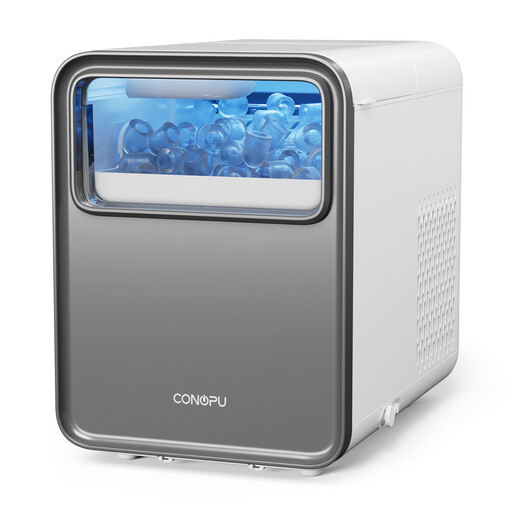
Why This Fits Their Persona: Ideal for those who occasionally need fresh ice for drinks or small gatherings. Its compact design fits on any kitchen countertop without taking up much space. The operation is straightforward and streamlined to the essentials.
The self-cleaning function is complemented by a side drain that facilitates the complete emptying of residual water, thus simplifying subsequent manual cleaning.
Produces 9 ice cubes in approx. 6-8 minutes. Offers two selectable ice cube sizes for different drinks. Water and ice bin level indicators prevent overflow or running dry.
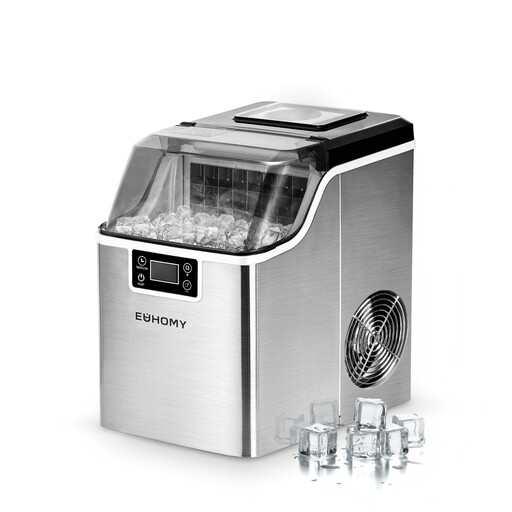
Why This Fits Their Persona: Designed for high demand at parties, in offices, or for families who use a lot of ice daily. The high production capacity and large water tank ensure a continuous supply without constant refilling.
Bypasses the daily output limitation with a large 3.2-liter water tank and the option to add a water bottle on top. This significantly reduces the frequency of refills.
Produces 24 ice cubes per cycle (approx. 13-25 min). The ice cube thickness is adjustable via the production time. Features a timer function and a 20-minute automatic cleaning program.
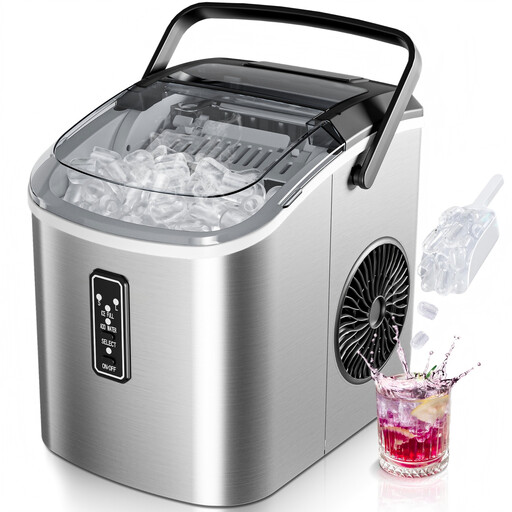
Why This Fits Their Persona: This portable ice maker is designed for on-the-go use. With its low weight and integrated carrying handle, it's easy to transport in an RV, on camping trips, or to garden parties.
Addresses the problem of noise and limited space in mobile environments with a compact design and a specified operating volume of under 45 dB, which is equivalent to a quiet room.
Low weight of just 6.3 kg and a sturdy carrying handle for maximum portability. The automatic cleaning function is especially practical when cleaning options are limited on the road.
We have compiled a complete, up-to-date list of products that fully meet these strict selection criteria and German safety regulations.
For optimal hygiene and to prevent limescale buildup, it is recommended to thoroughly clean the machine manually every 3 to 4 weeks. This includes wiping the water tank and ice bin, and running a cleaning cycle with a dedicated ice maker cleaner or a vinegar-water solution, followed by several rinse cycles with clear water. The self-cleaning function should be used as a supplementary measure in between.
The noise level varies by model but typically ranges between 40 and 55 decibels (dB). This is comparable to a quiet refrigerator or a soft conversation. However, in a very quiet environment, the periodic cycling of the compressor and fan can be noticeable. If noise is a critical factor, look for models explicitly advertised with a noise level below 45 dB.
An ice maker is particularly worthwhile for individuals and households that need ice regularly and in large quantities. This includes families who frequently consume chilled beverages, people who enjoy mixing cocktails, or party hosts. For RV owners or office communities, an ice maker can also be a practical and cost-effective alternative to constantly buying bags of ice. For the occasional need of a few ice cubes per week, traditional ice cube trays in the freezer are often sufficient.