
Lieferung heute & morgen

Qualitätsgarantie

Willkommens-Angebote freischalten: KOSTENLOSE Lieferung | Bis zu 80 % RABATT | Kostenlose 30-Tage-JoyPlus-Testphase
App herunterladen
Constantly refilling ice cube trays, waiting hours for water to freeze, or realizing you don't have enough ice right before a party—getting a home ice maker promises to solve it all. But the market is flooded with devices making lofty claims that often disappoint in practice. Before you invest, it's crucial to know the typical pitfalls that lead to frustration and an unused appliance collecting dust in a corner.
As your Joybuy Product Recommendation Officer, I'll filter out the noise and give you the essential information you need to make an informed decision, helping you distinguish marketing hype from genuine performance features. Here are the three most common problems and how to avoid them.
To avoid a bad buy, you should focus on objective, technical features rather than advertising slogans. These three parameters are crucial for home use.
Pay less attention to the theoretical 24-hour output and more to two concrete values:
For a quick drink after work, a model that makes 9 cubes in 6 minutes is sufficient. For a party where a continuous supply is needed, a device with a higher output and a larger water tank or a direct water line connection is the better choice.
The shape of the ice cubes has a practical impact on cooling performance and melting speed. The most common shape for home devices is "bullet ice" (hollow, bullet-shaped cubes). These cool drinks very quickly due to their larger surface area, but they also melt faster. Some devices offer an ice maker with 2 sizes, allowing you to choose between small, fast-cooling cubes and large, slow-melting ones. This is particularly relevant for lovers of cocktails or spirits who want less dilution.
For flexible use, such as an ice maker for camping or in the garden, a portable ice maker with compact dimensions and a carrying handle is ideal. Check the weight and dimensions of the device for this purpose.
Another often underestimated point is the operating noise level. A quiet ice maker operates at under 45 decibels (dB), which is roughly equivalent to a quiet conversation or a modern refrigerator. You can find this information in the technical data, and it is a decisive criterion for use in living rooms or offices. Last but not least, an integrated self-cleaning function is a must for hygienic, low-maintenance use.
Based on these objective criteria, we have identified a few models that suit different user profiles.
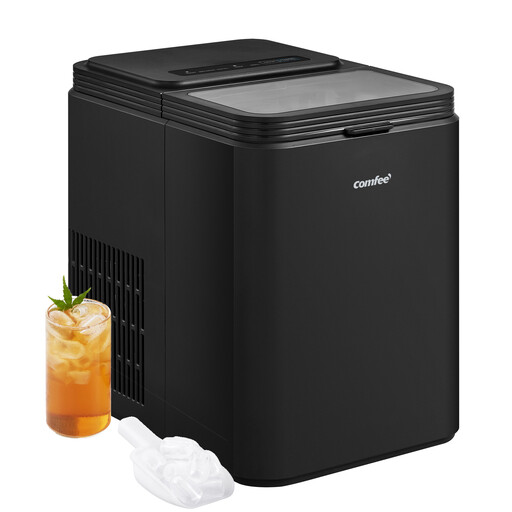
Why This Fits Their Persona: Ideal for couples or small families who need ice quickly for a few drinks. Its compact dimensions allow it to fit into smaller kitchens and be ready for use in no time.
The integrated self-cleaning function prevents the high maintenance burden (Trap 3). The stated output of 8 cubes in 6 minutes is realistic for on-demand needs, avoiding the disappointment of exaggerated capacity claims (Trap 1).
Very fast first ice cycle (6 min, according to the manufacturer). Offers two selectable ice cube sizes for different types of drinks.
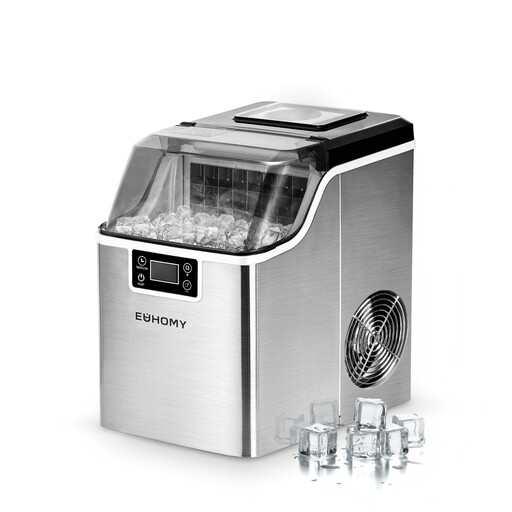
Why This Fits Their Persona: Designed for users who regularly entertain guests or have a consistently high demand for ice. The large production volume and water tank minimize the need for constant refilling.
Directly addresses the capacity trap (Trap 1) with a high production output (up to 20.5 kg/24h) and 24 cubes per cycle. The option to attach a water bottle ensures continuous operation without manual intervention.
High production capacity and flexible water supply (manual or via bottle). Timer function and an automatic cleaning program add convenience.
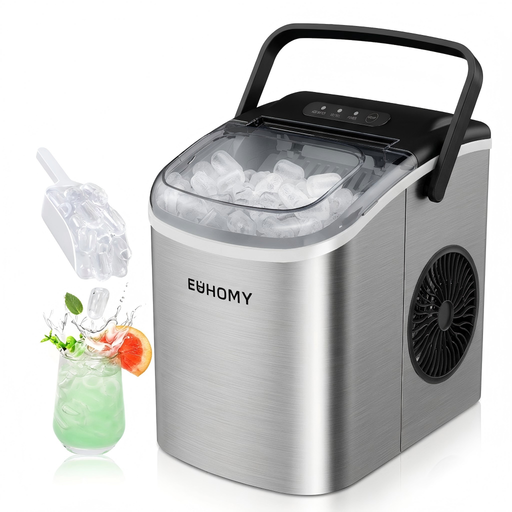
Why This Fits Their Persona: Perfect for use in an RV, on a camping trip, or for anyone who wants to move the unit flexibly between the kitchen and the patio. The integrated handle and low weight make it easy to transport.
The design is explicitly focused on portability. The self-cleaning function is especially valuable on the go, as manual cleaning can be cumbersome (Trap 3). Its compact build helps limit noise in confined spaces like an RV (Trap 2).
Lightweight and portable thanks to an integrated handle. Features an essential self-cleaning function and simple one-button operation.
We've compiled a complete, up-to-date list of products that fully meet these strict selection criteria and all relevant safety standards.
Even for models with a self-cleaning function, it is recommended to run the cleaning cycle every 2-3 weeks. Additionally, the water reservoir and ice basket should be wiped down regularly with a soft cloth. If the machine is not used for more than a day, the remaining water should be drained to prevent germ buildup.
No, manufacturers universally require the use of clean, potable water. Juices, sodas, or other liquids contain sugar and other substances that can clog the pump system and cooling rods, causing permanent damage. Using other liquids will typically void the warranty.
Models considered quiet operate at a noise level below 45 decibels (dB). This is comparable to the ambient noise in a library or the low hum of a modern refrigerator. Pay attention to the decibel rating in the product's technical specifications, as this is an objective value for comparison. A value over 50 dB can already be perceived as disruptive in quiet environments.