
Lieferung heute & morgen

Qualitätsgarantie

Willkommens-Angebote freischalten: KOSTENLOSE Lieferung | Bis zu 80 % RABATT | Kostenlose 30-Tage-JoyPlus-Testphase
App herunterladen
A TV stand with integrated LED lighting is more than just a piece of furniture—it's the centerpiece of a modern living room. The atmospheric lighting can enhance the home theater experience, create the right mood for gaming sessions, or simply serve as a stylish accent. But the market is crowded, and not every product lives up to its advertising promises.
Many buyers soon regret their purchase, dealing with sagging shelves, flickering lights, or an impractical design. This guide reveals the three most common pitfalls when buying a TV unit with lighting and explains the objective criteria you should focus on to make a durable and functional choice.
Before you make a decision, you should be aware of these common problems that often hide behind a sleek facade.
Pitfall 1: Unstable Construction and Low-Quality Materials A temptingly low price often conceals a construction of thin particleboard, which can quickly sag under the weight of a modern television (e.g., 65 inches). High-gloss finishes look appealing but can be extremely susceptible to scratches and fingerprints if poorly manufactured.
Pitfall 2: Poor LED Implementation Inexpensive LED systems are prone to visible flickering, uneven illumination, and unnatural color reproduction. They often come with a separate, clunky remote control while lacking convenient smartphone app integration.
Pitfall 3: Impractical Design with No Cable Management A modern living room should look tidy. However, many TV stands offer no or inadequate cable routing. The result is an unsightly mess of cables behind the unit. Furthermore, they often lack sufficiently ventilated storage for heat-generating devices like game consoles or AV receivers.
To avoid these pitfalls, focus on three core aspects: material, dimensions, and the quality of the lighting system.
The stability of your TV unit depends directly on the materials used.
The right size and layout are crucial for both function and aesthetics.
The lighting is the defining feature and should be of high quality.
Here are some recommendations tailored to different user profiles and requirements.

Why This Fits Their Persona: This model is specifically designed as a gaming TV stand. It offers a dedicated, open compartment for consoles like the PS5, ensuring optimal ventilation. The remote-controlled RGB lighting with 22 dynamic modes creates the perfect atmosphere for intense gaming sessions.
It directly addresses the impractical design trap with open compartments for good airflow and discreet cable openings at the back to prevent cable clutter.
Its sturdy construction from P2 particleboard supports up to 72 kg (approx. 158 lbs), according to the manufacturer. The adjustable shelves offer flexible storage options for accessories and games.
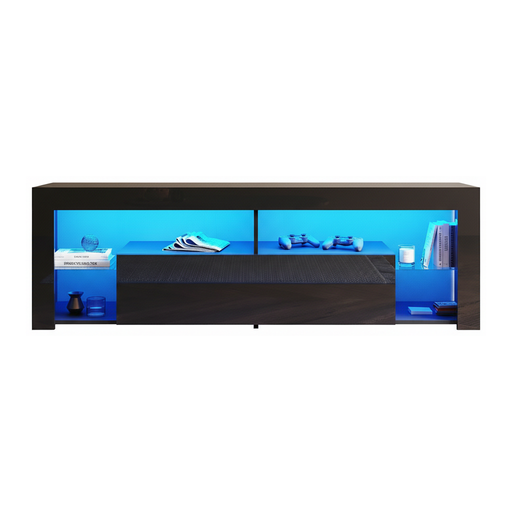
Why This Fits Their Persona: With its 160 cm width and elegant high-gloss black finish, this TV stand is ideal for large TVs up to 65 inches and fits seamlessly into a modern, minimalist living space. The 16-color LED lighting creates a sophisticated home theater atmosphere.
The construction from MFC and MDF promises greater stability than simple particleboard. The combination of open glass shelves and a closed drawer offers a balanced mix of display space and concealed storage.
The clean, handleless lines and high-gloss fronts emphasize its modern design. The LED lighting is discreetly integrated and controlled via remote.

Why This Fits Their Persona: For smaller apartments or budgets, this 120 cm wide version offers the essential features of a modern TV unit: a high-gloss look and integrated LED lighting. It's a cost-effective solution for a first home setup without sacrificing style.
Despite its attractive price point, the manufacturer states it uses a combination of MFC and MDF, providing a solid base for TVs up to about 55 inches. The LED lighting is a full-featured 16-color system.
Its compact format is space-saving yet functional. With one drawer and open compartments, it provides enough storage for basic media equipment.
If you want to upgrade your existing TV unit or are looking for other lighting solutions, we've curated a selection of smart LED products that meet strict quality criteria.
1. How much wider should a TV stand be than the TV? For a balanced aesthetic, the TV stand should be about 10 to 20 cm (4 to 8 inches) wider than the television on each side. For example, a 65-inch TV is approximately 145 cm (57 inches) wide. A suitable TV stand should therefore be at least 165 cm (65 inches) wide. This prevents the TV from visually dominating the furniture and also provides space on the sides.
2. Does a TV stand with LEDs use a lot of electricity? No, power consumption is typically very low. Modern LED systems are extremely energy-efficient. Consumption is usually in the single-digit watt range and has only a minimal impact on your electricity bill, even with several hours of daily use.
3. Can you retrofit LED lighting to a TV cabinet? Yes, this is easy to do and a popular option. Flexible LED strips like the Govee TV Backlight 3 Lite or the Yeelight Obsid RGBIC LED Light Strip can be easily attached to the back of the TV or the TV stand. These systems often offer advanced features like syncing with on-screen content or music and can be conveniently controlled via an app.