Owners of passive speakers
You want to keep using your existing stereo speakers and need an amplifier with the right speaker terminals and source inputs.


Start by choosing an amplifier that suits your passive speakers and music source. If you already have source equipment, a traditional integrated amplifier may be all you need. Built-in streaming could save you a separate device, but only if it supports the service and connection method you want. A higher wattage rating alone doesn’t prove there’ll be an audible benefit with orchestral recordings.
You want to keep using your existing stereo speakers and need an amplifier with the right speaker terminals and source inputs.
You play recordings from a computer, a separate source device or a music service, so you’ll want to check whether the exact amplifier model has the right connection or supports the right streaming method.
You want to fit your amplifier, speakers and cables into your home office, and are considering whether you’ll need an additional source device.
First check that the amplifier suits your speakers and music source. Then decide whether built-in streaming could save space by doing away with a separate source device.
| What matters | What to check before buying | Who is it important to? |
|---|---|---|
| Speaker compatibility | Check whether your speakers are passive, then compare their impedance and the number of speakers you plan to connect with the amplifier’s manual. | If I want to keep using my passive speakers, I’ll check the connections and impedance first. Around 36% of consumers are likely to put compatibility first. |
| Music source and playback method | Note your source’s output or the streaming service you want to use, then check that the exact model has the right input or supports the relevant standard. | I want to listen to my recordings using the source I already have, rather than discover later that the connection method isn’t suitable. Around 29% of consumers are likely to put their music source first. |
| Listening at low volume | Check that it has the volume and tone controls you want, as well as a suitable headphone socket. | When listening quietly in my home office, I want controls that suit the way I listen. Around 21% of consumers are likely to prioritise quiet or personal listening. |
| Space for equipment and cables | Measure the space available and leave room for connections and cables too. | If space is limited in my home office, I want to fit the amplifier, speakers and cables without adding unnecessary equipment. Around 14% of consumers are likely to make space their top priority. |
Manufacturers quote power at different speaker impedances and under different test conditions. A higher figure alone doesn’t prove that the amplifier is suitable for your speakers or will offer an advantage with orchestral recordings.
Compare power ratings alongside the stated impedance and test conditions. First, check that the amplifier is suitable for your speakers.
WiiM lists AirPlay 2 for the WiiM Amp, but not for the WiiM Amp Pro.
If you need a particular service or streaming standard, check the full model name and its listed features.
Traditional and connected amplifiers offer different ways to access your music source. Additional devices and cables also take up space in your home office.
Before buying, plan where your source, amplifier, speakers and cables will go, and measure the space you have available.
The A-S501 is a traditional integrated amplifier for separate sources and passive speakers.
The PMA-900HNE combines a stereo integrated amplifier with HEOS network features and a range of other inputs.
According to WiiM, the Amp Pro is a streaming amplifier for passive speakers, with features including an optical input and HDMI ARC.
The PM6007 is a traditional stereo integrated amplifier for existing analogue or digital sources.
The POWERNODE, as described by Bluesound, combines streaming and amplification for passive speakers.
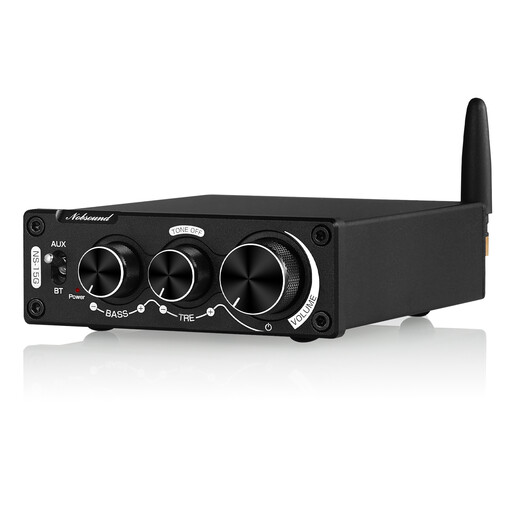
This selection includes a compact stereo amplifier for passive speakers, with RCA or Bluetooth input.
 No image available
For a pair of passive stereo speakers when you want to use RCA or Bluetooth as the input.
Features listed in the product name: 200 W, Bluetooth, and bass and treble controls.
Don’t connect active speakers to the amplified speaker terminals on an amplifier designed for passive speakers. Instead, check the signal input on your active speakers and whether the exact amplifier model has a compatible output that’s explicitly listed in its documentation.
No. According to the WiiM Help Center model list dated 18 May 2026, the WiiM Amp supports AirPlay 2, but the Amp Pro doesn’t.
Compare the dimensions of the unit with the space available, and leave room for cables and connections. Before connecting passive speakers, compare their specifications with the manual for your specific amplifier, and follow its positioning and safety guidance.
Consumer purchases are covered by statutory rights if goods are faulty; these are separate from a voluntary guarantee. The consumer advice centre Verbraucherzentrale also notes that many online purchases come with a right to cancel, usually within 14 days of receiving the goods. Check for any exceptions and the terms of your particular purchase.
The CE marking is relevant for equipment covered by applicable EU rules requiring it. The European Commission outlines the scope of the Low Voltage Directive, while Germany’s Federal Network Agency explains that the manufacturer uses the CE marking to declare that a conformity assessment procedure has been carried out. The rules that apply depend, among other things, on the technical features of the specific device.