Who is this relevant to?

People with a cool home office

If you only heat the room occasionally, check that the model you choose is designed to work at the temperature in your room. Trotec points out that, even with desiccant dehumidifiers, temperature, humidity and moisture entering the room all affect how much water is removed.

Home workers who are sensitive to noise

Noise levels and the relevant operating mode are important points to compare if you make calls or need to concentrate. De'Longhi Deutschland gives a rating of 34 dB(A) for both the DNS65 and DNS80; consider this figure in the context of the mode you intend to use.

Households with recurring condensation on windows

If you repeatedly notice water on your windows, consider the effort of emptying the tank and the electricity use alongside heating, ventilation and investigating possible causes. The German Environment Agency recommends identifying and addressing the causes of excess moisture.

What should you look for when buying?

Desiccant dehumidifier

A good fit if: Your home office stays cool for long periods and measurements show high humidity.

Consider: The amount of water removed still depends on the conditions in the room. Regeneration uses electricity and can release heat.

Compressor dehumidifier

A good fit if: Your home office is usually heated and you want to compare electricity use for the way you plan to use the appliance.

Consider: Many compressor models become less effective as room temperature falls; a daily extraction figure alone doesn’t prove that a model will work better in your room.

Check the cause, heat and ventilate

A good fit if: You haven’t measured the humidity yet, or your windows and nearby surfaces keep getting wet despite taking action.

Consider: Recurring damp may need investigating. An appliance won’t automatically fix water ingress or cold bridging.

What to consider What to check before buying Who is this important to?
Dehumidifying a cool home office Compare the room temperature and size with the stated operating range and the conditions used to measure dehumidification performance. If my home office stays cool for long periods, I want to know whether the specific model is designed to work at that temperature. Around 33% of consumers would prioritise suitability for cool rooms.
Working without disruption Check the noise rating in dB(A), the relevant operating mode and the available fan speeds. If I’m on calls or concentrating on work, I want to know whether I can use the appliance at my desk. Around 27% of consumers would put a quiet working environment at the top of their buying priorities.
Power consumption and heat Compare power consumption and planned running time on the same basis, and consider any heat the appliance may add to the room. If the appliance will run regularly, I want to take its power consumption and how long I’ll use it into account. Around 20% of consumers would prioritise running costs and heat output.
Water tank and emptying Check the tank capacity, whether the appliance switches off when the tank is full, and whether a hose connection is available if needed. If I’ll be using it frequently, I want to know how to dispose of the collected water safely and with as little effort as possible. Around 20% of consumers would put ease of use and emptying first.

Common buying mistakes

  • Assuming the litres-per-day figure guarantees performance in your room

    Even with desiccant models, the amount of water removed depends on temperature, humidity and the continued introduction of moisture. Manufacturers may also measure performance under set test conditions.

    Compare the conditions behind the performance figure with those in your room, and measure humidity before and during use.

    Longer-than-expected running times can increase electricity use.

  • Trying to fix condensation on windows with an appliance alone

    A dehumidifier won’t tell you why moisture is forming. The German Environment Agency recommends identifying and addressing the causes of excess moisture.

    Check your heating and ventilation, as well as possible sources of moisture. If building surfaces repeatedly get wet, you should investigate the cause too.

    An unexplained cause may need further investigation and appropriate remedial work.

  • Assuming desiccant models are automatically cheaper to run because they suit cool rooms

    Suitability for low temperatures doesn’t, by itself, tell you how much electricity a model will use in your home. Desiccant models need energy for regeneration and can warm the room.

    If your office is heated, compare both types of appliance under suitable operating conditions and factor in how long you plan to run them.

Key brands at a glance

Trotec

According to Trotec, the TTR 57 E desiccant dehumidifier is designed for unheated rooms up to 20 m². Its product page lists condensation on window panes as a possible use case.

  • Trotec states that the TTR 57 E can operate from 1 °C, has a 5-l tank and removes up to 9 l/24 h.
  • The daily figure isn’t a guarantee for a particular home office: temperature and moisture entering the room affect how much water is actually removed.

De'Longhi

The German product pages for the Tasciugo AriaDry Light DNS65 and DNS80 give specific noise, power consumption and dehumidification figures measured under certain conditions.

  • De'Longhi Deutschland gives a rating of 34 dB(A) for both models. For normal operation at 30 °C and 80 % relative humidity, the manufacturer states that the DNS65 removes 6 l/24 h and uses 520 W, while the DNS80 removes 7.5 l/24 h and uses 695 W.
  • These manufacturer figures aren’t an independently measured ranking for a cooler home office.

Meaco

Meaco sells DD8L desiccant models as well as separately identified compressor models, so check which type you’re comparing when browsing its range.

  • Meaco Deutschland states that both the DD8L Zambezi and DD8L Pro remove 8 l/day and can operate from 0 °C. The Pro is listed as being compatible with an app.
  • These figures come from the manufacturer and aren’t comparative measurements taken in a home office.

Dehumidifiers at Joybuy

The dehumidifiers below offer points of comparison for room size, humidity control and water tank capacity. If your home office stays cool, also check whether the type of appliance and its stated operating range are suitable for the temperature in your room.

Comfee' MDDO-10DEN7 dehumidifier, 10 L/day, 2.5-l tank

Comfee' MDDO-10DEN7

Could be worth considering for a smaller workspace if its stated room size suits your room and you want to control humidity.

The product information gives a maximum extraction rate of 10 l/24 h and a room size of up to around 40 m³ (16 m²).

The 2.5-l tank switches the appliance off automatically when full. According to the product information, Smart mode is designed to maintain relative humidity at 45–55 %.

Sleep mode is rated at 36 dB(A). These figures don’t show how the appliance performs in a consistently cool room.

Joybuy
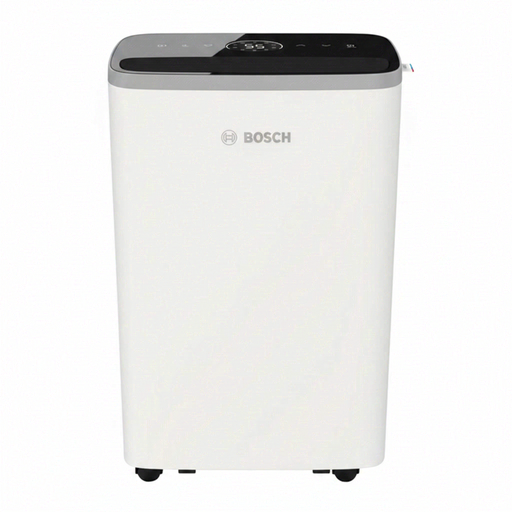
Bosch Dry 4000 dehumidifier, 16 l/day

Bosch Dry 4000

The stated room size and automatic humidity control give you useful points of comparison if these features suit your workspace.

The product information lists a maximum extraction rate of 16 l per day, a room size of up to 75 m³, a 2.5-l tank and a noise level of 40 dB.

It also lists an Auto mode that adjusts humidity, two fan speeds and a night mode.

A hose, which isn’t included, is needed for continuous drainage. Before buying, check that the drainage arrangement will work at your chosen location.

Joybuy
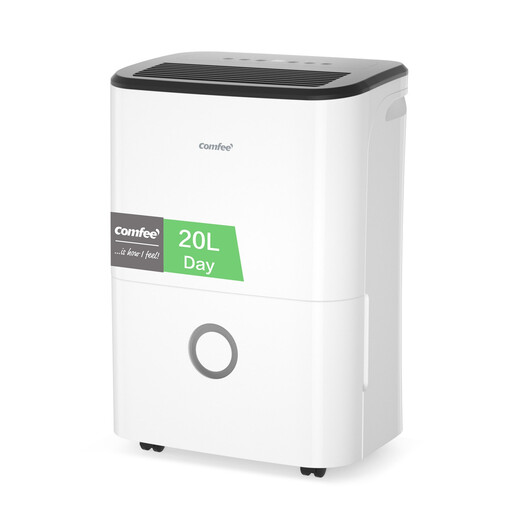
Comfee' MDDF-20DEN7 dehumidifier, 20 l/24 h, 3-l tank

Comfee' MDDF-20DEN7

The stated room size can help you compare models if you’re looking for one for a larger room and its operating range suits your conditions.

The product information lists a maximum extraction rate of 20 l/24 h, a room size of around 100 m³ (40 m²) and a 3-l tank.

According to the product information, Smart mode is designed to maintain relative humidity at 45–55 %.

A hose, which isn’t included, is required for continuous drainage. The tank needs to be emptied regularly.

Joybuy

Frequently asked questions

What humidity level should I check in my home office?

The Verbraucherzentrale recommends a relative humidity of around 40 to 60 % for a comfortable indoor climate and suggests using a thermo-hygrometer. However, a single reading won’t explain why moisture is condensing on a cold pane of glass.

Can a dehumidifier replace ventilation?

No, a dehumidifier can’t replace ventilation. Regularly opening windows wide or creating a through-draught helps remove moist, stale air. If damp keeps returning, you should also investigate the cause.

How do I work out a dehumidifier’s electricity use?

For an assumed constant run time, calculate: input power in watts × operating hours ÷ 1,000 = kWh. Multiply the result by your price per kWh. A humidistat and changing operating speeds can affect actual consumption.

What should I bear in mind when setting up and maintaining a dehumidifier?

Follow the instructions for your specific model. For example, the Meaco DD8L Zambezi instructions require a stable, level surface. Also check the tank, filter and any drainage outlet as directed by the manufacturer.

What should I do if my windows keep getting wet despite using a dehumidifier?

As well as measuring humidity, check your heating and ventilation and look for possible sources of moisture. If windows or nearby building surfaces repeatedly get wet, investigate the cause rather than relying on the appliance alone.