What should you look for when buying one?
First, decide whether you want to warm the room or mainly the area around your seat. Then compare the heater’s output, controls, noise source and positioning requirements.
| What matters |
What to look for |
Who is this important for? |
| Extra warmth for the room |
Take into account your existing heating, the room and its insulation, as well as the adjustable output of the specific model. |
If I want the room to feel warmer during certain periods of work, I’ll check that the heater and its heat settings suit my space. Around 31% of consumers put extra warmth for the room first. |
| Ongoing electricity costs |
Calculate costs using the output actually used, the hours of operation and your own electricity price. Don’t treat a control feature as a guaranteed saving. |
If I plan to run the convector for several hours regularly, I want to estimate the cost using my tariff. Around 25% of consumers see running costs as their main concern. |
| Working without distractions |
Check whether the heater has a fan and if you can switch it off. Noise figures apply only to the specific model and operating mode stated. |
When I’m on calls or concentrating at my desk, I want to take possible fan noise into account. Around 25% of consumers prioritise a quiet working environment. |
| A safe place to position it |
Check the installation method, feet, cable routing and clearances in the instructions for the specific model. |
If there’s little room beside my desk and furniture, I need to find a position that meets the appliance’s requirements. Around 19% of consumers focus above all on finding a suitable spot. |
Joybuy products for extra warmth at your desk
This selection includes convector heaters for extra warmth in a room, including models with a fan and wall-mountable options. Compare each model’s design and features with your workspace and the instructions supplied with the product.
 No image available
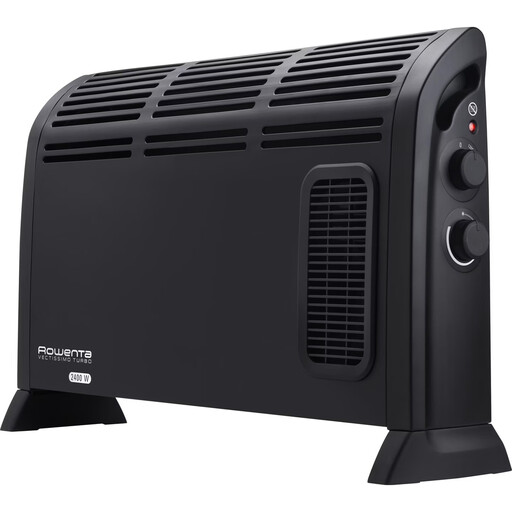
Rowenta Vectissimo II CO3035 convector heater with fan
Listed as an indoor convector heater with a fan; check whether a fan suits your working environment.
The product name specifies IP20 and black.
View at Joybuy
 No image available
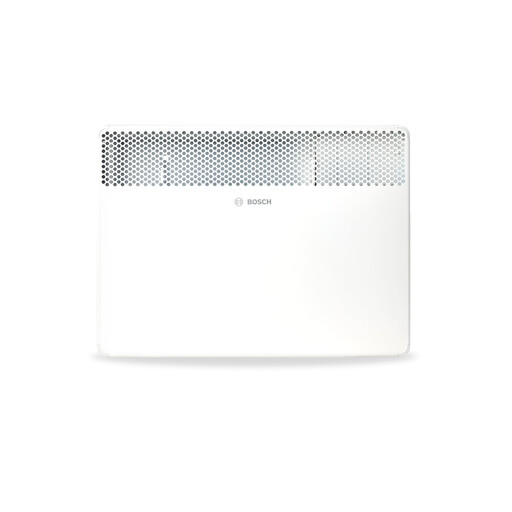
Bosch HC 4000-15 electric convector heater
The wall-mountable version may suit you if you want extra warmth at a fixed workstation while keeping the floor clear.
1,500 W; the product name states that it’s for rooms up to 15 m². An LED display, weekly programme, Eco mode, open-window detection and IP24 are also listed. Feet for freestanding use are available separately.
View at Joybuy
 No image available
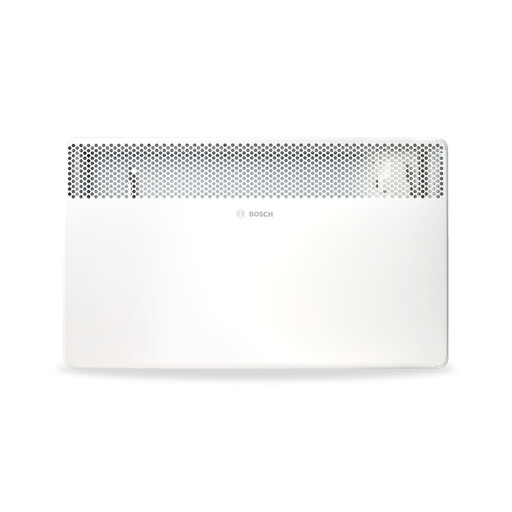
Bosch HC 4000-20 electric convector heater
A wall-mountable option for extra warmth in the room. For freestanding use, you’ll need to take into account the feet, which are sold separately.
2,000 W; the product name states that it’s for rooms up to 20 m². An LED display, weekly programme, Eco mode, open-window detection, child lock and IP24 are listed. The stated room size is a product specification, not a guarantee of a particular temperature.
View at Joybuy
 No image available
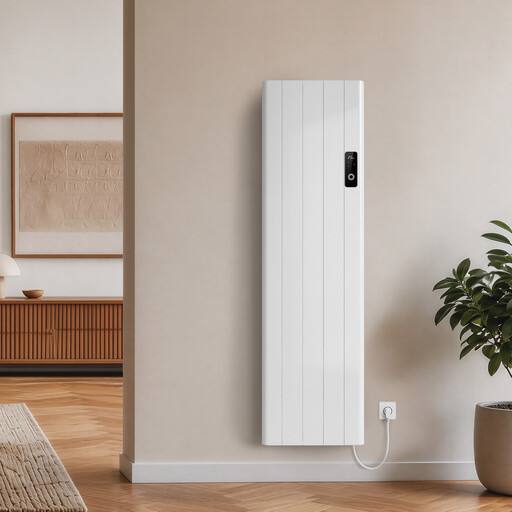
EMKE wall convector heater, 1,500 W, white
Wall mounting may suit a fixed workstation. Check that the proposed mounting position works for your room.
The product name lists an LCD display, Wi-Fi app control, thermostat and weekly programme.
View at Joybuy
 No image available
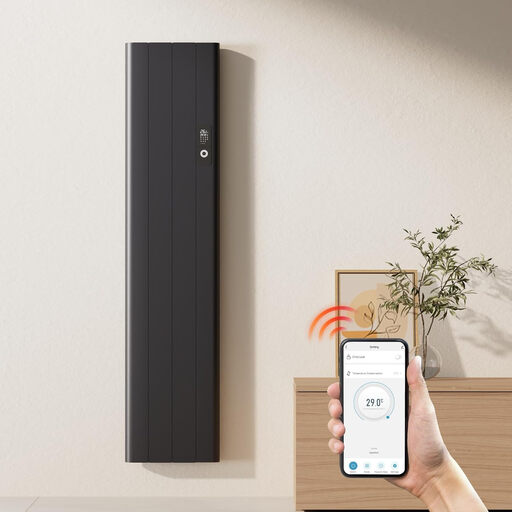
EMKE wall convector heater, 1,000 W, anthracite
Described as a wall-mounted model with a thermostat. Check the intended mounting position and the instructions beforehand.
The product name lists an LCD display, Wi-Fi app control, thermostat and weekly programme.
View at Joybuy
Frequently asked questions about convector heaters for home offices
How can I estimate the electricity cost for a working day?
Multiply the output actually used in kW by the actual running time and your electricity price in EUR/kWh. As a calculation, 1 kW for one hour equals 1 kWh; a thermostat that regulates the heat can change the actual time the heater is switched on.
Can I put a convector heater directly under my desk?
There’s no universal answer. Follow the positioning instructions and clearance requirements in the manual for the specific appliance, and make sure it has a suitable place to stand. A built-in safety cut-out doesn’t replace these requirements.
Are feet included with the Bosch Heat Convector 4000?
Bosch Home Comfort lists the feet for freestanding use as an accessory. Check whether they’re included with the specific offer you’re considering.
Is an EU energy label required for electric convector heaters?
Energy labelling for local space heaters excludes electric local space heaters. This is separate from the ecodesign requirements in Regulation (EU) 2024/1103, which apply to domestic local space heaters with a rated heat output of 50 kW or less, where they fall within the scope. The European Commission explains how these different scopes apply.
Does a CE marking prove that a convector heater has been independently tested for safety?
No. The Federal Institute for Occupational Safety and Health explains that CE marking isn’t the same as an independent safety test mark. A GS mark, by contrast, requires testing by a GS testing body. You should also follow the manual and the instructions for safe use.


