
Lieferung heute & morgen

Qualitätsgarantie

Willkommens-Angebote freischalten: KOSTENLOSE Lieferung | Bis zu 80 % RABATT | Kostenlose 30-Tage-JoyPlus-Testphase
App herunterladen
Setting up a functional workspace at home begins with choosing the right desk. However, the market is flooded with models whose weaknesses often only become apparent after a few months. A wobbly frame, an impractical surface, or a lack of storage can significantly hinder productivity. This guide highlights the critical features you should look for to find a durable and suitable desk for your home office.
Many buyers focus primarily on design or price, overlooking crucial functional flaws. Three problems are particularly common:
PC desk with no storage options inevitably leads to a cluttered workspace. Models with poorly designed compartments, such as those that can't accommodate standard A4-sized folders, also fail to serve their purpose.To avoid these problems, you should check three core parameters before buying. These largely determine the longevity and functionality of your new workspace.
The foundation of a stable office desk is the combination of its tabletop and frame.
The right dimensions are crucial for healthy posture and comfortable work.
Think carefully about what you need on and around your desk.
computer desk often offers useful extras like integrated power strips, USB ports, cable grommets, or hooks for headphones. A monitor riser can also be integrated, contributing to better neck posture.Here are some models tailored to specific user profiles and their requirements.
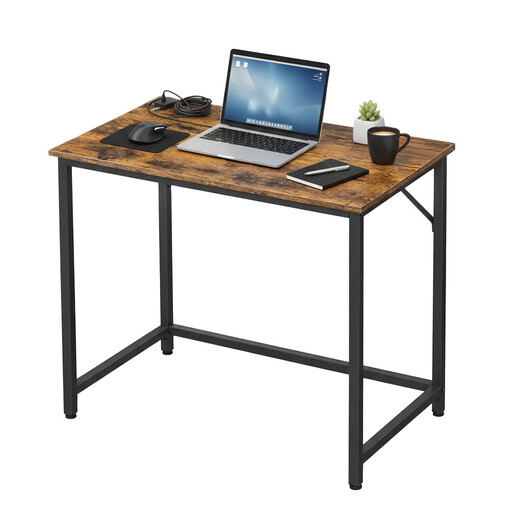
Why This Fits Their Persona: Ideal for students or a first home office setup where a functional, space-saving, and budget-friendly piece of furniture is needed. The minimalist design blends unobtrusively into a bedroom or living room.
The steel frame construction and adjustable feet actively counteract the problem of instability. With a 50 cm depth, it offers a functional work surface despite its compact size, avoiding the "too narrow" pitfall.
Stable footing thanks to the steel frame and adjustable feet, even on uneven floors. Quick and straightforward assembly due to clear instructions.
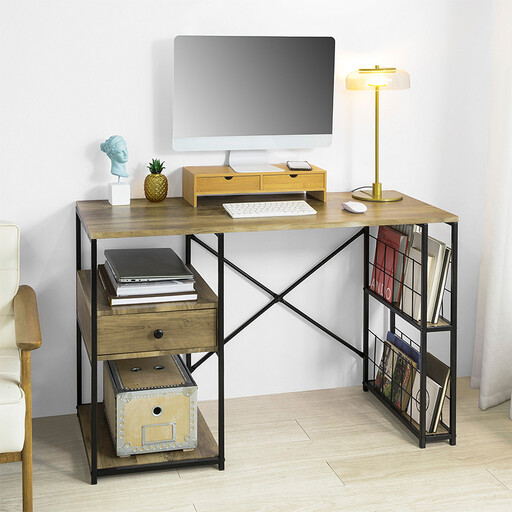
Why This Fits Their Persona: Perfect for users who value a tidy workspace and need to keep many documents, books, or office supplies within easy reach. The combination of open and closed storage creates order.
This model decisively solves the problem of insufficient storage. The shelves and drawer offer ample space and prevent chaos on the work surface. The sturdy metal frame provides the necessary load-bearing capacity.
High flexibility, as the storage unit can be mounted on either the left or right side. The combination of a drawer and shelves offers versatile storage space.
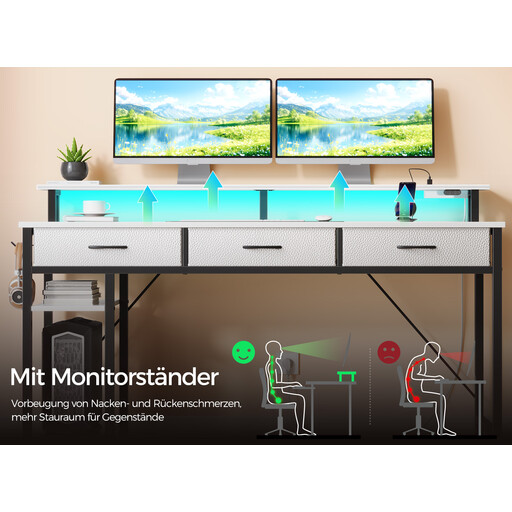
Why This Fits Their Persona: Designed for gamers and users with multiple tech devices. The integrated power supply, monitor riser, and additional storage create an optimised command centre for work and leisure.
The integrated monitor riser directly addresses ergonomic issues by promoting better screen positioning. The built-in charging station prevents cable clutter, while the steel frame ensures the stability needed for heavy setups.
All-in-one solution with 2 power outlets and 2 USB ports. Ergonomic benefit from the elevated monitor stand, which provides space for two monitors.
We have compiled a complete, up-to-date list of products that fully meet these strict selection criteria and German safety regulations.
The standard ergonomic height for a desk is between 72 cm and 76 cm. Combined with a height-adjustable office chair, this allows most people to adopt a posture where their forearms rest at a right angle on the tabletop and their shoulders are relaxed.
The maximum static load capacity varies greatly depending on the model and construction. Simple particleboard desks often support up to 50 kg. Models with a reinforced steel frame can carry significantly more. You can always find the exact maximum static load capacity in the manufacturer's product details. Check this value, especially if you plan to place heavy equipment like multiple monitors or a large PC tower on it.
A gaming desk is specifically tailored to the needs of gamers. It often features a larger and deeper tabletop for large mousepads and multiple monitors, a special surface texture (e.g., carbon fibre look), integrated cable management, holders for headphones and drinks, and often RGB lighting. A regular office desk, on the other hand, usually focuses on simple functionality and classic design.