
Lieferung heute & morgen

Qualitätsgarantie

Willkommens-Angebote freischalten: KOSTENLOSE Lieferung | Bis zu 80 % RABATT | Kostenlose 30-Tage-JoyPlus-Testphase
App herunterladen
Setting up a functional workspace at home starts with choosing the right desk. Whether for daily remote work, studying, or occasional office tasks, the right desk can significantly impact your productivity and comfort. However, with the vast array of models, sizes, and features available, making a decision can be complex.
This article serves as a guide. As a Joybuy Product Recommendation Officer, I have compiled information on various desk types to provide an objective basis for your choice. The goal is to help you find a home office desk that fits your space and work requirements.
Before you decide on a model, several fundamental criteria should be considered. These will help narrow down the selection to the products most relevant to you.
The dimensions of the desk are crucial. Measure the available space in your room accurately, ensuring you leave enough clearance around the desk to move freely. The desktop should offer sufficient space for your equipment, such as a monitor, laptop, and keyboard, without feeling cluttered.
The height of the desk is vital for ergonomic work. An adjustable-height desk offers the greatest flexibility here. It allows you to switch between sitting and standing and can be precisely adjusted to your body height. For rooms with limited space, a small desk with a compact work surface can be the perfect solution.
A tidy workspace promotes focus. A desk with drawers or integrated shelves helps keep office supplies, documents, and personal items stored neatly. This keeps your work surface clear and uncluttered.
A corner desk is another way to use available space efficiently. It often provides a generous work surface and can separate different work zones, such as the computer area from a writing area.
The choice of material affects both the look and the durability of the desk. Common materials include engineered wood (MDF, particleboard) and solid wood, often combined with a sturdy metal frame. Pay attention to the specified maximum load capacity, especially if you plan to place heavy equipment like multiple monitors or a printer on the computer desk. A solid steel frame generally ensures high stability.
Based on functionality, design, and user needs, we present three different models suitable for various home office scenarios.
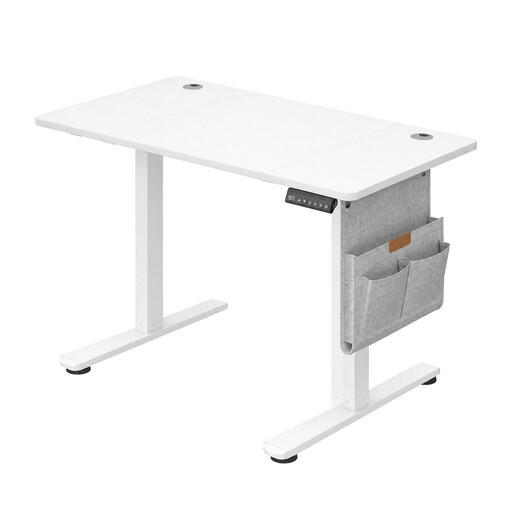
Why it stands out: This model combines a clean, modern aesthetic with practical functionality. The electric motor allows for seamless height adjustment, which can be saved to four memory presets.
Advantages:
Who is it for? This home office desk is an excellent choice for individuals who prioritise ergonomics and want to change their working position regularly. With its size of 120.1 x 60.1 cm, it fits well in most offices or living spaces.

Why it stands out: The Tribesigns corner desk makes optimal use of room corners, offering an exceptionally large work and storage area with its L-shape. The industrial-style design, featuring a wood-look finish and a black metal frame, also makes a visual statement.
Advantages:
Who is it for? Ideal for users who need a dedicated workspace with plenty of storage and want to fill an unused corner in their home office. It's suitable as an office desk for freelancers or as a spacious computer desk for gamers.
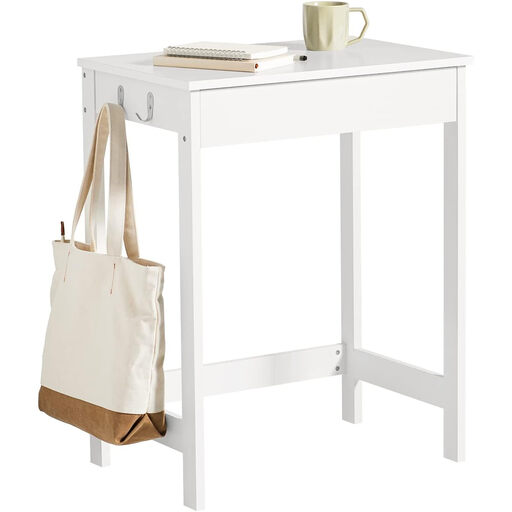
Why it stands out: With a footprint of just 60 x 40 cm, this desk is specifically designed for very small rooms, alcoves, or as a supplementary desk in a living room or bedroom.
Advantages:
Who is it for? This small desk is a suitable option for students, people in small apartments, or anyone who needs a minimalist workspace for occasional tasks.
The models presented here cover common requirements, but the selection of desks is far greater. If you prefer a different colour, a specific material, or another size, it's worth taking a look at other alternatives.
Explore our full range of white wood standing desks and find the perfect model for your workspace.
A good office desk combines three key features: the right size for your space and tasks, ergonomic features for comfortable work, and thoughtful organisational options like drawers or cable management to maintain order.
The standard height for desks is typically between 72 and 76 cm. For optimal ergonomics, your forearms should rest roughly parallel to the floor when seated. An adjustable-height desk is advantageous here, as it allows for precise adjustment to your body height and chair, and also permits working while standing.
The space required depends heavily on the model. A small desk like the SoBuy model only needs a footprint of about 60 x 40 cm. A standard desk is often 120 cm wide and 60 cm deep. A large corner desk, on the other hand, can occupy a corner of 140 x 100 cm or more. It is advisable to measure your available space carefully before purchasing.