
Lieferung heute & morgen

Qualitätsgarantie

Willkommens-Angebote freischalten: KOSTENLOSE Lieferung | Bis zu 80 % RABATT | Kostenlose 30-Tage-JoyPlus-Testphase
App herunterladen
Setting up a functional workspace at home starts with choosing the right desk. However, the market is flooded with models whose descriptions often promise more than they deliver. An unstable computer desk or a work surface that's too small can significantly hinder productivity. Before you make a decision, it's crucial to understand the most common pitfalls to ensure you make a choice that you'll be happy with for the long term.
Many buyers focus on design while overlooking fundamental flaws. The most common problems include:
To avoid a bad purchase, you should focus on objective criteria that determine practical, everyday use. Three factors are crucial here.
The longevity of a desk is directly linked to its material. A desktop made of MDF (Medium-Density Fibreboard) is generally more robust and resistant to sagging than simple particleboard. Pay attention to the thickness of the board—15 mm or more is a good benchmark.
The frame is the foundation. Structures made of powder-coated steel offer high stability. A critical value is the maximum load capacity. A good PC desk should be able to support at least 50 kg to safely hold monitors, a computer, and other equipment. Models for more demanding setups or those intended to double as a workbench often offer a load capacity of over 100 kg.
The right working height is essential to prevent muscle strain. Standard desks have a height of about 75 cm. For a flexible and ergonomic posture, a height-adjustable desk is a worthwhile consideration. Electric models allow for an easy switch between sitting and standing.
The form factor should suit the available space and your workflow. A corner desk (L-shape) makes optimal use of room corners and provides a generous work surface, ideal for multiple monitors or for separating computer tasks from paperwork. For smaller rooms, compact, rectangular models are a better fit.
A tidy workspace promotes focus. A desk with drawers and open shelves helps keep office supplies and documents organised.
For users with a lot of tech, like gamers or creative professionals, a gaming desk is often a great choice. These models frequently offer integrated solutions such as:
Instead of making a one-size-fits-all recommendation, we have identified models tailored to specific user profiles and room situations.
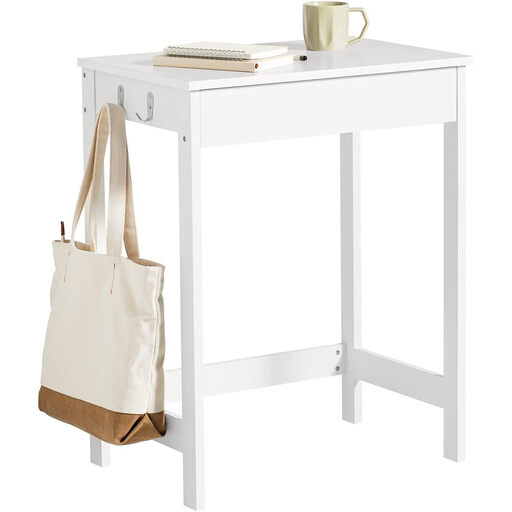
Why it's a great fit: Ideal for students or professionals with limited apartment space. With a width of just 60 cm, this desk fits into niches or small corners without overwhelming the room.
It solves the problem of insufficient functionality in a small footprint. Despite its compact dimensions, it offers targeted storage with a drawer and side hooks, thus preventing clutter.
The combination of an MDF board (E1 class) and an iron frame ensures high stability with a load capacity of up to 60 kg, which is more than sufficient for a laptop workstation.
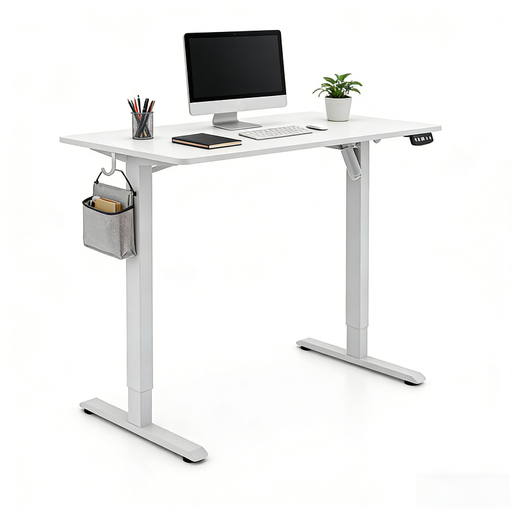
Why it's a great fit: For anyone who spends long hours at their desk and values a healthy posture. Switching between sitting and standing actively prevents back and neck pain.
This model directly addresses the ergonomic disadvantages of fixed-height desks. The electric height adjustment offers individual customisation that a standard desk cannot provide.
The steel frame and aluminium alloy legs ensure a stable load capacity of 70 kg. The quiet lifting mechanism allows for disruption-free adjustments during work.
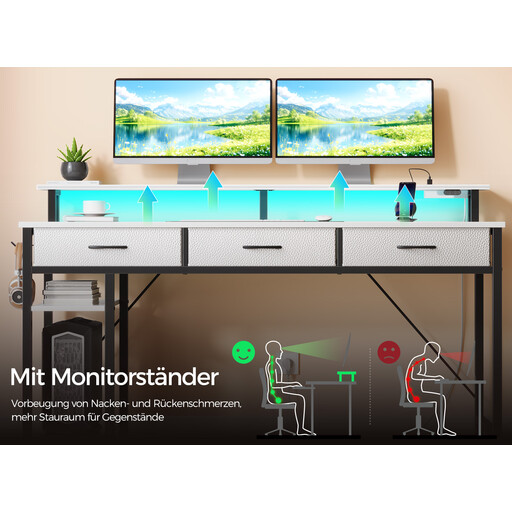
Why it's a great fit: This setup is designed for demanding users who need a fully integrated system for gaming or a tech-heavy home office. Everything has its place, from the console to the headphones.
It solves the problem of cable and organisational chaos. With 2 power outlets, 2 USB ports, drawers, shelves, and a headphone hook, it eliminates the need for external power strips and unsightly cable messes.
The combination of storage, integrated power, and customisable RGB lighting creates an immersive and highly functional work or gaming environment in a single piece of furniture.
We have compiled a complete, up-to-date list of products that fully meet these strict selection criteria and UK/EU safety regulations.
The ideal height depends on your body height and your chair. As a rule of thumb, when you are seated, your forearms should rest on the desktop at a right angle while your shoulders are relaxed. A standard height of 72-76 cm is suitable for many people, but a height-adjustable desk offers the ability to achieve the perfect individual fit.
A gaming desk is specifically tailored to the needs of gamers. It often features a more robust construction for heavy equipment, a larger desktop for multiple monitors, and special features like integrated USB hubs, LED lighting, cable management systems, and a carbon-fibre textured surface. A regular office desk tends to focus more on a minimalist design and basic storage.
The required load capacity depends on your equipment. For a simple laptop setup, 30-40 kg is sufficient. However, if you use a heavy PC, two or more monitors, and other peripherals, you should choose a model that can support at least 50-70 kg. The manufacturer's specifications for maximum load capacity are a reliable indicator of the construction's stability.