
Lieferung heute & morgen

Qualitätsgarantie

Willkommens-Angebote freischalten: KOSTENLOSE Lieferung | Bis zu 80 % RABATT | Kostenlose 30-Tage-JoyPlus-Testphase
App herunterladen
Setting up a functional workspace at home starts with choosing the right desk. However, the market is flooded with models whose promises don't hold up in practice. Unstable construction, impractical storage, or a surface that wears out quickly are common frustrations that hinder productivity. This guide will help you navigate the typical pitfalls and find a home office desk that meets your standards for stability, functionality, and durability.
Many buyers focus primarily on design, overlooking critical functional flaws. Pay close attention to these three points to avoid a poor investment:
To find the right computer desk or office desk, you should focus on objective, verifiable features.
The longevity of a desk is directly linked to the materials used. Look for a tabletop made from robust engineered wood like PB (Particle Board) or MDF (Medium-Density Fibreboard), ideally with an E1 classification, which signifies low formaldehyde emissions. A solid metal frame provides the necessary stability. A key indicator is the maximum load capacity specified by the manufacturer. For a simple laptop setup, 30-40 kg is often sufficient, while for multiple monitors and heavy equipment, models with a load capacity of 50 kg or more are recommended.
The ideal desk makes optimal use of the available space.
Different features are relevant depending on your specific use case. A gaming desk often stands out with additional features like integrated power strips, USB ports, cup holders, and atmospheric LED lighting. Those who share a workspace will benefit from a desk for 2 people, which offers a continuous, wide work surface. For the secure storage of confidential documents, a separate, locking file cabinet can be a sensible addition.
Here are some models tailored to specific user profiles that thoughtfully solve common problems.
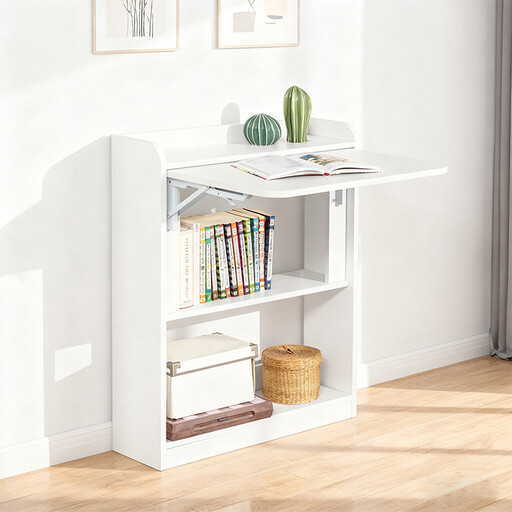
Why it's a great fit: Perfect for student dorms, small apartments, or as a temporary workspace in the living room. It offers a full-sized work surface that simply disappears when not in use.
Solves the problem of bulky furniture in limited living spaces. Instead of demanding permanent floor space, the area is only used when needed, without sacrificing storage.
Foldable tabletop and three integrated shelves for maximum space efficiency. The manufacturer states a load capacity of up to 35 kg.
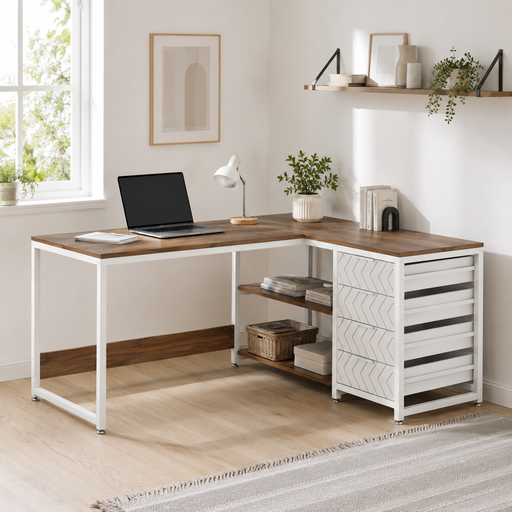
Why it's a great fit: Combines a generous work surface with a smart mix of open and closed storage. The industrial design complements modern interiors.
Addresses the problem of impractical storage. Four drawers and two open shelves provide flexible organisation. The reversible design allows it to adapt to any room layout.
Reversible L-shape design for flexible assembly. The combination of E1 particle board and a metal frame ensures stability. Adjustable feet compensate for uneven floors.
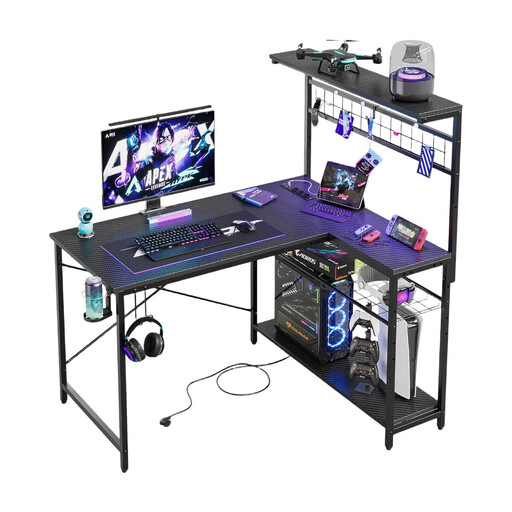
Why it's a great fit: Engineered for an immersive gaming or work experience with integrated tech and atmospheric lighting. Its compact L-shape is ideal for smaller rooms.
Solves the problem of cable management and a lack of ports. The built-in power strip with 3 outlets and 2 USB ports significantly reduces cable clutter.
Integrated power supply and customisable RGB lighting with 7 colours and 22 modes. The 4-tier shelf utilises vertical space for extra storage.
We have compiled a complete, up-to-date list of products that fully meet these strict selection criteria and relevant safety standards.
The required load capacity depends on your equipment. For a laptop and a few books, models with a capacity of 30 to 40 kg are usually sufficient. However, if you use multiple monitors, a PC tower, and other heavy devices, you should choose a model with a manufacturer-specified load capacity of at least 50 kg or more. You can find this information in the product specifications.
A reversible design means that the side sections of the desk can be assembled flexibly. You can decide for yourself whether the shorter part of the L-shaped desk should be on the left or right side. This offers maximum flexibility in adapting the furniture to the layout of your room.
A dedicated gaming desk is not strictly necessary, but it often offers thoughtful extras that are useful for gamers. These include integrated power outlets, USB hubs, cable management systems, headphone holders, and customisable RGB lighting. However, a stable computer desk or office desk with a sufficiently large and durable work surface can serve as an equally good foundation for a gaming setup.