Streaming playlists through passive speakers
You want to use your existing passive speakers at your desk to play a soul playlist from a particular service or your phone. First, check whether you need network streaming, AirPlay 2 or Bluetooth.


First, consider whether you have passive speakers and how your soul playlist will reach the amplifier. A network stereo amplifier combines streaming and amplification, while a traditional integrated amplifier is better suited to separately connected sources, provided its inputs—and, where necessary, an additional source device—work with your setup. Also check the speaker connections, available space and controls at the volume you usually listen at, rather than focusing on wattage alone.
You want to use your existing passive speakers at your desk to play a soul playlist from a particular service or your phone. First, check whether you need network streaming, AirPlay 2 or Bluetooth.
You want to keep using your passive speakers and existing CD, digital or vinyl sources, and might add a separate streamer later.
You’re looking for easy day-to-day controls and enough room for the device and cables in your home office. The models featured here vary in size.
A good fit if: You want to keep using passive speakers and compatible wired sources, such as a CD player or turntable.
Bear in mind: You may need a separate source device for network playlists; Bluetooth isn’t an integrated network service.
A good fit if: You want to play your playlist through a supported service or compatible network device, and use passive speakers with fewer separate components.
Bear in mind: The service and control method need to work with the specific model. WiiM doesn’t list AirPlay 2 for the Amp Pro, while Denon lists AirPlay 2 for the PMA-900HNE.
A good fit if: Your speakers already have built-in amplification, and their inputs or streaming features work with your playlist source.
Bear in mind: You may not need an additional stereo amplifier for this setup. Never connect a speaker output to an active speaker input.
People choosing a stereo amplifier for a soul playlist in their home office may have different priorities. The percentages show which consideration is the main reason for their purchase.
| Priority | What to check before buying | Who it matters most to |
|---|---|---|
| Playlist access | Supported service and connection method, full model name and available inputs. | If I want to start my soul playlist through a particular service or from my phone, the connection method and model need to work together. Around 36% of consumers put playlist access first. |
| Speaker compatibility | Active or passive design, connections and speaker specifications; compare power ratings only at equivalent impedance and under the same test conditions. | I want to keep using my existing speakers and first check whether they need an external amplifier and are compatible with the device. Around 29% of consumers put speaker compatibility first. |
| Controls and available space | Dimensions, room for cables and your preferred way to control playback, through an app or physical controls. | At my desk, I need room for the device and want to control playback easily while I work. Around 21% of consumers prioritise workspace and ease of use. |
| Other sources | Inputs for the sources you actually use; MM phono only if you have a compatible turntable, and allow for a separate streamer if needed. | If I also want to play CDs or vinyl, the inputs need to suit those sources. Around 14% of consumers prioritise additional sources and the extra components they need. |
Supported connection methods vary by model: WiiM lists AirPlay 2 for the WiiM Amp, but not for the WiiM Amp Pro.
Check the full model name and make sure it supports the method you’ll actually use to start your playlist.
Passive speakers need external amplification; active speakers already have it built in.
First check whether your existing speakers are active or passive, then make sure their connections suit your planned setup.
Manufacturers quote power ratings under specific conditions. A wattage figure alone can’t tell you whether an amplifier will sound better with soul music or suit a particular listening volume.
Compare power ratings only when the test conditions are clear and equivalent, and check your speakers’ specifications.
A traditional integrated amplifier and a network amplifier do different jobs. You may need a separate source device to play network playlists through a traditional integrated amplifier.
Plan the whole setup, from playlist source to amplification and speakers. Allow for a streamer and suitable cables if needed.
Models for passive speakers, from integrated amplifiers with Bluetooth and connections for separate sources to network amplifiers with HEOS.
Compact streaming amplifiers for passive speakers, including the WiiM Amp Pro and WiiM Amp.
Traditional integrated amplifiers such as the A-S301, for passive speakers and separately connected sources.
Traditional stereo integrated amplifiers with several inputs for separately connected sources.
The AXA35 is an analogue integrated amplifier for use with existing source devices.
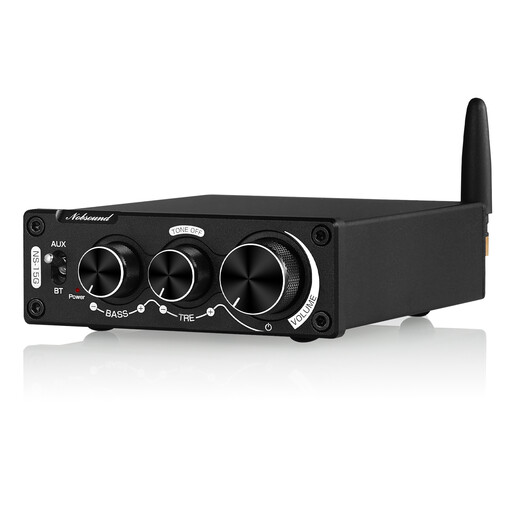
The Joybuy product featured here is a compact Bluetooth stereo amplifier for passive speakers, with Bluetooth or RCA connectivity for your source device.
 No image available
A good option if you want to connect passive speakers to your playlist source using Bluetooth or stereo RCA.
Bluetooth and stereo RCA input; speaker outputs with banana sockets; bass and treble controls, plus a bypass function.
Device dimensions: 92 × 108 × 30 mm. For the specific unit on offer, check the applicable EU conformity information and required CE marking. Bluetooth devices are also subject to the relevant requirements for radio equipment.
Not for amplification: active speakers have amplification built into the speaker system. Instead, check that their inputs or streaming features work with your playlist source.
No. WiiM lists the WiiM Amp as an AirPlay 2 receiver, but explicitly excludes the WiiM Amp Pro. Check the full model name against your preferred connection method.
Compare your speaker specifications and connections with the instructions for the specific amplifier. Power ratings are only meaningful under comparable impedance and test conditions; wattage alone doesn’t determine whether an amplifier is suitable for your workspace.
Electric amplifiers are subject to the relevant EU requirements and, where required, CE marking. Wi-Fi and Bluetooth devices are also subject to radio equipment requirements. The Bundesnetzagentur recommends checking that manufacturer information is clear and that a declaration of conformity is available. CE marking isn’t a quality award for sound.
Your statutory rights are against the seller and are separate from any voluntary guarantee. If a product is faulty, you may initially be entitled to a repair or replacement, subject to the applicable conditions. The Verbraucherzentrale explains the relevant requirements and how costs are allocated.