First, check whether you want to connect passive speakers and whether their specifications are compatible with the specific amplifier. An additional integrated amplifier isn’t automatically the right type of equipment for active speakers. Next, choose how you want to play your music: from existing wired sources, via Bluetooth or through integrated network streaming. For deep bass, speaker and listening positions matter too, as does a suitably connected active subwoofer if you want one – not just the wattage.
Which amplifier is right for you?
Bass-conscious listeners at their desk
If you listen to electronic music at a permanent workstation, check how your speakers and listening position are arranged in the room, and whether you might want to connect an active subwoofer later. WiiM documents a subwoofer output and EQ for the Amp Pro; Genelec points out that speaker placement affects the bass at your listening position.
Owners of passive speakers
If you want to keep using your existing passive speakers, check their connections and manufacturer specifications against those of the specific amplifier model. Yamaha and WiiM document speaker outputs for their respective models; these specifications don’t apply to every amplifier from either brand.
Listeners short on space
If your computer or phone is the music source and space is limited at your workstation, compare the playback options actually supported and measure the space available. Denon lists Bluetooth for the PMA-600NE, while WiiM documents network features for its Amp models. The options vary by model.
What should you look for when buying?
Start by checking which speakers you’ll connect, then choose your preferred way to play music, and finally consider the space available and whether you want to add more bass.
| What matters |
What to check before buying |
Who it matters most to |
| Deep bass at your listening position |
Check the subwoofer connection and settings available on the specific model; take the speaker and listening positions in the room into account. |
If I listen to electronic music at my desk, I want to judge the bass where I’m sitting and keep the option of adding more. For around 36% of consumers, deep bass at the listening position comes first. |
| Compatible speakers |
Check whether your speakers are passive or active. For passive speakers, compare the connections, impedance and operating guidance for both models. |
If I want to keep using my existing speakers, I want to know whether the amplifier and speakers are compatible, rather than relying on the wattage alone. For around 29% of consumers, speaker compatibility takes priority. |
| Music source and controls |
Compare the outputs on your computer or other sources with the amplifier’s inputs, supported services and the controls you want to use. |
If my music comes from my computer or phone, I want to play it through a connection or service that suits me. For around 21% of consumers, the source connection is the main consideration. |
| Space at your workstation |
Measure the unit and allow room for cables; if needed, check whether the specific model has a headphone socket and power-saving features. |
If space on my desk is limited, I want to fit the connections I need without cluttering my workspace. For around 14% of consumers, the space it takes up comes first. |
Common misconceptions
-
Comparing wattage without checking how it was measured
Power ratings may be based on different impedance levels and test conditions. A higher figure alone doesn’t prove that an amplifier is suitable for your speakers or will deliver better bass.
Compare the speaker specifications with those of the specific amplifier, and only compare power ratings measured on the same basis.
-
Assuming Bluetooth is the same as network streaming
Bluetooth, wired inputs and network services are different ways to play music. Even similarly named models may support different features.
Check the full model name and make sure it supports the service and controls you actually want to use.
-
Assuming a subwoofer output guarantees more bass
A connection alone can’t predict how the bass will sound at your desk. Speaker placement, listening position and sound settings all affect the result.
Plan your speaker and listening positions first, then check whether the connection and settings are suitable for an active subwoofer in your set-up.
Key brands at a glance
Yamaha
The A-S301 is an example of an integrated amplifier with connections for separate sources and passive speakers.
- Yamaha lists optical and coaxial inputs as well as a subwoofer output for this model.
- The unit measures 435 × 151 × 387 mm, so make sure you have enough space. These specifications apply to the A-S301, not every Yamaha amplifier.
Denon
The PMA-600NE combines traditional amplifier connections with Bluetooth for a compatible source.
- Denon lists digital inputs and an MM phono input for this model, in addition to Bluetooth.
- These connections don’t mean the unit has integrated network streaming. Check that it supports the sources you have and the services you want to use.
WiiM
The WiiM Amp and Amp Pro are examples of amplifiers with network features for passive speakers.
- WiiM lists a subwoofer connection and EQ for both models.
- Choosing the right model matters: according to WiiM, the Amp supports AirPlay 2, while the Amp Pro does not. These features don’t guarantee a particular level of bass at your listening position.
Fosi Audio
The V1.0G is an example of a small amplifier for passive speakers and a compatible analogue source.
- Fosi documents an RCA input and a power supply for the version described.
- No digital input is documented for this model. If you’re considering a specific listing, check that the version, power supply and plug are right for you.
Cambridge Audio
The AXA35 is an example of an amplifier for existing analogue sources and occasional headphone use.
- The user manual lists a front-panel Aux input and a headphone socket.
- According to the manual, connecting headphones mutes the speaker outputs. The documented features don’t indicate integrated network streaming.
Joybuy products
The product below is a compact stereo amplifier for passive speakers, with Bluetooth and RCA source options.
 No image available
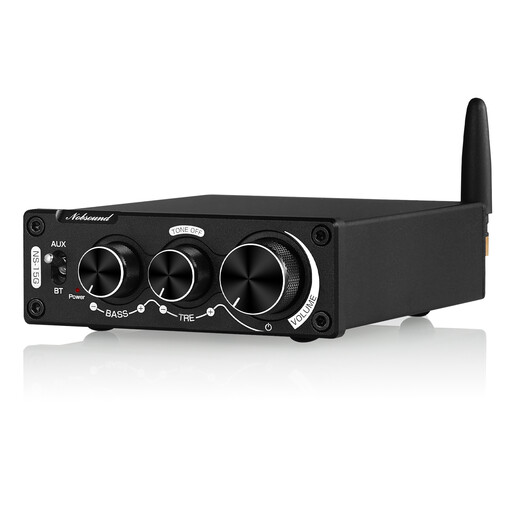
Nobsound 200 W Mini Bluetooth stereo amplifier with bass and treble controls
For a compact desk set-up with passive stereo speakers and a compatible Bluetooth or RCA source.
Bluetooth and RCA inputs, plus stereo speaker outputs, are listed. The unit measures 92 × 108 × 30 mm and weighs 320 g.
Before buying, check the requirements for the specific version on offer and the product information you need; the model name alone doesn’t prove compliance.
Joybuy
Frequently asked questions
Do I need a stereo integrated amplifier for active speakers?
Not just to power them: the amplifier outputs described here are intended for passive speakers. Instead, check which input your active speakers have and which output your music source provides.
How should I position speakers for electronic music at my desk?
Start by positioning them as symmetrically as possible around your listening position, then check the bass where you actually sit. Genelec points out that room reflections and room modes affect playback; its studio placement guidance can’t guarantee a particular result in a living space.
What are my rights in Germany if a product develops a fault or I return an online order?
Your statutory consumer rights against the seller are separate from any voluntary guarantee. According to the Verbraucherzentrale, online purchases usually come with a 14-day right to cancel; the applicable conditions depend on the specific purchase.
What should I check about product requirements and CE marking?
Check the requirements for the specific version of the product on offer. The European Union explains that CE marking applies only to products covered by certain EU rules; the Bundesnetzagentur lists the marking and required product information among the points to check.
How should I dispose of an old amplifier?
Electrical equipment must be collected separately and must not go in household rubbish. The Umweltbundesamt explains that local collection points generally accept old electrical equipment free of charge.


