Listeners with speakers they already own
If you want to play your record collection through active speakers, a hi-fi system or compatible Bluetooth devices, choosing the right signal path is essential.


First, check which inputs your speakers or amplifier have, and whether a turntable with a phono preamp, line output or Bluetooth will work with them. If you want to keep things simple while you work, consider a fully automatic model. For recording to a computer or having more control over the settings, a manual USB model may be a better fit. Also compare the speeds supported by your records and check which replacement stylus is compatible with the specific model.
If you want to play your record collection through active speakers, a hi-fi system or compatible Bluetooth devices, choosing the right signal path is essential.
If you want to start a record with as few steps as possible, a model with automatic tonearm movement could suit your everyday routine.
If you need to consider different record speeds, suitable replacement styli or a USB output for recording to a computer, check the features of the specific model.
The signal path is the first thing to consider when choosing a turntable for your home office. Automation, record care and USB recording matter depending on how you plan to use it.
| Priority | What to check before buying | Who is it important to? |
|---|---|---|
| Connection | Check the input on your hi-fi system or active speakers, and confirm the specific model's phono/line switch and Bluetooth output. | If I want to keep using my existing speakers, the output needs to match the input. Around 36% of consumers would prioritise connecting to devices they already own. |
| Ease of use | Check how the specific model starts, stops and returns the tonearm. | If I don't want to keep reaching over to the turntable while I work, automatic operation matters to me. Around 29% of consumers would make ease of use their top priority. |
| Record collection and care | Compare the speeds of your records with the model's specifications, and check which replacement stylus is compatible. | If my collection needs different speeds or a particular replacement stylus, I'll check the specifications for the specific model. Around 21% of consumers would prioritise record compatibility and care. |
| Recording | Check the exact model's USB function and recording method: computer or USB storage device. | If I also want to digitise my records, I'll first decide whether I want to record to a computer or a USB storage device. Around 14% of consumers would prioritise the recording function. |
For wireless playback through speakers or headphones, the turntable needs to transmit a suitable Bluetooth signal, and the receiving device must be compatible with it.
Check the Bluetooth function of both specific devices rather than relying solely on the description in a product listing.
The correct setting depends on whether your hi-fi system uses a phono or line input. You may need an additional phono preamp if neither the turntable nor the hi-fi system has a suitable preamp.
Make a note of your hi-fi system's inputs and compare them with the outputs and switch settings on the turntable you want.
A USB connection for recording to a computer isn't automatically the same as recording directly to a USB storage device.
Decide which recording method you want to use before buying. Audio-Technica describes the AT-LP120XUSB as connecting to a computer; for the Denon DP-450USB, Denon specifies recording to USB storage.
The AT-LP70XBT and AT-LP120XUSB offer different approaches to operation and connectivity.
According to Sony, the PS-LX310BT is designed for automatic playback over Bluetooth or through a wired hi-fi system.
According to Dual, the CS 329 is a pre-assembled, fully automatic turntable for wired playback.
According to Denon, the DP-300F offers fully automatic operation; for USB recording, the other model, the DP-450USB, is the one to consider.
According to Technics, the SL-40CBT combines direct drive, Bluetooth and an integrated phono preamp.
Here you'll find turntables for your home office, including models with built-in speakers and wired or wireless playback options.
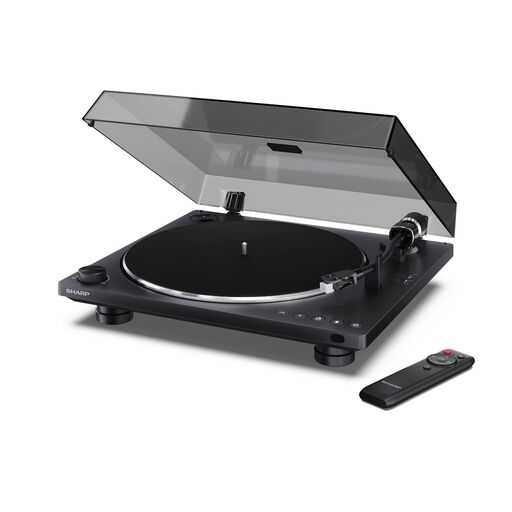 No image available
An option if you're looking for a fully automatic turntable with built-in speakers or a line output.
33 and 45 U/min; auto-stop; built-in speakers, line output and headphone socket.
Bluetooth 5.4 and USB-C recording are listed in the product name.
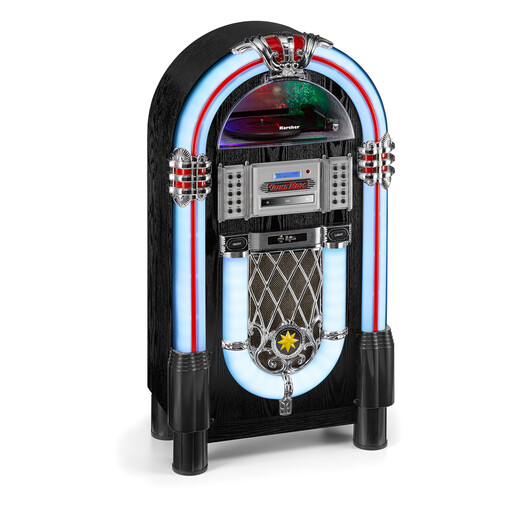 No image available
An option if you want to listen to records through built-in speakers and play music from other sources too.
Specified for 33, 45 and 78 U/min; built-in speakers, plus USB and SD card playback.
Bluetooth audio streaming, CD and radio are also listed in the product description.
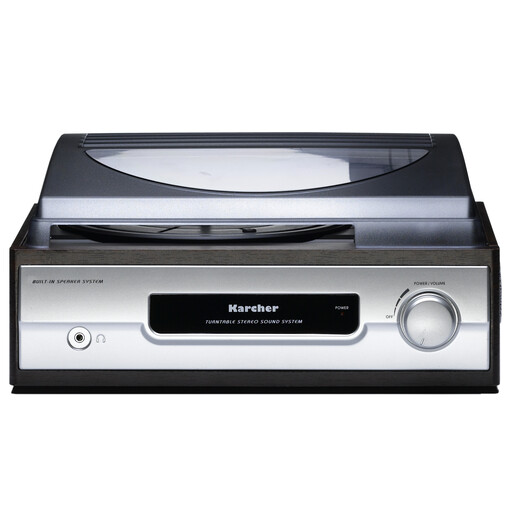 No image available
An option if you want to listen without separate speakers and connect an external device when needed.
33 and 45 U/min; auto-stop; built-in stereo speakers, line output and headphone socket.
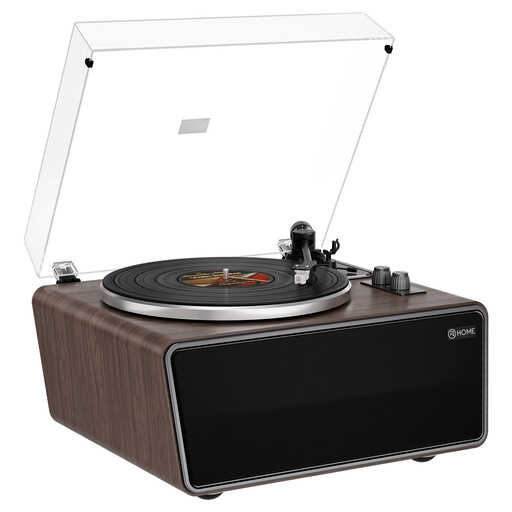 No image available
An option if you're looking for a single device with built-in speakers, wired connections and USB recording.
33⅓ and 45 U/min; four built-in speakers; phono/line RCA outputs; USB recording.
The product name lists an AT-3600L (MM) cartridge.
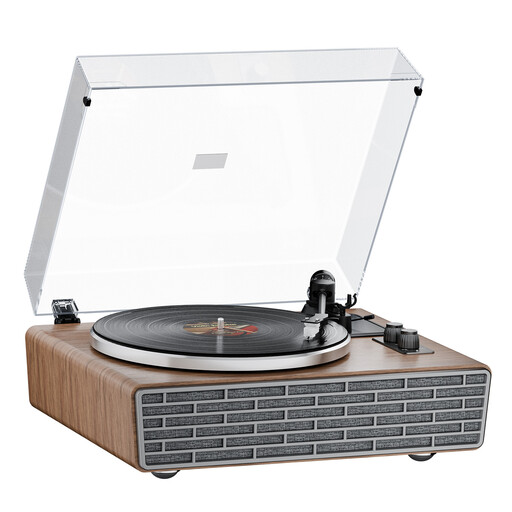 No image available
An option if you want to use built-in speakers while also connecting a wired hi-fi system.
33⅓ and 45 U/min; four built-in speakers, plus phono and line RCA outputs.
Bluetooth and belt drive are listed in the product name.
Yes, if the turntable's line output matches the input socket on your active speakers. If your turntable has a phono preamp, make sure the setting matches the input you're using. Check the connections on both devices before buying.
Setup depends on the model. According to Dual, the CS 329 is set up at the factory, while the manual Audio-Technica AT-LP120XUSB offers adjustable tracking force. Use suitable cleaning tools to remove dust and fluff from your records and stylus.
Check which replacement stylus is compatible with your specific turntable model and whether your hi-fi system needs any additional components. For online purchases in Germany, you generally have a 14-day right to cancel. According to the Verbraucherzentrale, you must notify the retailer that you wish to cancel.
No. Section 10 of the German Electrical and Electronic Equipment Act (ElektroG) requires old electrical equipment to be collected separately from unsorted municipal waste. Whether a retailer is obliged to take it back, and how this is handled, depends in part on the requirements set out in Section 17 of the ElektroG.