
Lieferung heute & morgen

Qualitätsgarantie

Willkommens-Angebote freischalten: KOSTENLOSE Lieferung | Bis zu 80 % RABATT | Kostenlose 30-Tage-JoyPlus-Testphase
App herunterladen
An effective workout doesn't necessarily require a fully equipped gym. For many who value flexibility and efficiency, at-home strength training is a convenient alternative. A resistance band set is a versatile tool that covers a wide range of applications, from rehabilitation to intensive muscle building.
This guide is designed to help you understand the different types of resistance bands and make an informed decision that aligns with your personal goals—whether it's increasing strength, improving mobility, or supporting physical therapy exercises.
Before making a choice, it's helpful to know a few key features that determine the functionality and application of resistance bands.
Most sets include bands in different colours, each representing a different level of resistance. A typical physical therapy band set offers a range from very light to very heavy.
A set with multiple levels allows you to create a progressive training plan and adjust the resistance to each exercise and your increasing strength level.
Resistance bands are made from different materials, each with its own specific properties.
Furthermore, there are different types of bands: closed loops (loop bands), long bands without handles, and resistance bands with handles. The latter are particularly well-suited for exercises that mimic traditional dumbbell movements, like bicep curls or shoulder presses. A stretch strap with multiple loops, on the other hand, is specifically designed for improving flexibility and for stretching routines.
Here, we present a selection of products that cater to different training needs.
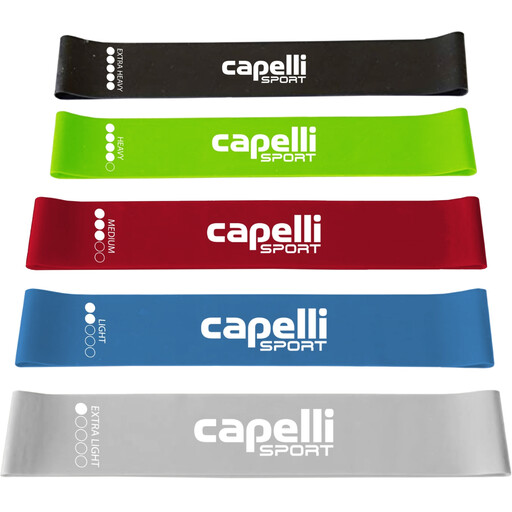
Why it stands out: This set is a classic all-rounder. It consists of five closed latex loop bands (Mini Loops) with clearly marked resistance levels from Extra Light to Extra Heavy. The included carrying bag makes it a convenient companion for workouts on the go or at home.
Benefits:
Who is it for? This set is suitable for beginners and advanced users looking for a complete resistance band set for a versatile full-body workout. It is particularly effective for exercises that strengthen the legs, hips, and glutes, as well as for stabilisation exercises.
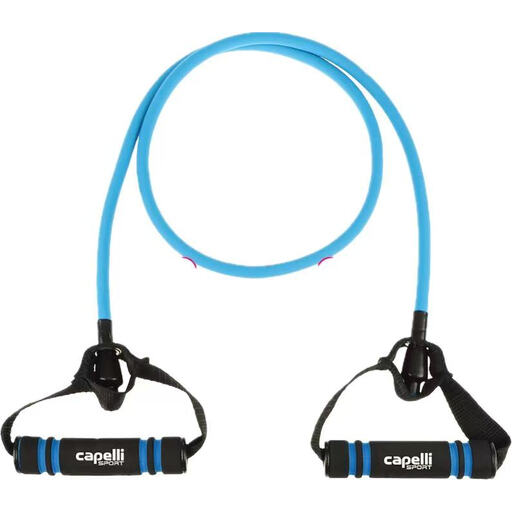
Why it stands out: This band is specifically designed for upper-body training. The integrated foam handles provide a secure and comfortable grip, which is advantageous for exercises like rows, bicep curls, or tricep pushdowns. The band is made of TPE and offers medium resistance.
Benefits:
Who is it for? Users looking for a targeted alternative to free weights for their at-home strength training. It is ideal for individuals who want to focus on their arm, shoulder, chest, and back muscles.
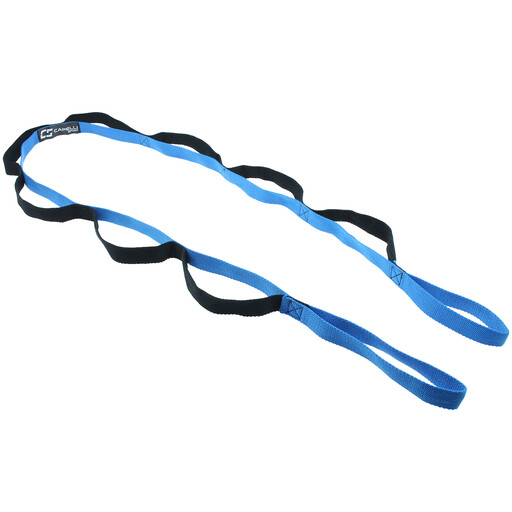
Why it stands out: This stretch strap is not a classic resistance band but a specialised tool for improving flexibility. It features eight integrated loops that allow the user to precisely control the stretch intensity and securely hold various positions.
Benefits:
Who is it for? Individuals who want to specifically improve their mobility, relieve muscle tension, or support their recovery phases. It is a valuable addition for athletes, dancers, and anyone working on their flexibility.
If the products featured here don't quite match what you're looking for, or if you'd like to explore a wider selection of equipment for your at-home strength training, you can find more products and sets in our Home Workout Sport Bands category.
For beginners, a resistance band set with multiple resistance levels is a great choice. Start with the lightest band (often yellow or another light colour) to learn the correct technique. Once the exercises become easier, you can move on to the next stronger band.
Yes, building muscle with resistance bands is possible. The key is the principle of progressive overload: to stimulate muscle growth, the muscle must be challenged by a resistance that pushes it. By gradually switching to bands with higher resistance, performing more repetitions, or increasing the time under tension, you provide the necessary stimulus for muscle growth.
To ensure the longevity of your bands, you should wipe them with a damp cloth after use and let them air dry. Avoid using harsh cleaning agents. Store the bands in a cool, dry place away from direct sunlight, as UV light and extreme temperatures can make the material brittle. Inspect the bands for small tears or damage before each use.