
Lieferung heute & morgen

Qualitätsgarantie

Willkommens-Angebote freischalten: KOSTENLOSE Lieferung | Bis zu 80 % RABATT | Kostenlose 30-Tage-JoyPlus-Testphase
App herunterladen
Whether you need a place for books, plants, spices, toiletries or keys, shelving and storage for your home can create extra space without taking up too much floor area. There’s plenty to choose from, including bookcases, freestanding shelves, wall shelves, corner shelves and room dividers with shelving. But design isn’t the only thing to consider. The dimensions, fixing method and weight capacity all determine whether a shelf will be practical for everyday use.
Product photos often show shelves in spacious rooms. In British homes, however, doors, radiators, sockets and skirting boards can all limit the space available. Before buying, measure the width, height and depth of the space you have in mind. For a wall shelf, also check that there’s enough clearance around window frames and light switches.
A decorative wood-and-metal shelf may look light, yet still be heavy. Conversely, a solid appearance doesn’t automatically mean it has a high weight capacity. Claims such as ‘sturdy’ or ‘robust’ are of limited use without specific load ratings. Check the maximum weight per shelf, how evenly the weight needs to be distributed and how the unit is fixed in place.
Tall freestanding shelves, corner shelves and room dividers can tip over if the weight is unevenly distributed. Fit the supplied anti-tip kit to a suitable wall, following the instructions. In homes with children, shelves must never be used for climbing. For wall-mounted shelves, the wall material, wall plugs and screws must all be suitable for the particular design.
These questions can help you find the right option for your needs:
A three-tier shelf is best suited to smaller items that you want to display neatly. For larger collections or lots of books, a tall freestanding shelf with several levels is usually a more practical choice.
Solid wood, MDF, coated wood-based materials and metal all have different properties. Wood adds a warm, natural look to vintage, rustic or minimalist interiors. Metal frames often complement an industrial style and, when properly designed, can add rigidity.
Claims such as scratch-resistant or water-resistant apply to the specific product and its finish. Even these materials shouldn’t be exposed to high levels of moisture for long periods. A soft, dry or slightly damp cloth is usually all you need for cleaning. Abrasive cleaners can damage surfaces and coatings.
Always check weight limits per shelf, rather than relying only on the capacity for the entire unit. Place heavier items on the lower levels. Buyers should also check:
A key holder with a shelf has different requirements from a bookcase. With a small wall-mounted unit, the fixing points and secure installation matter most. For a tall shelf, stability is the priority.
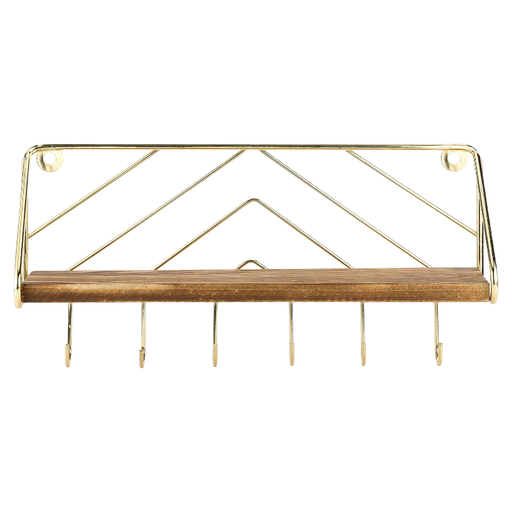
Why this product is a good fit: This compact wall-mounted design combines a shelf with six hooks, making it ideal for a hallway, entrance or small home.
Its dimensions of 30,3 × 15 × 9 cm and the included mounting hardware make it easier to plan where it will go. Be sure to check the weight limit before hanging it.
Six hooks, a top shelf, a wood-and-metal construction and space-saving wall mounting.
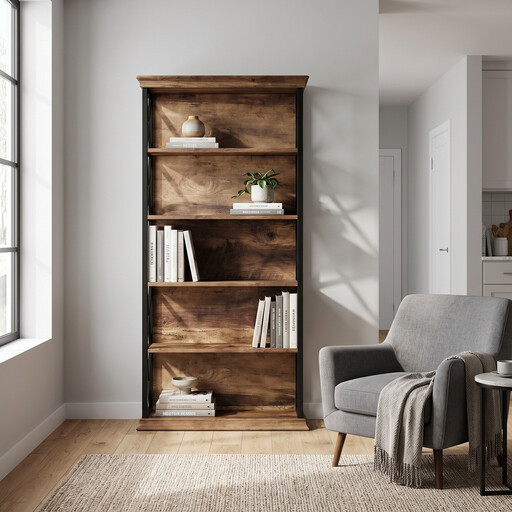
Why this product is a good fit: This tall industrial-style shelf combines open compartments with a metal frame, making it a good fit for a living room, home office or study.
The product details state a maximum load of 34 kg per shelf and include an anti-tip kit. The shelf must be secured to the wall as instructed.
Dimensions of 80 × 30 × 180 cm, five specified levels, a metal frame and MDF boards in the stated E0 class.
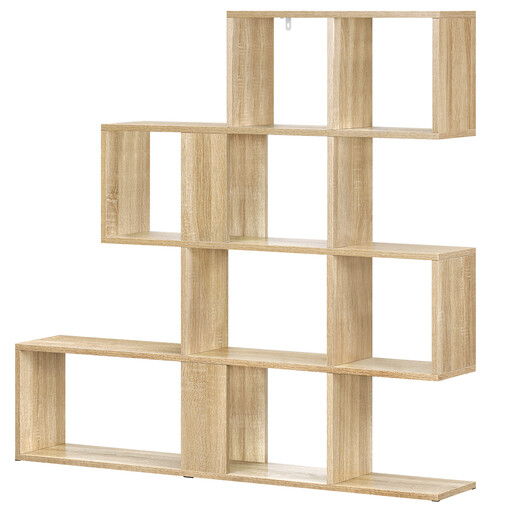
Why this product is a good fit: Used as a room divider, it helps define living, sleeping or working areas while providing open compartments for books, plants and storage boxes.
The design features a wide base, non-slip pads and a fixture for securing it to the wall. Its stated total load capacity is up to 70 kg.
Four levels, 11 open compartments, dimensions of 115 × 109,5 × 19,5 cm and a coated wood-based surface.
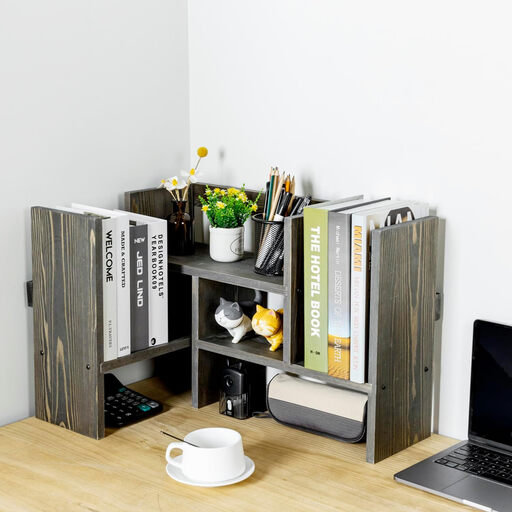
Why this product is a good fit: Adjust this desk shelf to suit books, ring binders, plants or tech accessories. It doesn’t need to be mounted to a wall.
The adjustable, freestanding design reduces the risk of choosing shelves that aren’t the right height. The stated depth of 6.7 inches should be converted to centimetres and checked against your desk before buying.
Three levels, height-adjustable shelves, solid wood with a vintage finish and no need for permanent wall fixings.
We’ve put together a complete, regularly updated list of products that meet these strict selection criteria and the safety regulations in force in the EU.
Read the assembly instructions in full before getting started. For wall shelves, choosing secure fixing points is more important than installing them as quickly as possible. Freestanding shelves must sit level; adjustable feet can compensate for slight unevenness. Wipe away dust with a soft cloth. Avoid leaving moisture on wood surfaces.
First, check the wall material and the position of any pipes or cables. Then use only suitable wall plugs and screws. The supplied hardware won’t necessarily be suitable for every wall. Place heavy items as close as possible to the fixing points, rather than at the outer edge.
This depends on the specific model, material, shelf and fixing method. The key figure is the stated maximum load per shelf. Don’t exceed it. Distribute books, ceramics and food supplies evenly, placing heavier items on the lower shelves.
A wall shelf makes use of wall space while keeping the floor clear. It’s ideal for keys, decorations or small plants. A freestanding shelf usually offers more storage and can be used as a bookcase or room divider, but it needs clear floor space and should be secured against tipping if it’s tall.