
Lieferung heute & morgen

Qualitätsgarantie

Willkommens-Angebote freischalten: KOSTENLOSE Lieferung | Bis zu 80 % RABATT | Kostenlose 30-Tage-JoyPlus-Testphase
App herunterladen
A honeycomb frying pan with glass lid combines several practical features. Its structured interior is designed to reduce direct contact between food and the cooking surface, while the lid lets you monitor the cooking process. However, not every honeycomb pan is automatically suitable for every household. The key factors are the material, coating, base construction, diameter and care instructions.
The term honeycomb frying pan initially describes only the pattern on the interior surface. Depending on the model, it may be made from stainless steel, have a ceramic coating or feature another non-stick layer. A stainless steel pan with a honeycomb structure is therefore not necessarily the same as a completely uncoated stainless steel pan.
Before buying, check the product description for the following details:
A surface advertised as a scratch-resistant pan may be more resistant to normal kitchen utensils. Sharp edges, abrasive scouring pads or incorrect cleaning can still damage the surface. With a ceramic-coated pan in particular, it is advisable to follow the manufacturer’s specific care instructions.
A honeycomb structure cannot prevent every type of damage either. It may reduce direct contact between a turner and the smooth surface, but it does not replace careful handling.
A glass lid comes with the pan, but it is not automatically suitable for use in the oven. Check whether information is provided about the maximum temperature, handle material and lid care. For the pan itself, the base is decisive: a pan for induction needs a magnetic contact area that is large enough.
A 304 stainless steel pan is made from a widely used grade of stainless steel, which product descriptions often refer to as food-safe. In multi-layer bases, aluminium may be placed between layers of stainless steel to support heat distribution. The specific manufacturer’s information about the construction is what matters.
With a coated pan or non-stick pan, easy cleaning and the ability to fry with little oil are usually the main priorities. A ceramic coating can offer these benefits too. Non-stick performance decreases with use and depends heavily on temperature, utensils and cleaning. Empty pans should never be heated to a high temperature.
The stated size generally refers to the upper diameter. When choosing, you should also consider the usable base area and the size of your hob zone.
A 28 cm wok pan is easier to handle than a 30 or 32 cm wok. For induction, the base of the pan should match the cooking zone as closely as possible so that heat is transferred evenly.
A pan for all hob types should be expressly listed as suitable for induction, gas, electric and ceramic hobs. On gas hobs, a sturdy handle is also important so that the pan can be moved safely. On ceramic hobs, avoid sliding it across the surface to prevent scratches.
When cleaning, follow these steps:
Hand washing is recommended for several of the models described here. A sudden change in temperature, such as placing hot cookware directly under cold water, can put stress on both the material and the glass.
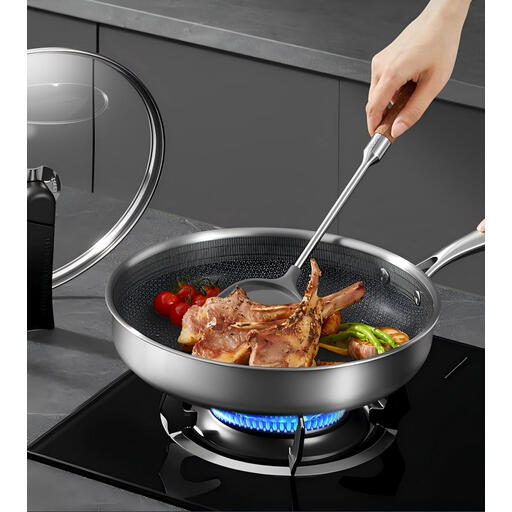
Why this product suits this profile: The 28 cm diameter is suitable for many everyday cooking quantities. According to the product name, the pan is made from 304 stainless steel, comes with a glass lid and is suitable for all common hob types.
The material, size, glass lid and hob compatibility are clearly specified. Before buying, also check the latest care and temperature instructions.
28 cm format, 304 stainless steel according to the product name, glass lid and suitability for all cooktops.
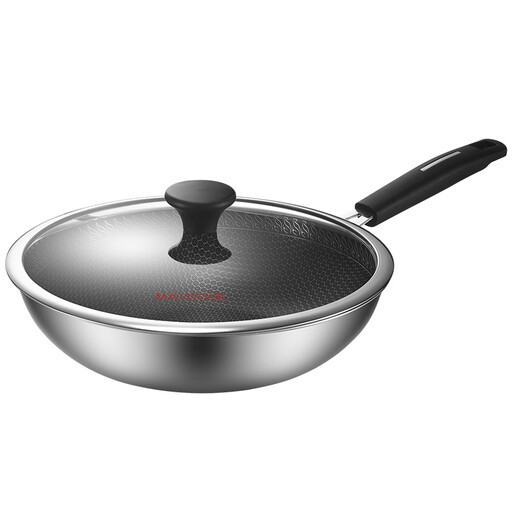
Why this product suits this profile: The three-layer stainless steel body, the ceramic non-stick coating according to the product description and the visible glass lid will appeal to users comparing construction and versatility.
The description expressly states that the pan should be hand-washed and warns against sharp metal tools. This makes its care and usage limitations clear.
30 cm diameter, three-layer stainless steel construction, ceramic interior coating according to the description, glass lid and compatibility with several hob types.
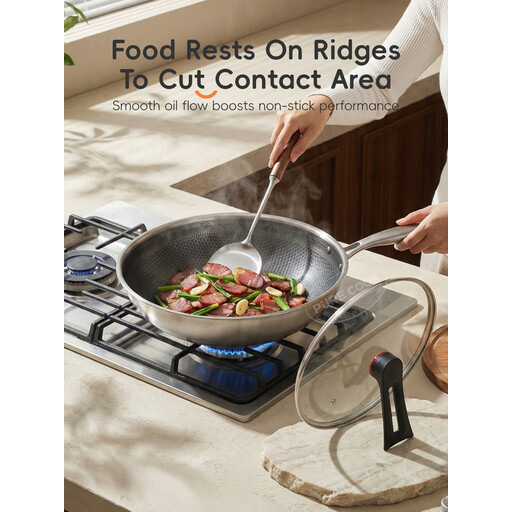
Why this product suits this profile: With its 32 cm diameter, this model is aimed at households that want to prepare larger quantities, wok dishes, braised meals or pan-fried dishes.
The product description highlights hand washing, drying the pan completely and avoiding thermal shock. This makes it easier to plan for realistic care requirements.
32 cm, 304 stainless steel in a three-layer construction according to the description, glass lid, honeycomb structure and suitability for gas, induction and electric ceramic hobs.
We have put together a complete, regularly updated list of products that fully meet these strict selection criteria and the safety regulations applicable in the EU.
That depends on the base, not the honeycomb structure alone. Look for an express statement that the product is a pan for induction or a pan for all hob types. If you are unsure, testing the base of the pan with a magnet can provide an initial indication. The manufacturer’s information remains decisive.
It is not possible to give a reliable fixed lifespan. This depends on the coating, temperature, frequency of use and care. Low to medium heat, suitable kitchen utensils, hand washing and avoiding overheating an empty pan can help protect the surface. If you notice visible flaking or deformation, the cookware should no longer be used.
Models with a non-stick or ceramic coating are often marketed for cooking with little oil. However, actual non-stick performance depends on the food, temperature and condition of the surface. A little fat can also be helpful when using a honeycomb stainless steel pan. Avoid preheating coated models while empty.