
Lieferung heute & morgen

Qualitätsgarantie

Willkommens-Angebote freischalten: KOSTENLOSE Lieferung | Bis zu 80 % RABATT | Kostenlose 30-Tage-JoyPlus-Testphase
App herunterladen
A hot air brush can replace several bathroom appliances: it dries, smooths, creates waves and adds volume. However, not every hot air brush is suitable for every hair type or styling routine. The key considerations are whether the device is designed for wet, towel-dried or exclusively dry hair, and which attachments are actually included.
A 2-in-1 hair styler may combine, for example, a heated brush and a curling iron without having an airflow function. According to its product description, the Wavytalk Thermal Brush is explicitly not a hair dryer brush and is intended for dry hair only. If you want to dry wet hair with it, you will not be buying what you actually need.
Therefore, look for specific details such as:
A 4-in-1 hot air brush sounds versatile. In practice, diameter, bristle shape and interchangeability are what matter. Large round brushes are more suitable for root volume and soft waves, while smaller brushes create more defined curls. A smoothing attachment does not automatically replace a classic heated brush for straight hair.
Before buying, check whether the attachments:
According to the relevant product information, an ionic hot air brush can reduce static electricity. This can be useful for taming flyaway hair. However, it does not guarantee shiny or completely frizz-free hair. Ceramic coatings distribute heat more evenly by design, but they cannot automatically prevent heat damage if the temperature is too high or the device is used for too long.
At least two temperature and airflow settings allow you to adapt the device to your hair type and styling goal. A lower setting is advisable for fine, dry or damaged hair, while thicker or still-damp hair may require greater airflow. A cool setting helps cool individual sections and can be used to set the style.
According to the product data, the Philips 3000 Series Hot Air Brush BHA313/00 offers three temperature settings, two speed settings and a cool-air option. A “Care” mode is also listed. Other devices, by contrast, offer only two temperature and airflow settings. More settings do not automatically mean better results, but they do provide greater flexibility.
Wattage primarily indicates electrical power, not styling quality. Models with 700 to 1,100 watts are available in the selection. Higher power can be useful for drying, but it also increases electricity consumption per minute of use. A dedicated heated brush usually operates at a considerably lower wattage, but is not suitable for drying.
If you want to style damp hair in the morning, choose a hair-dryer and styling brush with a clearly stated wet- or damp-hair function. A heated round brush such as the Wavytalk model is better suited to dry sections and targeted shaping.
A rotating hot air brush can make it easier to wrap sections of hair around the brush. A selectable direction of rotation and controllable airflow are important. Larger diameters, such as 50 mm, create looser volume, while smaller brushes help create more defined waves.
Attachments with ceramic coatings are often promoted as distributing heat evenly. Such coatings are specified for the Philips BHA313/00 and the Beurer HT 80. You should also remove hair and dust from the brush regularly to prevent the air openings from becoming blocked.
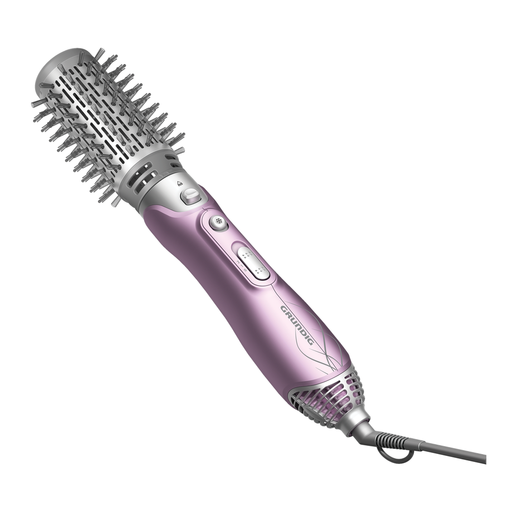
Why this product suits the profile: This hot air brush combines three round brushes with diameters of approximately 33, 40 and 50 mm, and offers two temperature and two speed settings.
The attachment sizes are clearly specified. This makes it easier to judge before buying whether volume, waves or softer shaping is your main priority.
1,100 watts, ceramic coating, cool-air function and a stated weight of 300 g.
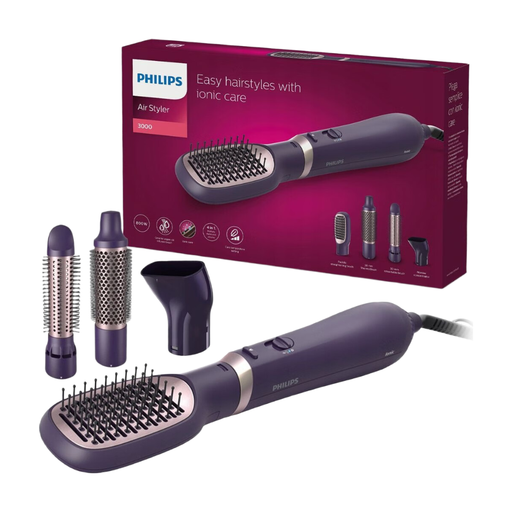
Why this product suits the profile: Four attachments cover drying, waves, more defined curls, smoothing and precise blow-drying.
The product data explicitly states that it can be used on wet and dry hair, and lists several settings and a cool-air option.
800 watts, ceramic attachments with argan oil specification, ionic function, three temperature and two speed settings.
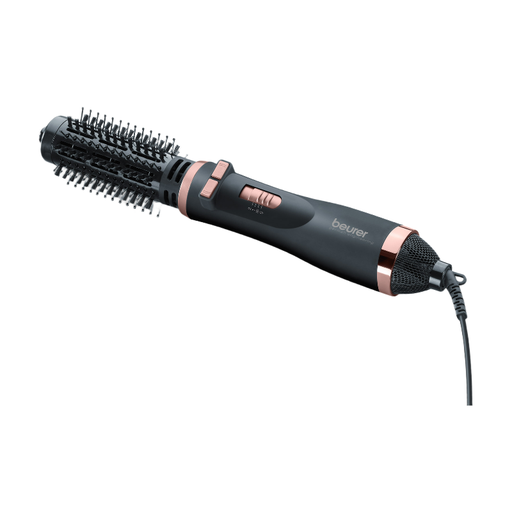
Why this product suits the profile: The brush rotates in both directions to help create volume and waves in towel-dried or pre-dried hair.
The instructions limit use to pre-dried, slightly damp hair. This prevents the mistaken expectation that the device can dry soaking-wet hair.
1,000 watts, two ceramic-coated attachments, ionic function, two directions of rotation and a cool-air burst.
Divide your hair into manageable sections and do not hold the brush in one place for too long. The attachments can become hot during use. Therefore:
We have put together a complete, regularly updated list of products that fully meet these strict selection criteria and the safety regulations applicable in the EU.
This depends on the model. Some devices, including the Philips BHA313/00, are intended for use on wet and dry hair according to the product information. Other models, such as the Beurer HT 80, should only be used on pre-dried, slightly damp hair. A dedicated heated brush is generally suitable for dry hair only.
Its lifespan depends on usage, cleaning, cable care and the strain placed on the motor. It is not possible to reliably determine a fixed lifespan from the wattage. Regularly remove hair from the brush and air inlet, and only store the device once it has cooled down completely.
Consumption depends on power and operating time. A 1,000-watt device used for ten minutes consumes approximately 0.167 kilowatt-hours in theory. Running costs therefore depend largely on short applications and using the appropriate airflow and temperature setting.