
Lieferung heute & morgen

Qualitätsgarantie

Willkommens-Angebote freischalten: KOSTENLOSE Lieferung | Bis zu 80 % RABATT | Kostenlose 30-Tage-JoyPlus-Testphase
App herunterladen
A hot plate can be a practical solution for small kitchens, student accommodation, camping, the office or additional cooking capacity. Before buying, however, it is worth taking a close look at the heating technology, connected load, dimensions and safety features. An inexpensive electric hot plate is not automatically suitable for every pan, worktop or electrical circuit.
A high power rating can speed up heating, but on its own it says little about actual running costs. What matters is how long the appliance operates, which heating technology it uses and how precisely its output can be regulated.
A classic electric hot plate rated at 1,500 watts theoretically consumes 1.5 kilowatt-hours per hour of operation at full power. In practice, it is rarely operated continuously at the highest setting. With an induction hot plate, the base of the pan is heated directly, whereas a conventional hot plate first heats the plate itself. This can affect heating time and operating duration, but it is not a blanket guarantee of lower costs.
A portable hot plate requires a suitable, stable and heat-resistant surface, as well as an appropriate power supply. Compact dimensions are useful for camping or office use. Nevertheless, the appliance must be positioned so that ventilation openings remain unobstructed and the power cord cannot come into contact with hot surfaces.
Appliances designed for permanent installation are subject to additional requirements. A built-in hob must fit the specified worktop cut-out. Dimensions such as 290 × 520 millimetres for the appliance and approximately 260 × 490 millimetres for the cut-out must not be confused with one another.
A timer, child lock or overheat protection are useful features, but they do not replace supervision while cooking. The cooking area should never be left unattended, particularly when heating oil or fat. A residual-heat indicator signals that the surface may still be hot after the appliance has been switched off.
A classic single hot plate with a metal heating surface transfers heat directly. It is often straightforward to use and suitable for many types of cookware, but typically requires some time to heat up and cool down. A continuously adjustable thermostat allows more precise control than a small number of fixed power settings.
A ceramic hob, also known as an electric glass-ceramic hob, has a smooth surface that is easy to clean. However, the cooking zone remains hot for some time after being switched off. The cookware used must have a flat base and be suitable for the size of the respective zone.
An induction hot plate or induction hob requires magnetic cookware. A simple magnet test on the base of a pan can confirm whether existing cookware is compatible before purchase. Induction usually responds quickly to power adjustments and often includes automatic pan detection. Aluminium or copper pans work only if they have a magnetic base.
For occasional heating, simple meals or use in student accommodation, a single burner is often sufficient. Anyone who wants to prepare pasta and sauce at the same time will need a double hot plate or a 2-zone hob.
Check the diameter of the cooking zones and compare it with your existing cookware. A 180-millimetre plate, for example, is suitable for medium-sized pans. With a flexible induction zone, two adjacent areas can be combined to create a larger cooking surface. This is particularly useful for roasting dishes or large pans, provided the model actually supports this function.
Portable appliances are typically connected to a 220–240-volt supply. Depending on the model, total output may be 1,500 watts, 3,000 watts or more. With several cooking zones, check whether the maximum output is available simultaneously or distributed through power management.
A permanently installed hob should be fitted in accordance with the manufacturer’s instructions. In Germany, depending on the appliance and installation, the electrical connection must be carried out by a qualified electrician. Before buying, check the cut-out dimensions, installation depth, ventilation clearances, fuse requirements and the position of the connection.
A hob with touch controls can be wiped clean easily, but may respond inaccurately when the control surface is wet or dirty. Rotary controls are often clear and straightforward to use on portable single burners.
A hot plate with a timer can switch off a cooking zone after the selected period. Other useful features include:
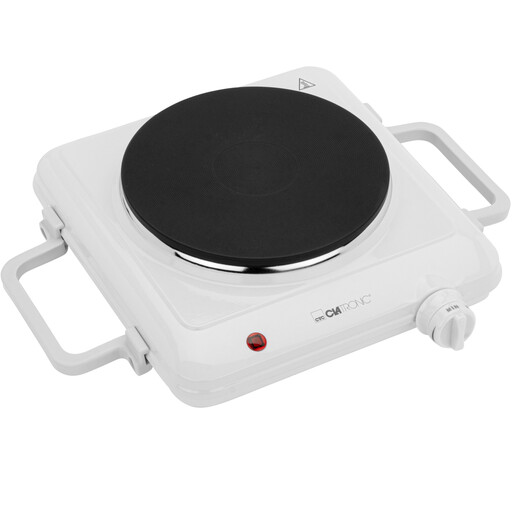
Why it fits: For students, offices, camping and households that occasionally need additional cooking capacity, this portable single burner offers a cooking zone measuring approximately 180 mm in diameter and 1,500 watts of power.
The continuously adjustable thermostat makes it easier to control the power level. A pilot light, overheat protection and high stability are explicitly specified.
1,500 watts, heat-resistant coating and attachable cool-touch handles for portable use.
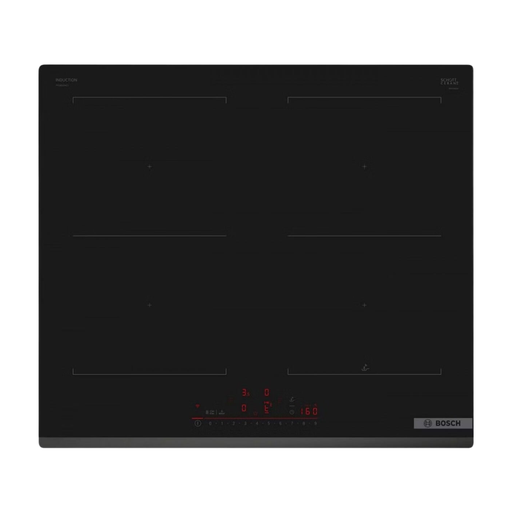
Why it fits: This 60 cm built-in hob is designed for households that need four cooking zones, digital controls and flexible functionality for everyday cooking.
The specifications list the cut-out dimensions, total output, pan detection, individual timers, child lock and automatic shut-off. Installation must be carried out professionally.
Four zones, CombiZone/FlexInduction, TouchSelect controls and 7,400 watts of total output according to the product specifications.
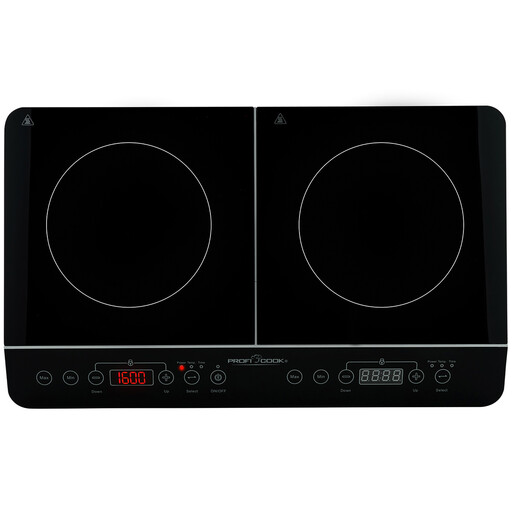
Why it fits: For small kitchens, additional cooking capacity and portable use, this double burner provides two induction zones with touch controls.
Automatic pan detection prevents operation without suitable induction cookware. The specifications include a timer, shut-off after inactivity and overheat protection.
Two cooking zones, up to 16 power levels per zone, a temperature range of 60 to 240 °C and a 180-minute timer according to the supplier’s specifications.
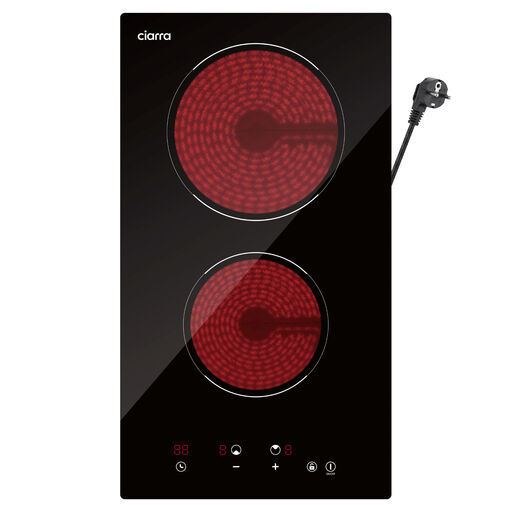
Why it fits: This compact built-in appliance is designed for kitchens with limited worktop space and operates with two electric cooking zones.
The 260 × 490 mm cut-out dimensions should be checked before ordering. The listed features include a residual-heat indicator, child lock, overheat protection and automatic shut-off.
3,000 watts of total output, nine power levels, touch controls and an individual timer of up to 99 minutes according to the product description.
The full selection of two-zone electric cookers can be compared by heating technology, power output, design and features.
For occasional use, a portable single hot plate is usually sufficient. If two pans are used at the same time on a regular basis, a double hot plate or a compact 2-zone built-in hob is the more practical choice. Before deciding, compare the available surface area, connected load and cookware sizes.
Consumption depends on the power rating and operating time. A 1,500-watt hot plate theoretically uses 1.5 kilowatt-hours during one hour of operation at full power. Since the thermostat or power control frequently cycles the heating element, actual consumption may be lower. For a reliable estimate, multiply the power rating in kilowatts by the operating time and the applicable electricity price.
Service life depends on usage, cleaning, build quality and correct operation. The surface should only be cleaned once it has cooled down. With a built-in hob, cracks or damage are reasons to disconnect the power supply immediately and contact customer service or a qualified professional. Over the long term, cables, controls and feet should also be checked regularly for visible damage.