Chutney makers short on worktop space
If you need to fit the pan, its handle and room to stir into a small space, compare the hot plate’s overall dimensions and the space you’ll actually need.


For making tomato chutney with limited worktop space, a portable single hot plate is usually a good choice. Induction is an option if your existing pan is suitable for the specific model. If your cookware is not induction-compatible, consider a cast-iron hot plate or a ceramic-glass hob with radiant heating, provided you can allow for the space it needs and time to cool down. When simmering chutney, easy-to-use heat controls and the occasional stir matter more than maximum wattage alone.
If you need to fit the pan, its handle and room to stir into a small space, compare the hot plate’s overall dimensions and the space you’ll actually need.
A tomato chutney recipe from LECKER calls for 30–60 minutes over a low heat, with the occasional stir. Easy-to-use controls and keeping an eye on the contents of the pan are key.
If you want to keep using your existing pan, check its base material and diameter against the specifications of your chosen appliance. Induction requires a compatible pan base.
A good choice if: your pan base is induction-compatible and its size and weight meet the specifications of the particular appliance.
Bear in mind: Not every pan you already own will be suitable, and the settings shown do not measure the temperature of the chutney.
A good choice if: your pan is not induction-compatible and you’d prefer a hot plate with a rotary control.
Bear in mind: The hot plate itself gets hot and must cool down before cleaning.
A good choice if: you want to use a pan that is not induction-compatible and prefer a smooth cooking surface.
Bear in mind: A ceramic-glass surface does not automatically mean the appliance uses induction. The Rommelsbacher CT 2200/E is 41 cm deep and needs time to cool after cooking.
A good choice if: you regularly need to heat a second pan at the same time as your chutney.
Bear in mind: A second cooking zone takes up extra space; the Severin DK 1014 measures approximately 46 × 29 cm.
| What you need | What to check before buying | Who will find this important? |
|---|---|---|
| Space for the appliance and pan | Compare the appliance’s overall dimensions with the available space, and allow room for the pan handle, cable and stirring. Severin lists the KP 1091 at approximately 25,5 × 28,8 cm; the DK 1014 measures approximately 46 × 29 cm. | If I’m cooking with one pan on a small worktop, I need room for the appliance, handle and stirring. Around 31 % of consumers put available worktop space first. |
| Heat control while simmering | Check the controls and lower settings; a timer is no substitute for keeping an eye on the pan or stirring. LECKER recommends a low heat and the occasional stir for its recipe. | When I’m slowly thickening chutney after bringing it to the boil, I want to turn the heat down easily and keep an eye on the contents of the pan. Around 31 % of consumers prioritise adjustable heat. |
| Suitability of your existing pan | Check the pan base, diameter and, where applicable, weight against the model specifications. CASO lists a pan diameter of 12–24 cm and a maximum load of 6 kg for the Touch 2000. | If I want to keep using my existing chutney pan, the heating method needs to suit its base. Around 25 % of consumers are mainly concerned with whether their pan will work with the appliance. |
| Purchase price and everyday use | Weigh up the total cost, including a suitable pan if you might need one, and check the cooling and cleaning instructions. According to the German Environment Agency, the difference in efficiency between hob types is greatest during heating and narrows when food is kept warm for longer. | When considering both the purchase and day-to-day use, I also want to take hot surfaces and cooling time into account. Around 13 % of consumers place the greatest importance on cost and ease of use. |
Even if the cooking zone is the right size, the appliance may be too wide or too deep for the space you have. You’ll also need room for the pan handle and stirring.
Compare the appliance’s full dimensions with the available space, and follow the setup instructions in the manual.
A smooth ceramic-glass surface can be paired with different heating methods. According to the manufacturer, the Rommelsbacher CT 2200/E uses HiLight radiant heating, while the CT 2020/IN is an induction model that requires a ferromagnetic pan base.
Check the heating technology, pan base and permitted pan size for the specific model.
Chutney needs to simmer over a low heat for a while. A high rated power on its own doesn’t tell you how easily you can control the heat during slow cooking.
Check how easy it is to use the lower settings, turn the heat down once the chutney has come to the boil, and keep an eye on its consistency.
The German Federal Institute for Risk Assessment warns of the risks of preserving food incorrectly. The hot plate alone cannot guarantee a safe preserving method or a particular storage life.
Assess preservation separately, using a suitable method for your specific recipe.
The Touch 2000 is a portable single induction hob for compatible pans.
The CT 2020/IN and CT 2200/E offer different heating methods in portable single hobs.
The KP 1091 is a single cast-iron hot plate, while the DK 1014 is a double hot plate.
The EKP 3582 is a single cast-iron hot plate with a rotary control.
The models below include portable single hobs with induction, cast-iron and radiant heating, to suit different pans and available spaces.
 No image available
A single cast-iron hot plate for one pan, if the heating ring and appliance dimensions suit the space available.
Heating ring: 18 cm; appliance dimensions: 25 × 28,5 cm; 1.500 W; continuously adjustable rotary control.
The cooking surface gets very hot during use and must cool down completely before cleaning.
 No image available
A single induction hob, provided your pan is magnetic and falls within the specified diameter range.
2.100 W; 9 heat settings; 8-hour timer; appliance dimensions: 35 × 28 × 4,4 cm.
For induction cooking, magnetic cookware with a diameter of 12–26 cm is recommended.
 No image available
A compact single induction hob, if your pan and available space meet the specified dimensions.
Appliance dimensions: 21,5 × 21,5 cm; 1.000 W; 5 power settings; rotary control.
Magnetic cookware is required for induction cooking.
 No image available
A portable radiant hot plate for one pan, provided there is enough space and your cookware is heat-resistant.
3.500 W; ceramic cooking surface; timer, touch controls and rotary control.
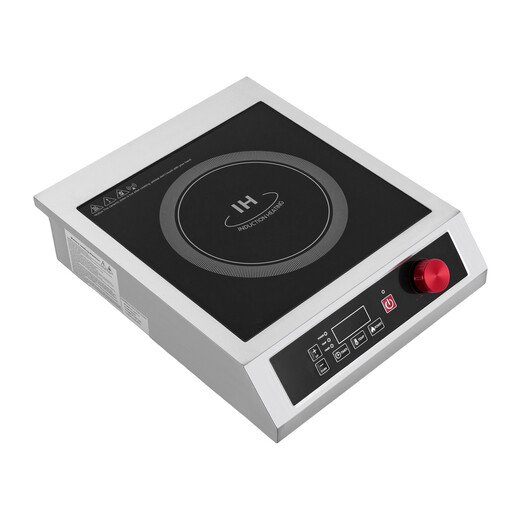 No image available
A worktop induction hob for one pan, provided your cookware and available space meet the product specifications.
3.500 W; 10 power settings; timer; EU plug.
The product description specifies flat-bottomed cookware up to 9,84 inches.
Only if the pan base is induction-compatible and its dimensions suit the specific appliance. Rommelsbacher requires a ferromagnetic base for the CT 2020/IN; CASO specifies a diameter of 12–24 cm and a maximum load of 6 kg for the Touch 2000.
No. The LECKER recipe calls for 30–60 minutes over a low heat, with the occasional stir. Keep an eye on the consistency; an appliance display does not measure the temperature of the chutney.
Compare the appliance’s full dimensions with the available space, and leave room for the pan handle and stirring. A cast-iron or radiant hot plate should cool down before cleaning and putting away. The residual heat indicator on the Rommelsbacher CT 2200/E shows when the surface is still hot.
No. Ceramic glass describes the surface, not the heating method. According to the manufacturer, the Rommelsbacher CT 2200/E uses a HiLight radiant heating element, while the CT 2020/IN uses induction and requires a ferromagnetic pan base.
No. The German Federal Institute for Risk Assessment warns of the risks of preserving food incorrectly. The hot plate’s power does not establish a safe preserving method or storage life for a particular recipe. Check preservation separately, using a suitable method for the ingredients you’re using.