Guests making individual portions of soup
For people who prepare one bowl at a time in a holiday home and want to select the amount of water directly on the appliance.


A hot water dispenser may be worth it if you regularly make individual portions of soup in your holiday home and can choose a suitable serving size. If you only use it occasionally, your existing kettle may be enough. You should also consider the height of your cup or bowl, the space it takes up, and how much cleaning and descaling it requires.
For people who prepare one bowl at a time in a holiday home and want to select the amount of water directly on the appliance.
If you need to make several portions one after another, the tank capacity, how often it needs refilling and the space beneath the outlet are important things to consider.
If you only make instant soup now and then, first check whether your existing kettle can provide enough water.
A good choice if: You regularly fill individual bowls and one of the appliance's settings matches the amount of water specified on the soup packaging.
The trade-off: It takes up space and needs a tank and regular care. The temperature setting does not tell you what temperature the prepared soup will reach.
A good choice if: You only make soup occasionally and your existing kettle can hold and pour the amount of water you need.
The trade-off: You need to measure the amount yourself and control it as you pour. The Verbraucherzentrale recommends boiling only the amount of water you actually need.
If you make instant soup in a holiday home, these are the main things to consider.
| Consideration | What to check when buying | Who will find this especially important? |
|---|---|---|
| Water per portion | Compare the dispensing settings with the amount specified on the packaging, and measure the height of your cup or bowl beneath the outlet. | When I make a bowl of soup, I want the amount dispensed to suit both the packaging instructions and my container. Around 40% of consumers prioritise getting the right amount for a single portion. |
| Several portions | Choose the tank capacity and appliance dimensions to suit the number of portions you plan to make and the space available. | When I have several guests, I want to serve a few bowls without having to refill the tank constantly. Around 30% of consumers prioritise tank capacity and fewer refills. |
| Occasional use | First check whether your existing kettle can heat and pour the amount you need conveniently. | If I only eat soup now and then, I don't want to buy another appliance if my kettle is up to the job. Around 20% of consumers prioritise avoiding an unnecessary appliance. |
| Care and water | Consider cleaning, descaling and, where applicable, filter maintenance. The Umweltbundesamt advises against using tap water for food or drinks if it has been sitting in the plumbing for more than four hours. | If the holiday home has been empty for a while, I want to keep on top of tank care and using fresh water. Around 10% of consumers prioritise maintenance and how to handle water after it has been standing. |
The tank capacity tells you how much water the appliance holds, not how much comes out at the touch of a button. Even a large tank may not have a dispensing setting that suits your soup.
Compare the appliance's settings with the amount stated on the soup packaging, and measure tall cups before you buy. CASO gives the HW 660's clearance beneath the outlet as around 15.9 cm with the drip tray in place; check the height for the specific model you're considering.
The product specifications don't establish a general energy advantage for a hot water dispenser over a kettle. The Verbraucherzentrale also recommends filling a kettle with only the amount of water you need.
If you only make soup occasionally, first check whether your existing kettle is enough rather than assuming you'll save energy or money.
A filter may need additional care and doesn't replace the need to handle water properly. The Umweltbundesamt recommends not using tap water for food or drinks if it has been sitting in the plumbing for more than four hours.
Follow the care instructions for the specific appliance and use fresh tap water after a long period of disuse.
The HW 660 is designed for selectable single portions and occasional use with larger containers; CASO also specifies continuous dispensing.
For the ADD5910M/10, Philips lists several preset dispensing volumes and temperature settings.
The PC-HWS 1168 is a freestanding model with a freely selectable dispensing volume.
According to the manufacturer, the HW400's 4-l tank makes it suitable for situations where you need to serve several portions one after another.
This selection includes countertop and freestanding hot water dispensers. When choosing, consider whether the portion sizes suit your needs, how much space you have and whether a water container is included.
 No image available
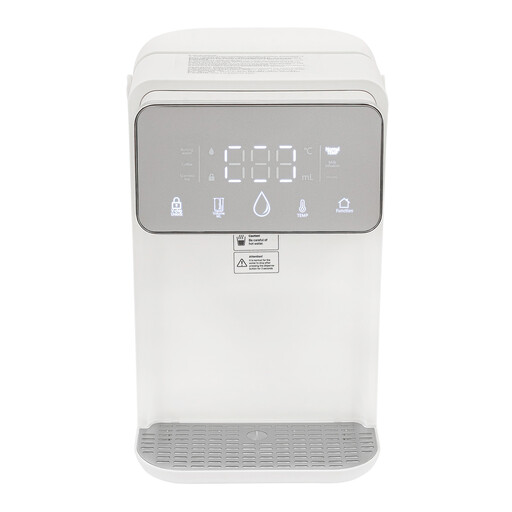
The removable tank may be useful when making several portions one after another.
The description lists a 3.5-l tank, adjustable water dispensing and temperature control. A grounded EU socket with 220 V/50 Hz is required for operation.
 No image available
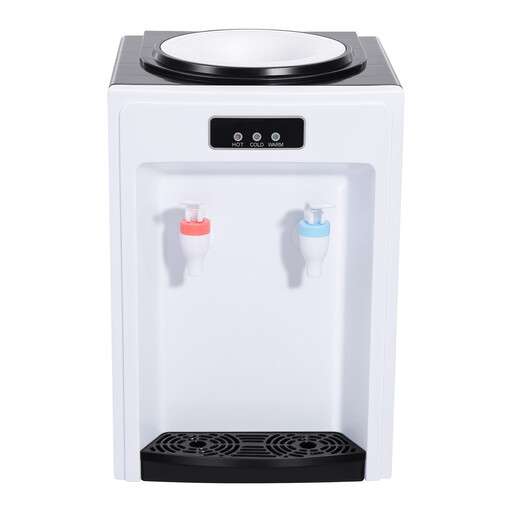
This countertop appliance dispenses hot and cold water. Before buying, check that the water containers you need are compatible with it.
The description lists a heating temperature of at least 90 °C and compatibility with containers from 4.5 to 18.9 l. A water container is not included.
 No image available
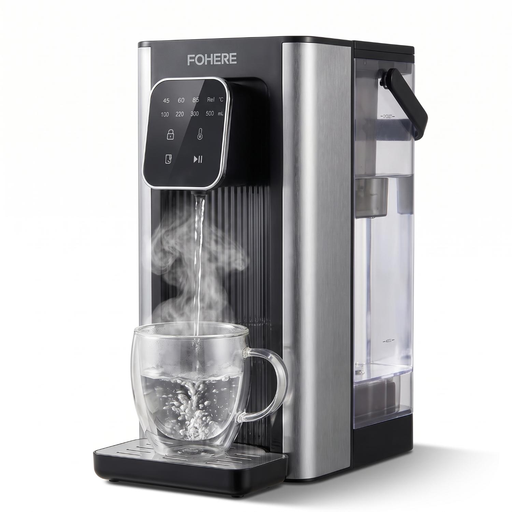
The selectable temperature settings may be useful when matching the water to the preparation instructions. Check that the appliance's settings suit how you plan to use it.
Specifications include four temperature settings from 45 to 100 °C, a 2.5-l tank, a filter and a child lock. The description states that a grounded EU socket with 220 V/50 Hz is required.
 No image available
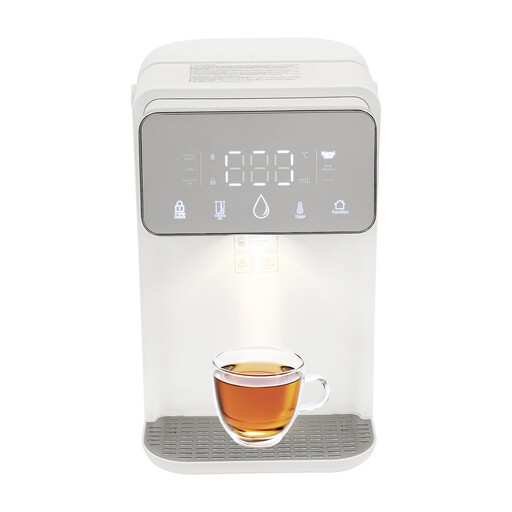
The adjustable dispensing volume of 150 to 500 ml can be matched to the amount of water stated on the soup packaging.
The title lists 2,000 W, a digital display, temperature selection from 25 to 99 °C and a night light. The description specifies an EU plug with 220 V/50 Hz.
 No image available
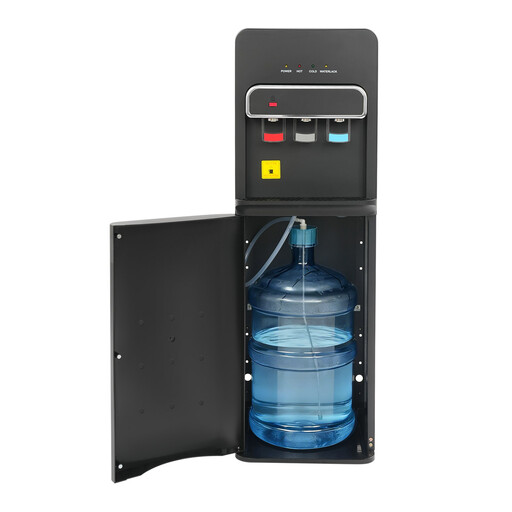
This freestanding model may be an option for several people; consider how much space it takes up compared with a countertop appliance.
The hot water outlet is specified at 85 to 95 °C. The title lists a heating output of 550 W and a cooling output of 75 W; the description also mentions a child lock on the hot water outlet and boil-dry protection.
Follow the preparation instructions on the packaging of the soup you're making. Compare the stated amount of water with the appliance's dispensing settings; the temperature setting on the dispenser doesn't measure the temperature of the prepared soup.
The Umweltbundesamt advises against using tap water for food or drinks if it has been sitting in the plumbing for more than four hours. Run fresh water first, then clean and fill the appliance's tank according to the instructions for your particular model.
Follow the instructions for your specific model and take the local water hardness into account. The Verbraucherzentrale recommends descaling kettles and coffee machines regularly; CASO lists a descaling reminder for the HW 660.
If an appliance is faulty, your statutory warranty claims are against the seller; this is separate from any manufacturer's guarantee. In Germany, online purchases are generally covered by a 14-day right of withdrawal from the date you receive the goods. You must notify the retailer that you wish to exercise this right.
The EU lists product groups for which CE marking is compulsory; whether a particular appliance needs it depends on the applicable requirements. The manufacturer is responsible for the declaration of conformity. CE is not a general, independent quality mark.