A cup a day
If you usually make just one cup for your tea break, a suitable serving size and ease of everyday use may be important to you.


A hot water dispenser may be worth considering if you regularly make single cups and want to choose a temperature and serving size to suit your tea. For the occasional cup, your existing kettle may be all you need. For herbal and fruit teas, the German Federal Institute for Risk Assessment (BfR) recommends using freshly boiled, bubbling water. A displayed temperature of 100 °C alone does not prove that the water reaches a full, rolling boil before it is poured over the tea.
If you usually make just one cup for your tea break, a suitable serving size and ease of everyday use may be important to you.
If you want to choose a different temperature for each type of tea, check the appliance settings against the instructions on the packaging. For herbal and fruit teas, safe preparation takes priority over a lower temperature.
When making tea for several people, consider the tank capacity, the amount dispensed each time you use the controls and the space available on your worktop.
| What matters to you | What to look for | Who is this important for? |
|---|---|---|
| Temperature for different teas | Check the temperature settings against the tea packaging; for herbal and fruit teas, follow the BfR recommendation to use freshly boiled, bubbling water. | If I switch between types of tea, I want to be able to choose the brewing temperature. Around 33% of consumers say choosing the right temperature for their tea is their top priority. |
| A suitable single serving | Check the available water volumes, spout clearance and whether you can stop the flow. Philips lists preset volumes from 150 ml for the ADD5910M/10; CASO lists seven settings from 100 to 400 ml for the HW 770 Advanced, as well as continuous dispensing. | If I’m making just one cup during a break, I want the serving size to suit my mug. Around 25% of consumers prioritise a suitable single serving. |
| Herbal and fruit teas | Follow the packaging instructions and check whether freshly boiled, bubbling water is reliably available; a nominal 100 °C setting alone does not prove this. The BfR recommends using freshly boiled, bubbling water for herbal tea. | When making herbal or fruit tea, I don’t want to compromise on preparation just to use a lower temperature. Around 17% of consumers prioritise a preparation method suited to these teas. |
| Several cups | Compare tank capacity, the maximum amount dispensed each time, appliance dimensions and clearance under the spout separately. For the HW 770 Advanced, CASO lists a 2.7-l tank and settings dispensing up to 400 ml, as well as continuous dispensing. | If several people are having tea one after another, I don’t want to keep refilling the appliance. Around 17% of consumers focus on making several servings in succession. |
| Cleaning and ongoing costs | Check the cleaning instructions, whether the tank is removable and, for models with filters, whether replacement filters are needed. A portion-control function alone does not prove that the appliance saves energy. | If I’m buying an additional appliance, I want to keep cleaning effort and any ongoing costs manageable. Around 8% of consumers prioritise cleaning and ongoing costs. |
A 100 °C setting on an appliance does not, by itself, tell you what temperature the water actually reaches when poured over the tea. In its 2005 assessment, the BfR recommended using freshly boiled, bubbling water for herbal tea and leaving it to brew for at least five minutes.
Follow the packaging instructions and the BfR recommendation. If you cannot reliably ensure the dispenser provides freshly boiled, bubbling water, boil the water separately.
A large tank does not tell you how much water will go into your cup or teapot each time you use the controls.
Check the tank capacity, preset volumes and continuous dispensing separately. Also consider the clearance under the spout.
The German consumer advice centre recommends filling a kettle with only the amount of water you need. A dispenser’s portion-control function alone does not mean it will generally cost less to run than a kettle.
Weigh the convenience against how you actually use the appliance, and factor in possible filter and cleaning requirements for models with filters.
The Philips ADD5910M/10 is a filter-equipped dispenser that delivers water in portions and lets you choose the temperature. In its review dated 21 July 2026, F.A.Z. Kaufkompass named this model its favourite; this verdict applies to the model, not the brand as a whole.
The HW 770 Advanced combines adjustable temperature settings with preset and continuous dispensing options.
According to the manufacturer, the Design Quick Tea 42330 hot water dispenser is designed to let you choose the temperature and cup size.
According to the manufacturer, the PC-HWS 1168 offers adjustable temperature settings and lets you choose the amount of water dispensed.
The Smart Electric Hot Water Dispenser 5L, model MEK01-EU, specified for Germany may be worth considering if a larger stated capacity is your priority.
This selection includes appliances that dispense water in portions and models with larger water capacities, for making tea for one or several cups.
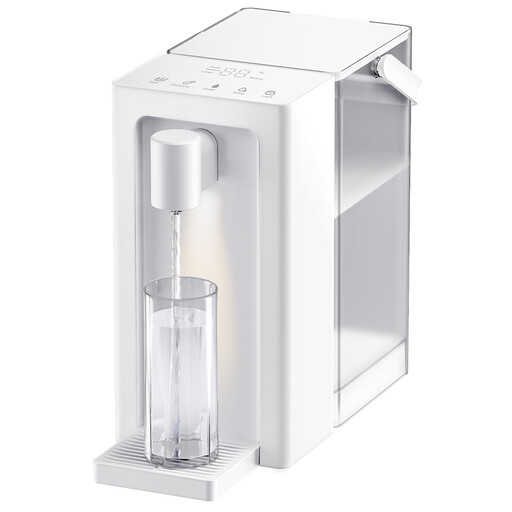 No image available
The selectable volumes may be useful for single cups and dispensing several servings in a row.
Listed features include a 3-l tank, removable tank, three selectable volumes of 200, 350 or 500 ml, and manual dispensing. The product title lists temperature settings from 25 to 100 °C and a memory function.
For herbal and fruit teas, a nominal temperature setting alone does not prove that the water is freshly boiled and bubbling when poured over the tea; follow the BfR recommendation.
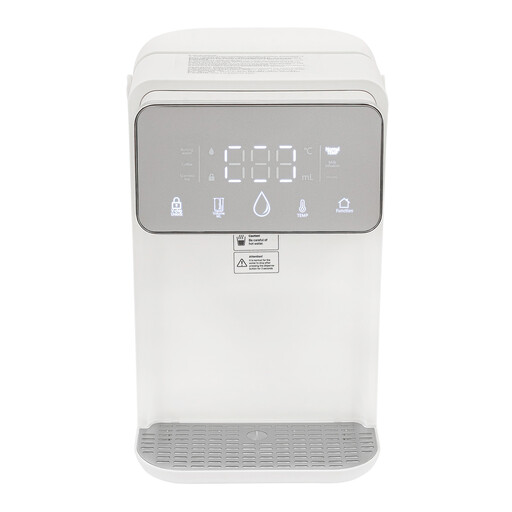 No image available
The stated tank capacity may be useful when making several servings in a row; you should also check how much water is dispensed each time.
The product description lists a capacity of 3.5 L, a removable tank, adjustable volumes from 5.28 to 17.6 fl oz and temperatures from 77 to 210 °F.
For herbal and fruit teas, the temperature shown on the appliance alone does not prove that the water is freshly boiled and bubbling when poured over the tea; follow the BfR recommendation.
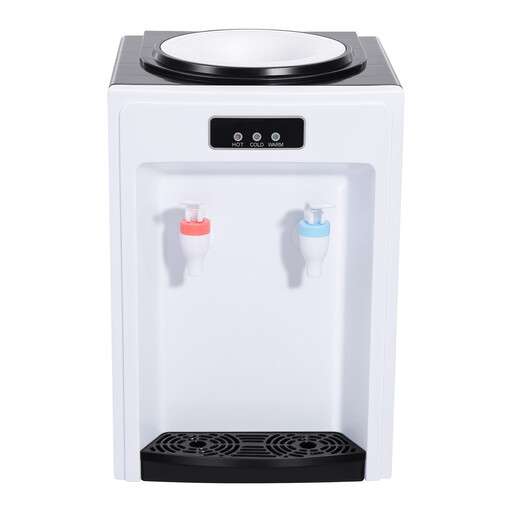 No image available
This appliance may suit your tea break if you want to use the hot water function described with a compatible water container.
The product description lists PP/304 stainless steel, a drip tray and compatibility with water containers from 4.5 to 18.9 L. The hot water function is stated to reach at least 90 °C, with 500 W heating power and 75 W cooling power.
A stated minimum temperature of 90 °C does not prove that herbal or fruit tea is brewed with freshly boiled, bubbling water. Follow the BfR recommendation.
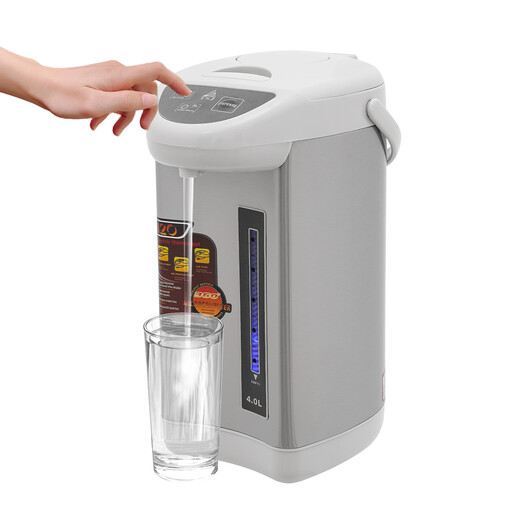 No image available
The larger capacity and dispensing options described may be useful when making several drinks in a row.
The product description lists a 4 L capacity and automatic, cup-detection and manual dispensing. The product title lists 750 W and stainless steel.
The product description does not prove that herbal or fruit tea is brewed with freshly boiled, bubbling water. Follow the BfR recommendation.
 No image available
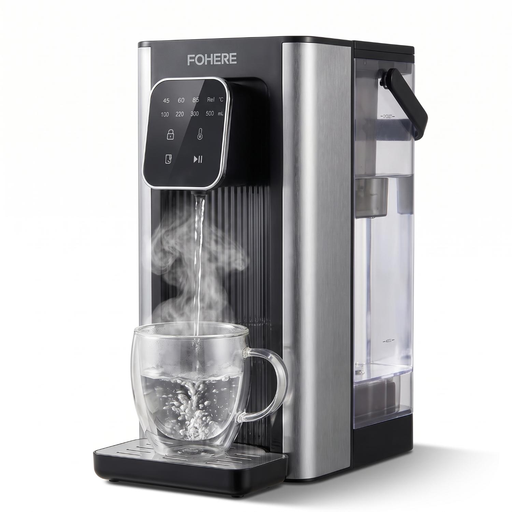
The selectable temperature settings may suit different drinks; check that each setting matches the instructions on the packaging.
The product description lists a removable 2.5-l tank, an integrated filter and four temperature settings, including 65 °C for green tea and 100 °C for black tea. The product title lists a child lock.
A nominal 100 °C setting alone does not prove that herbal or fruit tea is brewed with freshly boiled, bubbling water. Follow the BfR recommendation.
The BfR recommends using freshly boiled, bubbling water and leaving the tea to brew for at least five minutes; also follow the instructions on the tea packaging. The BfR’s 2005 assessment focused in particular on dispenser water at around 80 to 85 °C. A nominal 100 °C setting on a modern appliance does not, by itself, prove the actual brewing temperature.
Clean and descale the tank and water-bearing parts in accordance with the instructions for your specific model. CASO lists a removable tank and descaling reminder for the HW 770 Advanced; this does not establish a standard maintenance interval for other appliances.
No. When you buy as a consumer, your statutory rights are against the seller; a guarantee is an additional, voluntary benefit. The German consumer advice centre explains that if the seller puts things right by repairing or replacing the item, they must cover the necessary transport, labour and materials costs.
Electrical appliances covered by the EU Low Voltage Directive must meet the applicable electrical safety requirements; products covered by relevant EU harmonisation rules must carry the CE marking. The CE marking is the manufacturer’s declaration of conformity, not independent proof that a particular serving of tea has been heated in a hygienically suitable way.