If guests at your holiday home often want individual cups one after another, a hot water dispenser that serves water by the cup, with temperature selection and easy-to-access parts for cleaning, can be practical. If tea is only needed occasionally, a kettle may be enough. For herbal and fruit infusions, the German Federal Institute for Risk Assessment (BfR) recommends using freshly boiled water at a rolling boil. A dispenser setting labelled 100 °C does not prove that the water is boiling at the outlet.
Who are these appliances suitable for?
Hosts who offer herbal tea
If you offer guests herbal or fruit infusions, distinguish between choosing a temperature on the dispenser and preparing the drink correctly. The BfR advises against using temperature-controlled dispenser water for these infusions.
Hosts who serve tea frequently
If several guests want tea one after another, suitable serving sizes and a refillable tank are important. Details such as portion buttons and tank capacity can help you check whether an appliance meets your actual needs.
Hosts with changing occupancy
If the appliance is used irregularly, a removable tank and easy-to-access parts for cleaning can make maintenance simpler. Descaling and, where applicable, replacing the filter are also part of ongoing care.
What should you look for when buying?
For herbal and fruit infusions, the BfR recommends using freshly boiled water at a rolling boil. A 100 °C display on a dispenser does not prove that the water is boiling at the outlet.
| What matters |
What to check when buying |
Who is it most relevant to? |
| Preparing tea safely |
Check the tea varieties and instructions on the packaging. For herbal and fruit infusions, follow the BfR recommendation on using water at a rolling boil and observe the recommended steeping time. |
If I offer herbal or fruit infusions, I want to follow the recommended preparation method. Around 33% of consumers prioritise preparing tea correctly. |
| Serving lots of individual portions |
Compare the serving sizes with the cups you have, and take the tank capacity and available space into account. |
When several guests want tea one after another, I want a suitable portion size and as little refilling as possible. Around 27% of consumers prioritise serving lots of individual portions. |
| Temperature selection |
Check the available temperature settings against the preparation instructions for the teas you offer. |
If I offer different teas with different preparation instructions, I want to be able to set a suitable temperature. Around 20% of consumers prioritise temperature selection. |
| Easy maintenance |
Check whether the tank and drip tray can be removed, and find out what cleaning, descaling and filter-care instructions apply. |
When occupancy changes, I want to be able to look after the appliance easily between stays. Around 20% of consumers particularly value easy maintenance. |
Common misconceptions
-
Assuming a 100 °C display means the water is boiling vigorously
For herbal and fruit infusions, preparation is about more than taste. The BfR advises against making these infusions with temperature-controlled water from hot water dispensers.
Follow the BfR recommendation and the instructions on the packaging for these teas. Do not treat a dispenser’s temperature setting as proof that the water is boiling at the outlet.
-
Assuming a built-in filter automatically benefits your health
For health reasons, the German consumer advice centre generally considers additional treatment unnecessary for drinking water in Germany. However, an appliance filter may still be a maintenance part specified by the manufacturer.
Check the stated purpose of the filter, the replacement instructions and whether the correct replacement filter is available for the specific model.
-
Assuming it will use less electricity than any kettle
Different appliances and usage patterns cannot be compared fairly as a general rule on energy consumption without like-for-like conditions. The German consumer advice centre recommends filling a kettle with only the amount of water you actually need.
Choose based on how many cups you need and which features you will actually use in your holiday home.
Suitable brands and models to consider
Philips
The ADD5910M/10 is a portion-controlled dispenser with selectable temperatures.
- Philips lists six preset temperatures and portion buttons from 150 ml.
- These features do not change the BfR recommendation for herbal and fruit infusions: a temperature setting does not prove that the water is boiling at the outlet.
CASO Design
According to the manufacturer, the HW 660 offers selectable temperatures and serving sizes.
- CASO lists a removable 2,7-l tank, serving sizes of 100–400 ml and a descaling reminder.
- Remember to factor in the larger tank and water filter when considering space and maintenance.
Rommelsbacher
According to the manufacturer, the HWS 2500 offers a choice of temperature settings and portion sizes.
- The specifications list 13 temperature settings, a removable 2,7-l tank and a guided descaling programme.
- The replaceable filter means extra maintenance.
ProfiCook
The PC-HWS 1168 is a hot water dispenser with adjustable temperature and serving-size settings.
- ProfiCook lists a removable 2,2-l tank and a temperature range of 45–100 °C.
- The stated temperature range does not prove that the water is boiling at the outlet for herbal and fruit infusions.
Appliances for tea in your holiday home
This selection includes portion-controlled hot water dispensers for serving cups one after another, as well as kettles as an alternative way to prepare tea.
 No image available
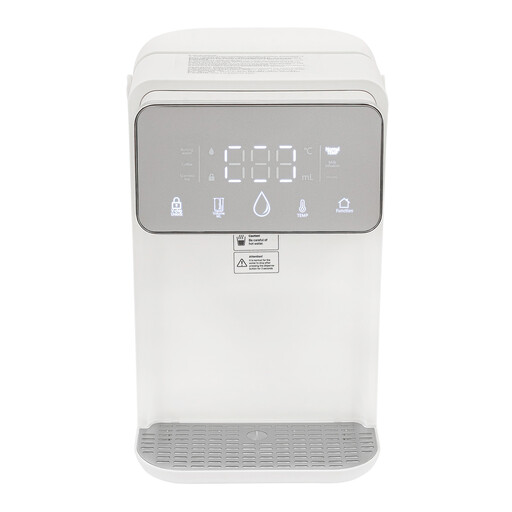
Countertop hot water dispenser, 3,5 l, digital display
If you’re making several drinks one after another, the adjustable serving size is worth considering.
The removable tank holds 3,5 l. A digital display and child lock are also listed.
View at Joybuy
 No image available
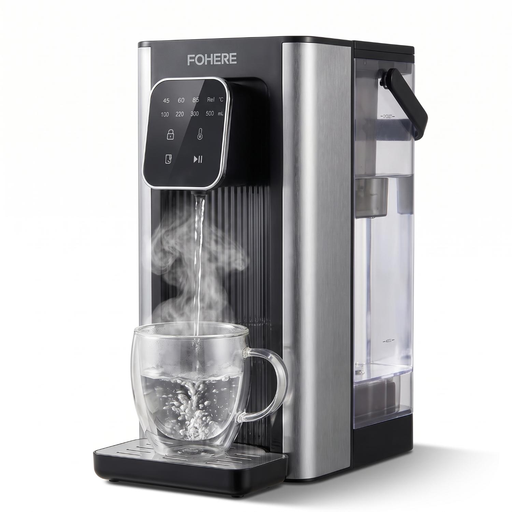
FOHERE hot water dispenser, 2,5 l, four temperature settings
The temperature settings and removable tank are useful for households with different drink preferences and several guests.
Listed features include 2.600 W, four temperature settings, a removable 2,5-l tank, a child lock and an integrated filter. Check the care instructions for the filter on this specific appliance.
View at Joybuy
 No image available
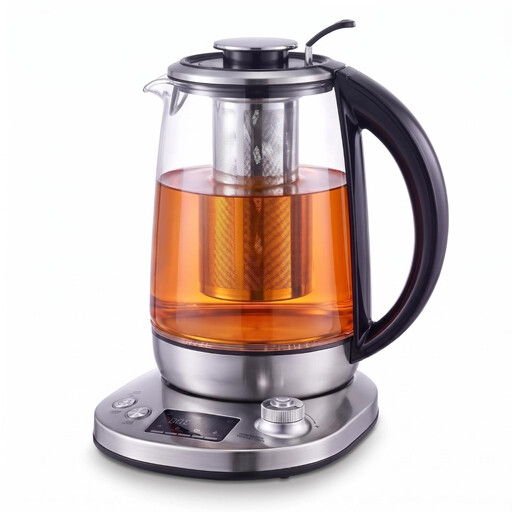
FOHERE glass kettle, 1,7 l, with tea infuser
As a kettle, this model is an alternative to a dispenser that serves water by the cup. You’ll need to refill and reboil the water for more individual servings.
Listed features include 2.200 W, temperature selection from 40–100 °C, a removable tea infuser and a two-hour keep-warm function.
View at Joybuy
 No image available
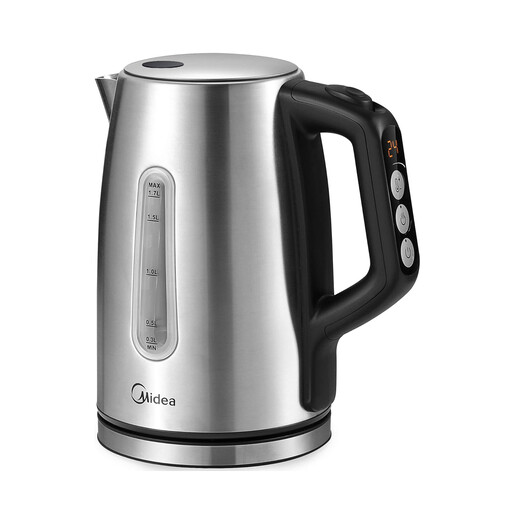
Midea stainless steel kettle, 1,7 l, six temperature settings
This kettle is an alternative if you don’t want to serve tea in several individual portions from a dispenser. You’ll need to refill and reheat the water for more servings.
The product name lists 2.200 W, 1,7 l, six temperature settings from 40–100 °C and a keep-warm function.
View at Joybuy
 No image available
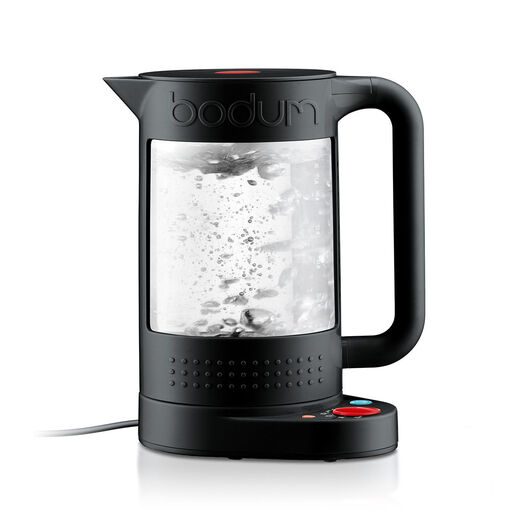
Bodum 11659-01EURO Bistro kettle, double-walled
The stated capacity may be useful for smaller quantities. You’ll need to refill and reheat the water for more individual servings.
The product description lists a 1,1-l capacity, five temperature settings from 60–100 °C and a keep-warm function.
View at Joybuy
Frequently asked questions
Can I use a dispenser’s 100 °C button to make herbal or fruit infusions?
No. The display alone does not prove that the water is boiling at the outlet. For herbal and fruit infusions, the BfR recommends using freshly boiled water at a rolling boil and following the stated steeping time. It advises against using temperature-controlled water from hot water dispensers for these infusions. If needed, use a kettle instead.
What should I do before making tea after the holiday home has been unused for a while?
Run off any water that has been sitting in little-used pipes. The German Environment Agency recommends this for dealing with stagnant water. Also clean the dispenser according to the instructions for the specific model and fill it with fresh water.
What ongoing costs and rights should I bear in mind when buying?
For appliances with replaceable filters, ongoing costs include buying the right replacement filters and following the appliance’s care instructions. If a product is faulty, you have statutory rights against the seller. The German consumer advice centre distinguishes these rights from a voluntary guarantee.
What labelling is relevant for a mains-powered dispenser in Germany?
Electrical equipment covered by the EU Low Voltage Directive must meet requirements including conformity assessment and CE marking. The voltage range covered is 50–1.000 V AC and 75–1.500 V DC. According to the German Federal Network Agency, the manufacturer affixes the CE marking under its own responsibility. It is not an independent quality assessment and does not prove a particular outlet temperature.


