
Lieferung heute & morgen

Qualitätsgarantie

Willkommens-Angebote freischalten: KOSTENLOSE Lieferung | Bis zu 80 % RABATT | Kostenlose 30-Tage-JoyPlus-Testphase
App herunterladen
A pair of household scissors belongs in many drawers, yet it is often chosen for its appearance rather than its intended use. Small scissors can be practical for opening packages, but they are unsuitable for cutting through several layers of fabric. Conversely, large kitchen scissors take up more space and may feel awkward during delicate craftwork.
Anyone looking to buy kitchen scissors, multipurpose scissors or utility scissors should therefore look beyond terms such as “extra sharp” or “multifunctional”. The key considerations are the blade material, blade length, handle design, care instructions and the materials that will be cut most frequently.
A pair of stainless-steel scissors is generally more resistant to corrosion than an unprotected steel model. However, the term does not automatically reveal the precise steel grade, hardness or cutting geometry. The following details are therefore also important for everyday use:
Micro-serration can provide a better grip on slippery materials. For exceptionally clean cuts in paper or fine fabrics, however, a smooth, precisely ground blade may be the better choice.
Household scissors with a bottle opener, nutcracker or screw-cap opener are versatile. These features are useful if kitchen-related tasks arise regularly. They do not, however, automatically make a pair of scissors the right choice for cutting textiles or cardboard.
Before buying, it should be clear whether the main focus is food, packaging, paper, fabric or general household tasks. For different applications, it may be more practical to use two purpose-built pairs of scissors rather than one overloaded combination model.
With dishwasher-safe scissors, cleaning is more convenient. Nevertheless, detergents, heat and prolonged exposure to moisture can place greater strain on the blades and joint. If the product description recommends hand washing, the scissors should be cleaned with a soft cloth and dried immediately.
With detachable models in particular, it is important to dry all parts thoroughly after cleaning and care for the joint according to the manufacturer’s instructions.
For precise work, compact scissors with a blade length of around 4 to 7 cm are often sufficient. An overall length of approximately 10 to 16 cm is easy to store and control. For fabric, cardboard or larger packages, models measuring around 20 to 23 cm provide greater leverage.
A longer blade is not automatically more practical: in smaller hands or when following tight cutting lines, a shorter model may offer better control.
Scissors used for paper and fabric should not subsequently be used to cut adhesive tape, wire or hard plastic components. Adhesive residue and excessive strain can impair the cutting edge.
Ergonomic scissors should sit securely in the hand without the fingers touching the blade or joint. Large, rounded finger holes make longer cutting sessions more comfortable. For occasional tasks, a lightweight model weighing 25 to 100 g may be sufficient; when working with heavier materials, a sturdier construction is often the more practical choice.
Left-handed users should look for a handle and blade configuration suitable for use with either hand. According to the product description, the Tefal Ice Force kitchen scissors feature an ambidextrous handle.
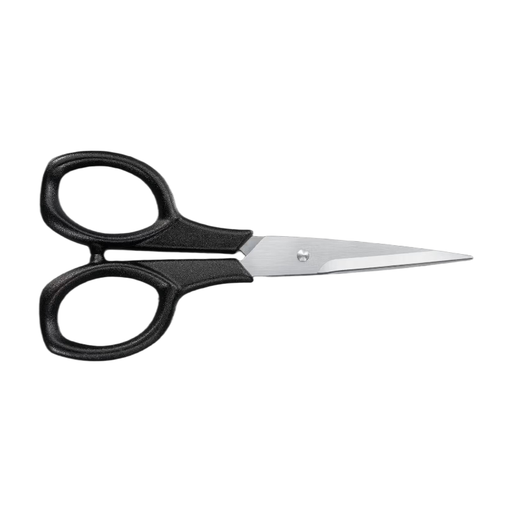
Why they suit this profile: This compact model is suitable for smaller cutting tasks around the home, packaging and office work.
The product data specifies a 4 cm stainless-steel blade, a low weight of 25 g and a polyamide handle. This makes light, controlled tasks easier.
According to the product details, they are detachable and dishwasher-safe; hand washing is recommended to protect the blade.
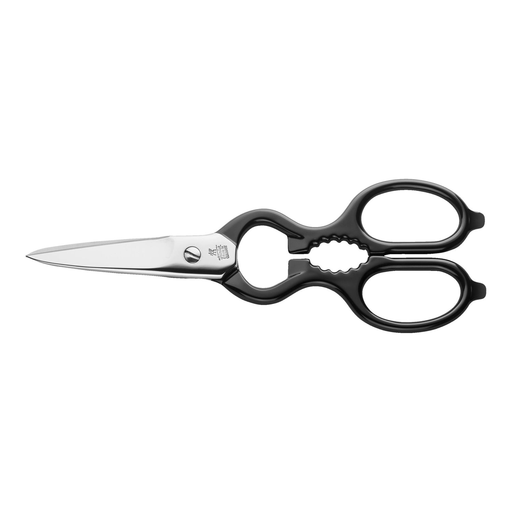
Why they suit this profile: For keen home cooks and households that want to use kitchen scissors beyond the kitchen.
The micro-serrated stainless-steel blades are designed to grip the material being cut and reduce slipping. The additional functions are clearly specified.
At 20 cm long, with an ergonomic handle and integrated bottle and jar opener, they are designed for a wide range of kitchen tasks.
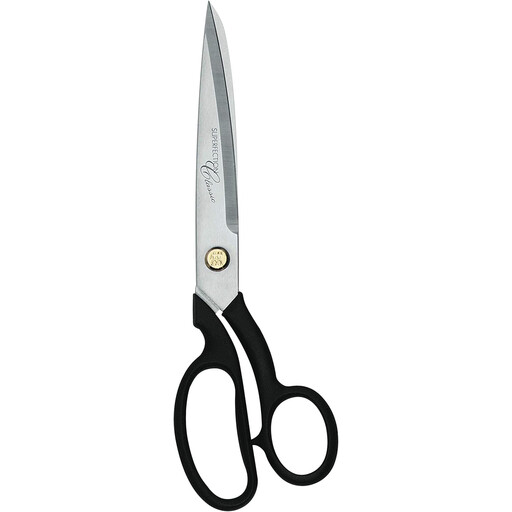
Why they suit this profile: A purpose-built choice for sewing enthusiasts who cut multiple layers of fabric, wool, paper or cardboard.
The 21 cm design is intended for longer cuts and is not described merely as a general-purpose pair of scissors.
According to the product description, the blades are made of stainless steel; the glass-fibre-reinforced plastic handle and precision screw support adjustment and a secure grip.
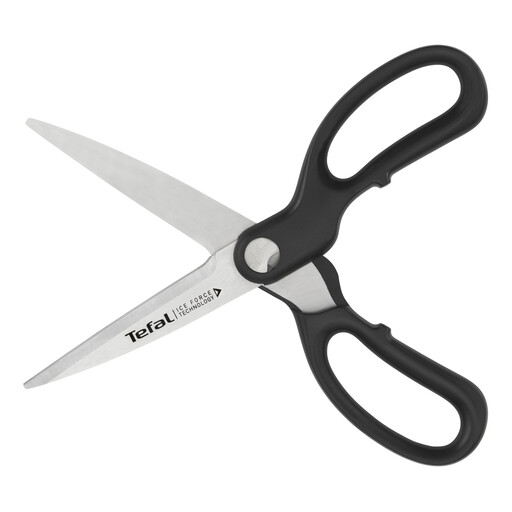
Why they suit this profile: For regular kitchen tasks where easy cleaning and ambidextrous use are important.
According to the product details, the blades can be removed. This allows more thorough cleaning than a permanently closed construction.
The product description lists blades made of German stainless steel, an ambidextrous handle and multifunctional use for cutting, trimming and chopping.
For multiple kitchen functions, the Tefal K12241 Fresh Kitchen 3-in-1 is also worth considering. According to the product details, it features a titanium-reinforced non-stick coating, a soft-touch handle, bottle opener and nutcracker. It is described as dishwasher-safe. Those who prefer classic Victorinox scissors may find a suitable option in the Victorinox Household Scissors “France”, 15 cm, made of forged, nickel-plated steel. According to the product data, it is not intended for dishwasher use.
For larger household tasks, ZWILLING models measuring between 20 and 23 cm are also available. Depending on the model, the Twin-Select and Twin-L series feature micro-serrated blades, stainless-steel blades, ergonomic handles and opener functions. The exact specification should be checked on the product page before purchase.
Our complete selection includes a range of models, materials, sizes and features for the home, kitchen, office and sewing projects.
A multipurpose pair of scissors measuring 18 to 20 cm, with a stainless-steel blade and micro-serration, can be suitable for herbs, packaging and light kitchen tasks. For food use, the scissors should be expressly approved by the manufacturer for contact with food.
Their service life depends on the material, cutting volume, care and intended use. Scissors generally remain functional for longer when they are not used on hard materials, stored dry and checked regularly for damaged or loose joints.
They can reduce the effort involved in cleaning. For the gentlest possible care, however, hand washing followed by thorough drying is often preferable. The manufacturer’s instructions are decisive, as coatings, handle materials and joint designs vary.