
Lieferung heute & morgen

Qualitätsgarantie

Willkommens-Angebote freischalten: KOSTENLOSE Lieferung | Bis zu 80 % RABATT | Kostenlose 30-Tage-JoyPlus-Testphase
App herunterladen
A toaster is part of the everyday kitchen setup in many households. Yet the wide selection can quickly lead to unsuitable purchases: a compact appliance may be enough for one person, while families often wait unnecessarily long when the toaster can only handle two slices per cycle. Different types of bread, frozen bread and bread rolls also come with different requirements.
This buying guide from the Joybuy Product Recommendation Officer provides an objective overview of key product features and explains what to look for when choosing a toaster in 2026.
Power consumption is measured in watts. A 1,600 W toaster can brown toast in a suitable amount of time, but it uses more energy over the same operating period than a 750 or 850 W model. The wattage alone also says nothing about how evenly the heating elements are distributed.
The important factor is therefore the combination of power, slot size, centring function and adjustable browning level. For a two-person household, a 2-slice toaster with 750 to 850 W may be sufficient. Families are more likely to benefit from a 4-slice toaster or a long-slot toaster.
Standard toast, thick farmhouse bread, bagels and croissants do not require the same design. A standard slot may be too narrow for thicker slices. For this reason, check the specified internal dimensions.
A wide-slot toaster with slots approximately 40 mm wide is more practical for thick slices, bagels or toast rolls. A long-slot toaster, on the other hand, can accommodate several elongated slices or up to four smaller slices of toast, depending on the model. For baked goods with icing, fillings or ingredients that may drip heavily, follow the operating instructions.
Defrost, reheat and cancel functions are useful in everyday use. However, they do not prevent breadcrumbs from falling into the appliance. A toaster with a removable crumb tray makes regular cleaning easier and helps reduce crumb build-up beneath the appliance.
An integrated or removable bun warmer is practical when you want to warm bread rolls, croissants or smaller baked goods. It should be allowed to cool after use and cleaned according to the manufacturer’s instructions.
Also check the space available on your worktop. A longer appliance needs not only sufficient counter space, but also clearance from walls, curtains and other heat-sensitive objects.
A toaster with an adjustable browning level allows you to adapt the results to different types of bread and personal preferences. Six or seven settings offer finer control than a model with only a few options. However, the scale is not directly comparable across all manufacturers.
Automatic bread centring keeps the slice closer to the heating elements. This can help produce more even browning. With particularly thick or irregularly cut bread, the actual distribution will still depend on the shape of the slice.
The defrost function is designed for frozen bread, while the reheat function warms slices that have already been toasted and cooled without starting a complete toasting cycle. A cancel button allows you to stop the process early.
Look for:
Never use knives, forks or other metal objects to remove bread that has become stuck. Unplug the appliance first and allow it to cool down. A toaster must never be immersed in water and should be disconnected from the mains before cleaning.
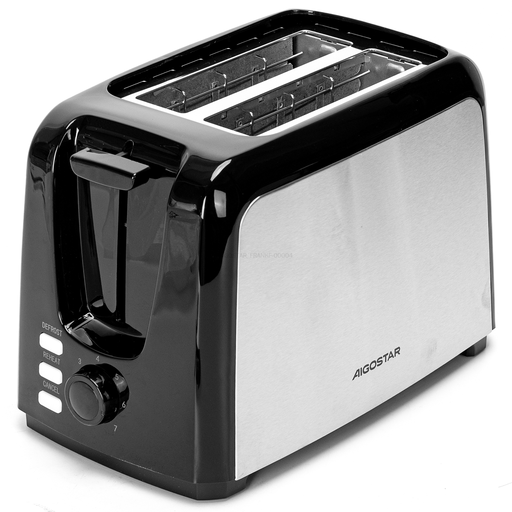
Why is this model a good fit? This 750 W toaster is designed for two slices and offers seven browning levels for everyday use in smaller households.
The seven settings, defrost, reheat and cancel functions cover key everyday needs without requiring the larger design of a 4-slice toaster.
750 W, two slots, seven browning levels, removable crumb tray and cable storage on the base.
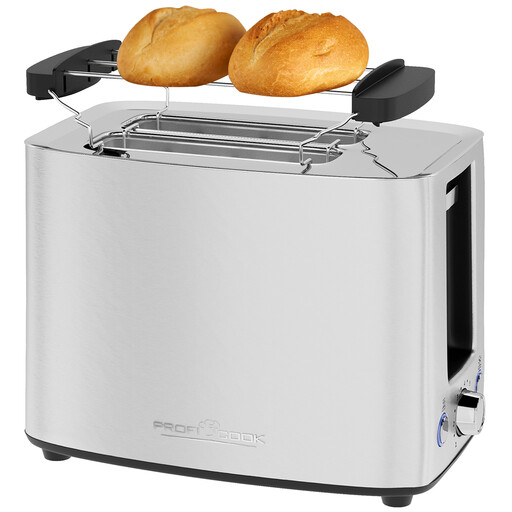
Why is this model a good fit? The 40 mm-wide slots are designed for bagels, thicker slices of toast and toast rolls. The removable bun warmer expands its versatility.
The slot width is specified precisely as 40 mm. This makes it easier to check before buying whether your preferred bread size will fit.
Stainless steel housing, continuously adjustable browning control, defrost and reheat functions, crumb tray, plus automatic and manual shut-off.
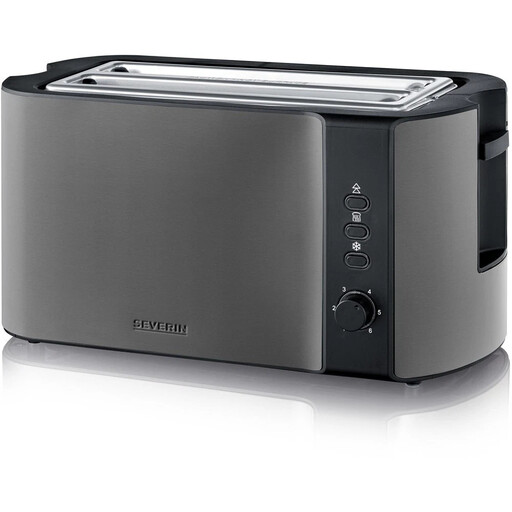
Why is this model a good fit? According to the product specifications, the two long toast slots can accommodate up to four slices. This is practical for several people who have breakfast at around the same time.
The capacity is clearly stated. A bun warmer, defrost and reheat functions are also integrated, eliminating the need for separate accessories.
1,400 W, stainless steel housing, automatic bread centring, two long slots and removable crumb tray.
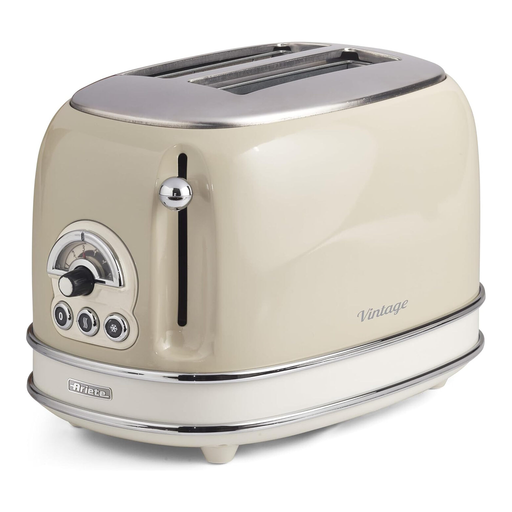
Why is this model a good fit? The beige retro design is aimed at buyers who want to coordinate a visible kitchen appliance with their interior style.
In addition to its appearance, the specifications include six browning levels, bread centring, defrost and reheat functions, as well as a crumb tray.
Two slices, 810 W, six adjustable settings, removable crumb tray and integrated cable storage.
According to the product specifications, the Ariete Vintage 156 4-slice toaster features two separate control units, six browning levels on each and a power output of 1,600 W. This allows two pairs of slices to be toasted at different settings. Before buying, check that you have enough counter space for its dimensions of 31.9 × 28.9 × 20.5 cm.
The current selection includes additional toasters and designer stainless steel toasters with different capacities, features and designs for households.
Depending on the design, around 700 to 1,000 W is common for a 2-slice toaster. A 4-slice toaster often requires more power because it supplies multiple heating zones. Wattage should be considered alongside capacity, slot size and intended use.
It is not possible to give a reliable standard lifespan for every model. This depends on factors including frequency of use, cleaning, storage and build quality. Remove crumbs regularly, unplug the appliance after use and operate it only as described in the instructions. If the cable or housing is damaged, stop using the toaster.
For example, an 800 W appliance running for three minutes uses approximately 0.04 kWh in theory. The actual cost depends on your electricity tariff and how long you use the appliance. Higher wattage can affect heating time, but longer or more frequent use also results in higher consumption.