What should you look for when choosing?
First, describe the task, parts and handover points. Then decide whether the pilot involves development work of your own, movement between locations or a test with people sharing the work area.
| Consideration |
What to look for when buying |
Who it matters most to |
| Task suitability |
Define the parts, handover points and success criteria; check the gripper and hand configuration of the variant on offer. |
If I want the robot to pick up specific parts and place them in a defined location, I need a suitable end effector rather than a general movement demo. Around 26% of consumers put task suitability first. |
| Safety measures |
Include the movement zone, people’s routes, tools and moving parts in the assessment; plan for separation or technical safeguards. |
For a test in a shared work area, I want to know how people will be protected from potential collisions. Safety measures are the top priority for around 26% of consumers. |
| Integration |
Check the required data, control permissions and interfaces against the exact variant on offer. |
If my team wants to integrate its own sensors, movement or controls, access to the required interfaces must be confirmed. Integration is the most important consideration for around 21% of consumers. |
| Mobility |
Check the route, floor, handovers and movement zone; establish whether the pilot is intended to assess wheeled travel or bipedal walking. |
For a workflow between stations, I want to trial the actual route and handovers, not just movement in a fixed location. Around 16% of consumers prioritise mobility. |
| After-sales requirements |
Ask for an itemised breakdown of the variant, gripper, integration, training and maintenance for the same pilot scope. |
If my project team needs to plan configuration and support, I want to define the services required in advance. After-sales requirements are a priority for around 11% of consumers. |
Suitable product variants on Joybuy
The Joybuy offers below are Unitree R1 variants with different specifications for degrees of freedom and cameras. Product details alone do not prove that a model is suitable for a manufacturing workplace; check the configuration, safeguards and intended use before starting a pilot.
 No image available
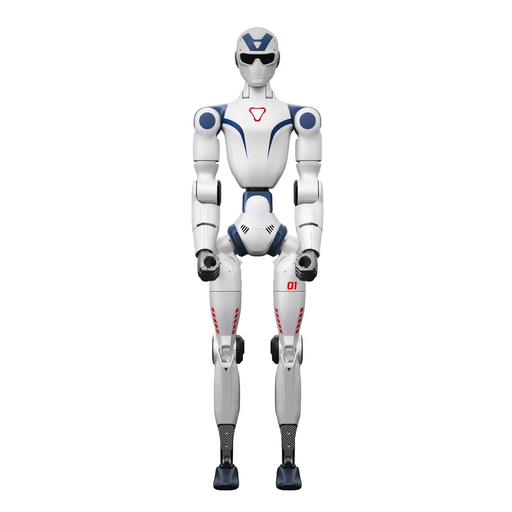
Unitree R1 – 26 degrees of freedom, dual cameras, blue and white
May be worth considering for a defined movement and perception test; the product details do not demonstrate suitability for your specific manufacturing workflow.
Product title specifies 26 degrees of freedom and dual cameras. Connections listed include Ethernet, Wi-Fi 6 and Bluetooth 5.2.
The product description warns that the robot can exert considerable force and move at speed, and requires sufficient clear space. Children should not operate it unsupervised.
View on Joybuy
 No image available
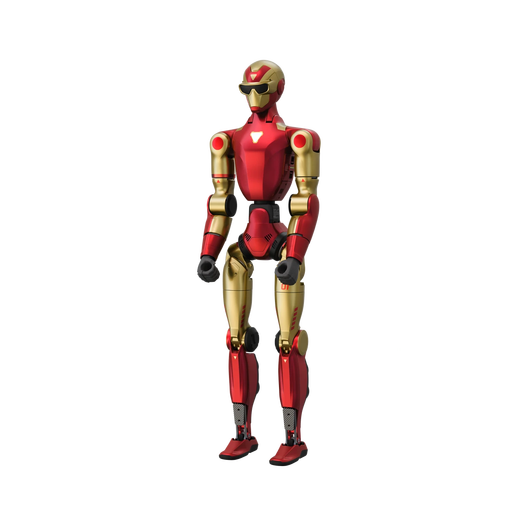
Unitree R1 Air – 20 degrees of freedom, monocular camera, red and gold
May be worth considering for a defined movement and perception test; check in advance whether this variant meets the requirements of your pilot workflow.
Product title specifies 20 degrees of freedom and a monocular camera.
The product description warns against stairs, edges and uneven surfaces, as well as the risk of trapping at moving joints. It also describes the device as not waterproof and unsuitable for high humidity.
View on Joybuy
Frequently asked questions
Is CE marking enough to approve our pilot workplace?
No. Where CE marking is required, it must be affixed before a product is placed on the market under Section 7 of the ProdSG; however, it does not replace a workplace risk assessment. Under Section 3 of the BetrSichV, the employer must assess the risks of the specific use in advance.
Who assesses the risks when employees work directly with the robot?
For the collaborative use described, the DGUV advises that the robot manufacturer’s risk assessment must include the intended workplace. The employer must also assess the risks of using the robot at their own workplace; this may include the end effector and moving objects.
How do we start a development trial with the Unitree G1?
First, confirm which G1-EDU version, hand configuration and interfaces the trial requires. Unitree’s developer guide describes communication with an external Ubuntu PC over Ethernet and DDS, as well as a secure safety fixture for initial development work. This platform guidance does not constitute approval for use in a manufacturing workplace.
Does integrating a robot into an existing system automatically create a new machinery assembly?
No, this cannot be assumed in every case. For a case-by-case decision on whether a group of machines constitutes an assembly, the Federal Institute for Occupational Safety and Health (BAuA) refers to an interpretation paper with a flowchart. Before integration, clarify the specific combination and the responsibilities that follow.
When will the new EU Machinery Regulation apply to placing machinery on the market?
According to the BAuA, Regulation (EU) 2023/1230 will apply to the placing of machinery on the market from 20 January 2027. If you plan to procure or make a system available at a later date, check the legislation in force at that time and how the integrated system is classified.


