Choose a platform based on the purpose of your experiment. If you want to develop your own control systems, access to the SDK for the version you order is essential. For movement research, you’ll also need a suitable simulation workflow, while grasping experiments require the right hand to be included. Begin the competent risk assessment before selecting and purchasing equipment, as required by section 3 of the German Industrial Safety Regulation (BetrSichV). A supervised rental may allow you to run a short-term demonstration, but it does not automatically give you unrestricted access for development.
Who are humanoid research robots for?
Teaching labs with programming classes
Teaching teams need easy-to-follow development tools and repeatable exercises that students can carry out under supervision. Aalen University and Ostfalia University of Applied Sciences have reported on the use of humanoid robots in research and teaching.
Research groups studying movement and grasping
If you’re investigating your own control systems, simulation or manipulation, check the sensor access, joints and hand for the exact configuration. For example, ROBOTIS documents simulation workflows for the OP3, while Unitree Robotics publishes development information for G1-EDU variants.
Teams preparing for their first purchase
Lab operations and commissioning need to be organised before you buy. Under section 3 of the BetrSichV, the risk assessment must begin before equipment is selected and purchased, and it must be carried out or advised on by a competent person.
What should you consider when choosing one?
First, establish which development features and experiments your lab actually needs. Then plan the simulation, equipment and safe operation of that specific variant.
| Requirement |
What to check before buying |
Who needs this most? |
| Development access |
Check that the model and variant, SDK features, documentation and supported control levels match the offer. |
If we want to develop our own control projects, access must match the version we order. This is the main requirement for around 31% of consumers. |
| Simulation and transfer |
Check the simulator, ROS version, robot model and interfaces, as well as the process for testing on real hardware. |
For virtual movement trials before a supervised hardware test, we need a clear transition between the two. Simulation is the main requirement for around 25% of consumers. |
| Safe lab operation |
Begin the risk assessment with a competent person before purchasing, and assess the setup, safety measures and supervision needed in your specific space. |
If lab operation needs to be predictable and manageable, the room and safety measures matter just as much as the features. Safe lab operation is the main requirement for around 25% of consumers. |
| Hands and grasping functions |
Confirm the included hand, degrees of freedom, controllable functions and suitable simulation documentation for the variant on offer. |
For experiments involving objects, we need a suitable hand and the control system to go with it. Grasping experiments are the main priority for around 13% of consumers. |
| Commissioning and service |
Get the training, support route, RMA process, spare parts and delivery terms for the specific offer in writing. |
If our team needs help getting started or wants a short trial, supported commissioning is important. A supported start is the main requirement for around 6% of consumers. |
Common purchasing pitfalls
-
Assuming a standard G1 is the same as an EDU platform
Unitree Robotics distinguishes between the standard G1, which the manufacturer says does not support secondary development, and EDU versions with a documented SDK. The model name alone therefore doesn’t tell you which development features are included.
Make sure the full variant name and the interfaces you need are specified in the offer.
An unsuitable configuration could mean you have to buy again.
-
Assuming simulation results will transfer directly to real-world movement
Simulation tools provide a development workflow, but they don’t guarantee identical movements or that every programme can be run safely on real hardware.
Check that versions and states are compatible when moving to hardware, and plan controlled tests with suitable safety measures.
Adaptation, controlled testing and supervision can all add to the workload.
-
Booking a supervised demonstration as a freely programmable trial
A rental offer in Germany from TONEART stipulates that the robot can only be used with an operator and technical staff present. This does not mean students will have unrestricted access for development.
Before booking, get written confirmation of who is allowed to programme and operate the robot, and carry out experiments.
You may need a rental agreement with different terms or a purchase to run your own lab experiments.
-
Leaving repairs and spare parts until after you buy
Maintenance and RMA terms vary by supplier and model. Make sure spare-parts arrangements and responsibilities are right for the configuration you choose.
Before signing a contract, ask about model-specific parts, the repair process and who is responsible for what.
Depending on your agreement, you may face uncovered repair costs, shipping charges and downtime.
Key brands to consider
Unitree
G1-EDU variants are an option for teams carrying out their own bipedal research. Aalen University and Ostfalia University of Applied Sciences have reported on individual purchases of humanoid Unitree platforms for research and teaching.
- Unitree Robotics documents SDK2 and a range of EDU configurations.
- According to Unitree, the standard G1 does not support secondary development. Check the hands, support and spare-parts provision for the specific offer.
ROBOTIS
The OP3 is a compact, well-documented humanoid platform for teaching and research exercises.
- ROBOTIS and ROBOTIS Docs describe ROS support and simulation with Gazebo and Webots.
- This miniature platform is no substitute for experiments with human-sized hardware. Check the delivery and RMA terms for your specific purchase.
Booster Robotics
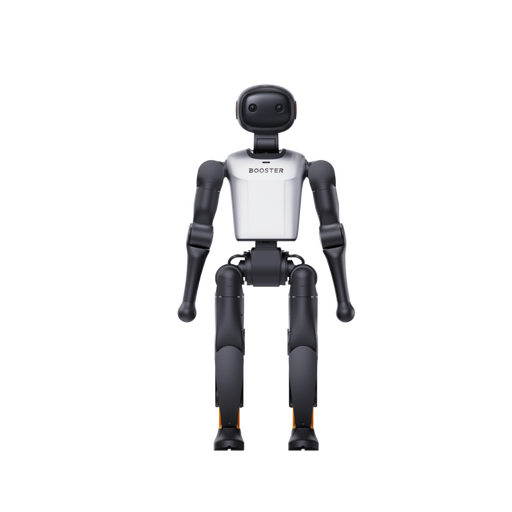
The T1 is aimed at teams looking to combine movement research with the manufacturer’s development and training tools.
- Booster Robotics publishes SDK and ROS2 resources, as well as tools for training and deployment.
- The published tools don’t specify which equipment or support is included with every T1 configuration.
PAL Robotics
TALOS is a large ROS-based research platform available on request.
- PAL Robotics gives TALOS’s height as 175 cm and its weight as 95 kg. The company also documents a simulation model.
- Its size and weight require careful planning for the setup and lab space. Equipment and support need to be agreed for each project.
Joybuy product selection
This selection focuses on an EDU platform for teaching and research projects that require development access.
 No image available
Booster Robotics K1 EDU Humanoid Robot
For teaching and research projects centred on your own programming; the product description lists software APIs and development tools.
The product title lists 22 DoF and 117 TOPS AI.
View at Joybuy
Frequently asked questions
Is a CE mark enough to use a robot in a university lab?
No. If the robot is used as work equipment, CE marking does not replace the employer’s risk assessment under section 3 of the BetrSichV. The assessment also takes the working environment and planned activities into account; it does not specify a universally applicable room size. The relevant legislation is published by the German Federal Ministry of Justice on “Gesetze im Internet”.
Will the new EU Machinery Regulation already apply in October 2026?
The Regulation (EU) 2023/1230 will apply to the placing of products on the market from 20 January 2027. The Federal Institute for Occupational Safety and Health states that the previous Machinery Directive will remain in force until 19 January 2027. You should check the documentation and classification of the specific product separately.
Can a standard Unitree G1 be programmed later like a G1 EDU?
Don’t assume it can: Unitree Robotics states that the standard G1 does not support secondary development and recommends the EDU version for modifications. Before ordering, check which SDK features are included with the variant on offer.
How can you combine simulation with tests on a real robot?
For the OP3, ROBOTIS describes Gazebo and Webots environments; the ROS and simulator versions you need must be compatible. Before testing movements on hardware, you should also follow the manufacturer’s instructions and take account of the risk assessment for your specific setup.
What should a lab agree on for repairs and ongoing costs?
For the exact variant, clarify spare parts, the RMA process, shipping, training and maintenance. ROBOTIS describes a parts replacement process for the OP3 using an RMA procedure, while Unitree Robotics sets out terms for maintenance and parts replacement. This does not mean all suppliers offer the same level of service.


