Movement control research team
Needs clearly documented access to the control systems and sensors on the specific version, rather than relying on pre-programmed demonstrations.


Choose a humanoid platform to suit the experiment you have in mind. If you want to run your own movement and control experiments, make sure the development access available for the specific version is clearly documented. For teaching, clear documentation and a suitable route from programming to testing on the robot matter just as much. If several groups only need hardware occasionally, first consider whether a shared laboratory platform could work. The European Union’s Your Europe portal explains that CE requirements depend on the product rules that apply in each case. For work equipment, a CE marking does not replace a risk assessment under § 3 BetrSichV.
Needs clearly documented access to the control systems and sensors on the specific version, rather than relying on pre-programmed demonstrations.
Needs clear programming documentation, a suitable learning environment and practical sessions on the physical robot that can be planned in advance.
Must coordinate access times, supervision and the operation of a shared platform before buying additional devices.
Suitable if: movement control, sensors or full-body experiments are part of your research. Unitree Robotics documents SDK interfaces for the G1 and R1; PAL Robotics describes TALOS as a configurable, ROS-based platform.
Trade-off: Features and access vary by version. Make sure the development scope and sensors are specified in the quotation.
Suitable if: repeatable exercises and student development projects are the priority. Booster Robotics describes K1 as a teaching and development platform and publishes SDK and ROS 2 resources.
Trade-off: A compact teaching platform cannot necessarily replicate experiments involving the dimensions and forces of a larger humanoid system.
Suitable if: several groups only need hardware from time to time, or the specific experiment has not yet been decided. Check whether supervised sessions and bookable access times are actually available.
Trade-off: Sharing requires agreed schedules and clear responsibilities, and does not provide unrestricted access for ad hoc experiments.
As well as your project goals, compare development access, teaching requirements, laboratory arrangements and the service conditions for the specific delivery.
| Requirement | What to check before buying | Who will find this particularly important? |
|---|---|---|
| Development access | Check the SDK, available control levels, sensor access, version identifier and documentation against the experiment you have planned. | If I want to test my own control or perception algorithms, I need access to the interfaces required to do so. Around 31% of consumers put development access first. |
| Programmable teaching | Check the developer documentation, supported software versions, simulation model and access rights for the specific version. | Clear instructions and a practical introduction using the robot are important for repeatable exercises with different groups of students. Around 22% of consumers prioritise programming exercises in teaching. |
| Safe laboratory operation | Plan the operating area, experiment procedure, user permissions and information for staff in relation to your site. | If I organise experiments using moving hardware, I need to plan protective measures for the laboratory and everyone involved. Around 22% of consumers focus above all on manageable operation. |
| Use by multiple groups | Agree booking arrangements, supervision, responsibilities and maintenance windows for shared use. | When projects change, I need clear rules about who can use the robot and when, and who can supervise experiments. Around 14% of consumers prioritise access across different groups. |
| Servicing and repairs | Get written confirmation of the repair process, who is responsible in Germany, parts availability, warranty terms and software maintenance. | If a long-term research project depends on the device, I want to understand the service conditions before placing an order. Around 11% of consumers prioritise predictable servicing and ongoing costs. |
Unitree Robotics documents different versions and development scopes for its G1 EDU configurations. A general product label therefore does not guarantee that every interface required for an experiment is included.
Include the full version identifier, available interfaces and required sensors in the quotation, and check them against your experiment plan.
Checking interfaces and sensors can involve additional integration work.
If employees use the robot as work equipment, a CE marking does not replace the risk assessment required under § 3 BetrSichV.
Before use, include the laboratory, the specific tasks and everyone involved in your assessment. Under § 12 BetrSichV, employees must receive appropriate information before using the equipment for the first time.
The institution must allow time for site-specific protective measures and staff instruction.
Terra Robotics stated that its Terra Research Program ran from 1 to 30 September 2026; that period has ended as of October 2026.
Only include delivery and service terms in your budget if the supplier has confirmed them to your institution in writing and they are still current.
G1 and R1 EDU versions for development projects; use of a G1 at Aalen University is documented.
K1 as a compact humanoid development and teaching platform.
TALOS for research using a large, ROS-based humanoid system; use at TU Darmstadt is documented.
The humanoid platforms below are intended for practical programming, development and research projects. Check that the specific version is suitable for your requirements.
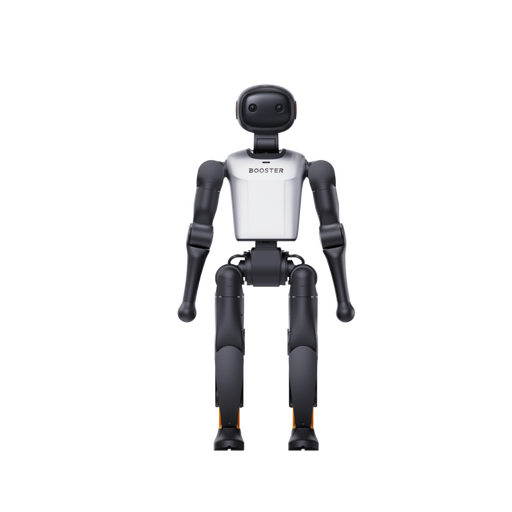 Image unavailable
For programming and development projects; check that the tools included meet the needs of your planned experiments.
Product specifications: 22 DoF and 48 TOPS AI.
Image unavailable
For practical teaching and research projects; check which APIs and development tools are included in the configuration on offer.
Product specifications: 22 DoF and 117 TOPS AI.
 Image unavailable
For projects exploring perception and AI interaction; check in advance that the research access you need is available.
Product specifications: 20 DoF and a monocular camera. The product description warns against operating the robot near stairs, edges or uneven surfaces, and against putting hands, hair or loose clothing near moving joints.
 Image unavailable
For development and teaching projects involving visual perception or interaction; check that the sensors you need match your experiment plan.
Product specifications: 26 DoF, dual cameras and 3D depth sensors. The product description advises keeping the area clear when starting the robot and during fast movements, and not forcing powered joints by hand.
Not on its own. CE marking is only required for products covered by applicable harmonised EU rules; you need to establish which requirements apply to the specific product. If employees use the robot as work equipment, CE marking does not exempt the employer from carrying out a risk assessment before use under § 3 BetrSichV.
Under § 3 BetrSichV, the employer must assess the risks associated with the intended use and identify suitable protective measures. The assessment should begin before selecting and purchasing the equipment. § 12 BetrSichV requires employees to be given information before using it for the first time. The specific measures will depend on the site and the task.
Yes, if the initial learning objective is to develop and test a model. Unitree Robotics publishes development documentation for G1 EDU versions; PAL Robotics documents ROS 2-integrated simulation environments for supported robots. Check that the specific version and software environment are supported; simulation does not replace validation on the physical robot.
Ask for a quotation covering repair responsibility, parts availability, shipping, software maintenance and service terms for the specific delivery. Unitree Robotics, Booster Robotics and PAL Robotics document support or ticketing channels, but this does not mean that prices or response times are standardised or guaranteed.
No. EUR-Lex gives 20 January 2027 as the date when Regulation (EU) 2023/1230 replaces Machinery Directive 2006/42/EC. The product rules that apply to a specific robot and its supply must be checked separately.