Hosts with opened hummus
If you’re preparing for a get-together, you’ll want to keep your opened dip chilled and covered until it’s time to serve. Always follow the storage and use-by guidance on the specific pack.


When storing opened hummus, make sure the fridge is actually cold enough and follow the storage and use-by guidance on your specific pack. The German Federal Institute for Risk Assessment recommends a temperature of 2 °C to no more than 7 °C for perishable foods. Check the temperature once your appliance is set up. Then choose fridge and freezer capacity to suit your usual food shop, and compare the appliance dimensions and annual energy consumption.
If you’re preparing for a get-together, you’ll want to keep your opened dip chilled and covered until it’s time to serve. Always follow the storage and use-by guidance on the specific pack.
If you need to chill other food and drinks alongside your dip, as well as store frozen food, choose fridge and freezer capacities that suit your day-to-day needs. Germany’s consumer advice centre recommends taking your storage requirements into account when choosing an appliance.
If space is tight, check the appliance’s external dimensions, door swing and, where necessary, installation clearances. Germany’s consumer advice centre also points out that appliance size affects energy consumption.
First, check the cooling performance and fridge capacity you need. Then consider energy consumption, available space and how much maintenance you’re happy to do.
| Priority | What to check before buying | Who it matters to |
|---|---|---|
| Keeping opened hummus chilled | Follow the instructions on the pack and measure the actual temperature once the appliance is set up. | If I want the dip to stay chilled until everyone sits down to eat, I check the temperature and the pack instructions. Around 33% of consumers put suitable cooling first. |
| Fridge space for a shared meal | Compare fridge and freezer capacity separately, and check that the shelves and compartments suit the food you usually store. | If you need room for food and drinks for several people as well as hummus, you’ll need enough fridge space. Around 27% of consumers prioritise shared storage space. |
| Ongoing energy consumption | Compare the stated annual energy consumption in kWh for appliances with similar usable capacity. | If I care more about ongoing energy use than extra features, I compare the kWh figure for the specific model. Around 20% of consumers prioritise running costs. |
| Available space and maintenance | Check the height, width, depth, door swing and required clearances. Compare NoFrost and LowFrost features on the specific model. | If you need an appliance to fit precisely and want to factor in maintenance, check its dimensions, door hinging and freezer technology. Around 20% of consumers prioritise kitchen fit and maintenance. |
Storage advice for after opening applies to the specific product and shouldn’t be assumed to apply to other packs.
Read the storage and use-by guidance on your hummus, and keep the dip chilled and covered until you’re ready to serve it.
Part of the stated total capacity is taken up by the freezer and isn’t available for chilled food.
Compare the capacity in litres of the fridge and freezer compartments separately, and check the internal layout.
The Siemens KG39EAICA is listed as a LowFrost model; Siemens does not describe it as frost-free. Bosch states that the KGN36VICT is frost-free.
Check the defrosting information for the exact model if low maintenance is important to your buying decision.
A LowFrost freezer may still need to be defrosted from time to time.
The EU energy label also shows annual energy consumption and capacity. Depth, door movement and required clearances may also affect where you can install the appliance.
Compare annual energy consumption for appliances of a suitable size, and measure the full space available before you buy.
The freestanding B3RCNO256XB could suit kitchens where a narrower appliance is a priority.
The freestanding KGN36VICT has separate fridge and freezer capacities and is described by the manufacturer as frost-free.
The KG39EAICA is an option if a larger stated fridge capacity matters more to you than frost-free operation.
The GBBS322CEV could suit a kitchen designed for an integrated appliance.
According to the manufacturer, the CBNdgc 5723 Plus combines freshness drawers with NoFrost for frozen food.
This selection includes freestanding fridge freezers with a range of fridge and freezer capacities, as well as an integrated appliance with a separate freezer compartment. Compare the dimensions and layout with your available space and storage needs.
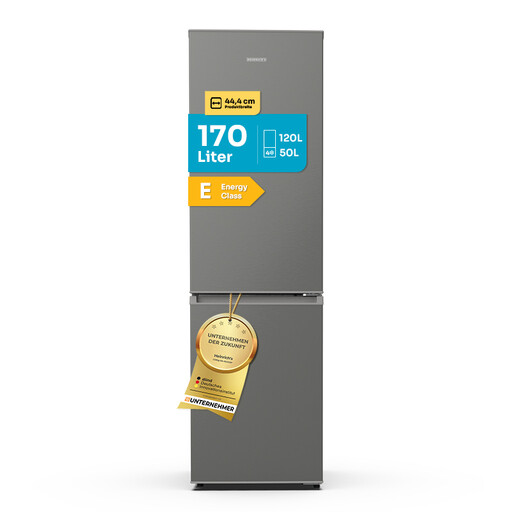 No image available
Fridge and freezer capacities are listed separately, so you can store chilled and frozen food in separate compartments.
Fridge: 120 l; freezer: 50 l; 4-star freezer compartment; adjustable temperature control; energy efficiency class E.
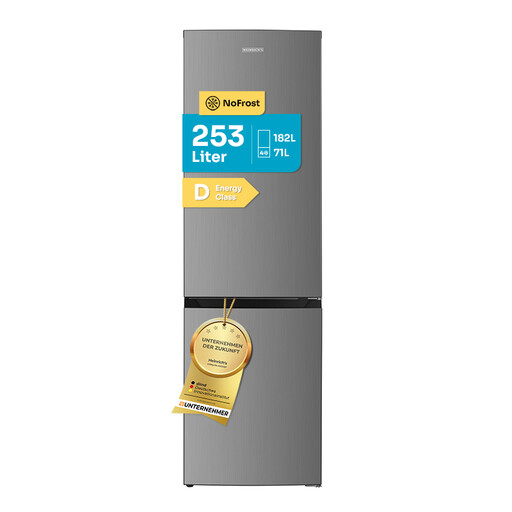 No image available
Both capacities are listed separately for households that need freezer space as well as room in the fridge.
Fridge: 182 l; freezer: 71 l; No Frost; reversible door; energy efficiency class not stated.
 No image available
The separate capacities make it easier to compare fridge space and freezer capacity with your storage needs.
Fridge: 121 l; freezer: 52 l; 124 kWh/year; width: 49.5 cm; height: 142.5 cm.
 No image available
Fridge and freezer capacities are listed separately for this model, which offers more space in both compartments.
Fridge: 262 l; freezer: 113 l; energy efficiency class A; 112 kWh/year; Total No Frost.
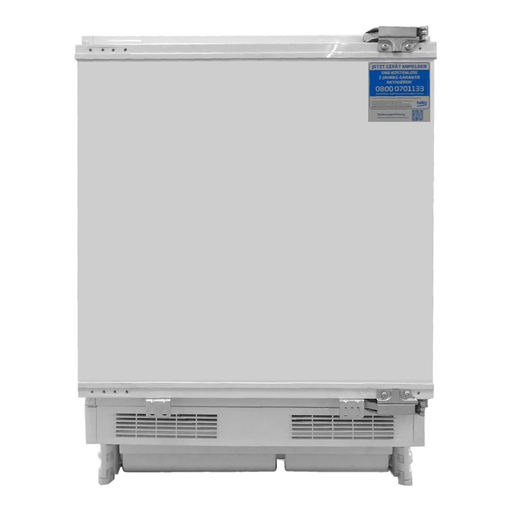 No image available
This integrated appliance could be suitable if you have a matching kitchen cabinet with a niche height of 88 cm.
Fridge: 92 l; freezer compartment: 15 l; energy efficiency class E; approximately 145 kWh/year; mechanical temperature control.
Follow the storage and use-by guidance on the pack of your specific product. Keep opened dip chilled and covered until you eat it. There’s no single time limit that applies to all hummus products.
No. Use a fridge thermometer to check the actual temperature. The German Federal Institute for Risk Assessment recommends a temperature of 2 °C to no more than 7 °C for perishable foods. Follow any different temperature guidance on the hummus pack for that product.
Compare the stated capacity in litres of the fridge and freezer compartments separately. The total capacity alone won’t tell you how much space is available for the chilled food you need for a meal with others.
Compare the kWh per year shown on the EU energy label for appliances with a suitable usable capacity. To work out your own running costs, multiply the annual energy consumption by your electricity price per kWh.
Check the information for the exact model: LowFrost isn’t the same as operation described as frost-free. Siemens lists the KG39EAICA as a LowFrost model, while Bosch states that the KGN36VICT is frost-free.