
Lieferung heute & morgen

Qualitätsgarantie

Willkommens-Angebote freischalten: KOSTENLOSE Lieferung | Bis zu 80 % RABATT | Kostenlose 30-Tage-JoyPlus-Testphase
App herunterladen
A wearable exoskeleton is designed to support movement without becoming an obstacle itself. When buying one, it’s not just about wattage or terms like AI exoskeleton. What really matters are fit, battery design, operation, usage limits and exactly what’s included in the box.
A high power output sounds impressive at first. But with a leg exoskeleton, the wattage alone doesn’t tell you how comfortable the system feels when walking or hiking. What’s also important are the support modes, the weight, how power is transferred, and whether you can adjust the assistance to suit the terrain and your pace.
For the Hypershell X Pro, the product specs mention 800 W output power and ten intelligent modes. These figures should not be taken as a medical or therapeutic guarantee. They describe technical product features and are no substitute for individual advice if you have any physical complaints.
The stated range of an exoskeleton depends on factors including body weight, incline, ground surface, support level and temperature. The advertised distance is therefore not a guaranteed figure for every outing.
The Hypershell X Pro is sold as an exoskeleton with a 17.5 km range. For longer distances, it’s also important to know whether a second battery is included and how it can be carried or charged.
A common buying mistake happens when customers only realise after ordering that a charger is missing. For the model described here, the product listing states that two batteries are included, but a charger is not supplied. Before buying, you should check what charging power is needed and whether you already have a compatible charger.
An exoskeleton for walking should be adaptable to different situations. A different setting may be suitable for flat paths compared to slopes, stairs or uneven hiking trails.
Look out for:
The term AI exoskeleton doesn’t automatically mean a specific level of safety or comfort. So ask exactly which functions are actually automated. For the Hypershell X Pro, an intelligent wearable with AI-powered support and ten modes is described. You should check the exact operation using the manufacturer’s instructions before use.
With an exoskeleton with two batteries, the second battery can make planning your outings easier. However, you shouldn’t simply double the runtime: the real-world range depends on the support level you choose and the conditions.
Practical points to check:
For UK buyers, information on CE marking, the instruction manual, the responsible person in the EU, and return or warranty conditions is also relevant. A CE mark is not a promise of a certain level of performance; it simply indicates compliance with the applicable conformity requirements.
An exoskeleton must sit securely on your body, but it shouldn’t unnecessarily restrict your movement. Before ordering, check the available sizes, straps, contact surfaces and whether it works with your clothing.
For your first use, we recommend:
An exoskeleton isn’t automatically suitable for every type of terrain. Wet rocks, steep paths, loose scree or dense undergrowth can create additional risks. The device should only be used in accordance with the instructions. If you have any health conditions, it’s a good idea to get medical or physiotherapy advice; the product is not intended as a medical treatment.
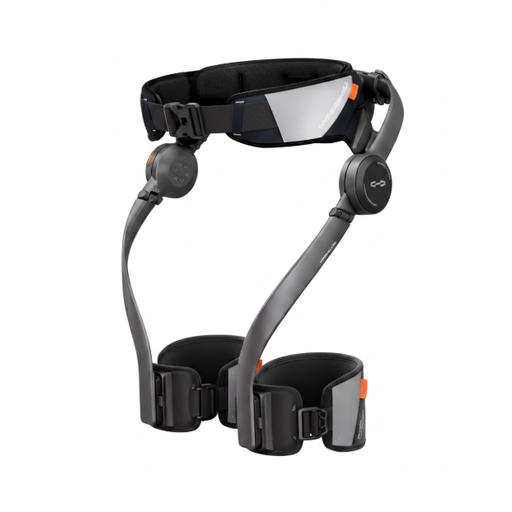
Why this product fits the profile: This model brings together the key details beginners need in one offer: leg support, ten intelligent modes and two batteries. However, before buying, you should check the charger, fit and usage limits.
The product name clearly states two batteries are included, while also pointing out that no charger is supplied. This means you can plan for the accessories you need before buying.
According to the product specs: 800 W output power, ten modes, two batteries and a stated range of 17.5 km.

Why this product fits the profile: As a complementary wearable, these headphones suit users who also value wireless communication and audio features while hiking. They are not a replacement for an exoskeleton.
The technical specs list battery life, IP57 protection, Bluetooth and charging options separately. This makes it easier to check whether the accessory suits your planned outdoor use.
According to the product specs: ANC, Bluetooth 6.1, IP57 and up to 30 hours total playback with charging case when ANC is off.

Why this product fits the profile: For hikers who want to document their trips, an action camera is a useful addition to an exoskeleton. However, it is a recording device, not a walking aid.
The features list the number of batteries, water resistance and recording time in detail. Buyers can therefore check accessory needs and usage conditions in advance.
According to the product specs: 4K recording, 1/1.3-inch sensor, 360-degree HorizonSteady and Adventure Combo with three batteries.
We’ve put together a full, regularly updated list of products that fully meet these strict selection criteria and the safety regulations in force in the EU.
According to the product name, two batteries are included, but a charger is not supplied. Check the required charging parameters before buying and plan to purchase a compatible charger separately.
The model is sold as an exoskeleton with a 17.5 km range. This figure should be understood as a product specification. The actual range may vary depending on the support mode, terrain, temperature, user weight and battery condition.
The Hypershell X Pro is sold as an exoskeleton for hiking, walking and daily activities. Before a trip, you should check the fit, battery level, weather conditions and the nature of the path. For challenging terrain, the instructions in the user manual apply; a technical walking aid is not a substitute for suitable footwear, safe route planning or individual medical advice.