
Lieferung heute & morgen

Qualitätsgarantie

Willkommens-Angebote freischalten: KOSTENLOSE Lieferung | Bis zu 80 % RABATT | Kostenlose 30-Tage-JoyPlus-Testphase
App herunterladen
An i-Size car seat needs to fit your child, your vehicle and your family’s daily routine. However, the label alone doesn’t tell you whether a model is suitable for every car or every stage of development. Mistakes often happen when parents focus only on the price, a swivel function or the longest possible period of use.
An i-Size car seat is based on the European safety standard UN R129. Depending on the model, different height ranges apply, for example 40–105 cm or 76–150 cm. This does not mean that every seat will fit in every vehicle. Before buying, you should check the ISOFIX anchor points, the space required, the position of the support leg and the vehicle manufacturer’s recommendations.
A 360° car seat makes it easier to get your child in and out. However, what really matters for safety is correct fitting, proper belt routing and the right travel direction. When using the seat rearward-facing, also known as a rear-facing car seat, you must ensure there is enough space between the seat and the front seat.
A growing car seat for the 40–150 cm range can cover several developmental stages. But the requirements change: a newborn needs different support to a school-age child. So check when inserts, impact shields or a 5-point harness need to be removed. A long period of use is only practical if the adjustment steps are clear and can be carried out correctly.
With i-Size, height is the key factor. A car seat from birth usually starts at 40 cm. Models from 76 cm are intended for children from around 15 months. A seat labelled car seat 15 months to 12 years is therefore not suitable for newborns, even if the age range at first glance suggests a broad span.
Examples of common ranges:
Look for the specific designation UN R129/03 or UN R129/04. In addition, the installation must be compatible with your vehicle. An ISOFIX car seat is usually secured using the ISOFIX hooks; depending on the model, a top tether or support leg may also be used. Some seats can alternatively be fitted using the three-point seat belt.
Before every journey, check the indicators, the firm contact with the seat and the belt tension. A car seat with ISOFIX should not be considered correctly installed simply because the connection has clicked into place.
A car seat with side impact protection may have additional protective elements on the shell, headrest or seat wings. What you can objectively compare is the existing approval and the technical design. Manufacturer claims about percentage reductions should be understood as brand-specific information. According to CYBEX, certain L.S.P. systems reduce the forces in a side impact depending on the model; however, this does not allow a general statement to be made for all seats.
Other practical features to look for include:

Why this product suits the profile: The baby carrier is designed for newborns from 40 to 87 cm and up to 13 kg. At 4.4 kg, it is ideal for families who regularly move the carrier between the house, car and pushchair.
The clearly defined height range prevents the baby carrier from being used too early or for too long. ISOFIX or a three-point belt are available as installation options.
UN ECE R129-03, removable newborn insert, adjustable headrest and washable cover.

Why this product suits the profile: The 360° rear-facing seat is designed for 40–105 cm and features an integrated ISOFIX base with support leg.
The clearly defined use from birth to around four years avoids an unclear transition period. Before every journey, the support leg and ISOFIX indicators must be checked.
360° swivel mechanism, 12-way adjustable headrest, five recline positions and integrated L.S.P. side impact protection.
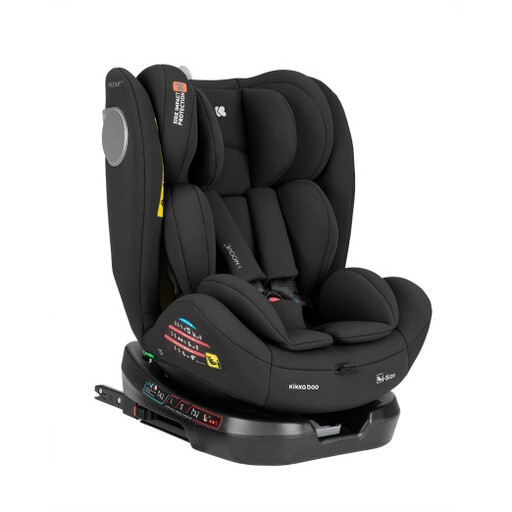
Why this product suits the profile: The seat covers 40–150 cm and is aimed at families who want as few seat changes as possible and travel regularly by car.
The individual travel directions are specified by height range: rearward 40–105 cm and forward 76–150 cm. This makes the transition easy to follow.
360° swivel, 24 headrest positions, ISOFIX with top tether and integrated SPS side protection system.
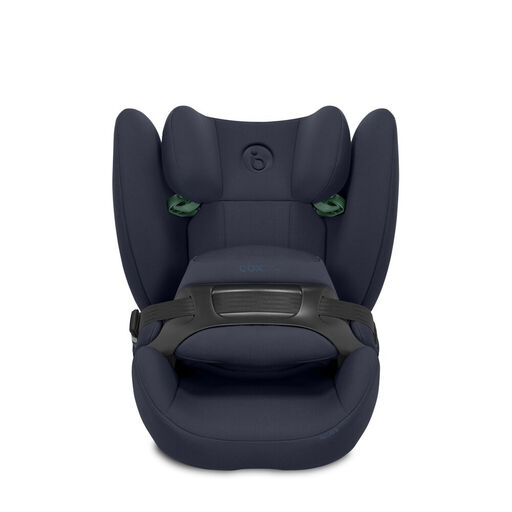
Why this product suits the profile: The 2-in-1 seat is designed for 76–150 cm, or approximately 15 months to 12 years, and can therefore cover several seating phases.
The product details clearly state when the impact shield should be used and when it should be removed from 105 cm or 21 kg. This ensures the switch to the three-point belt is not overlooked.
UN R129/04, 12-way adjustable headrest, ISOFIX with top tether and flexible backrest. According to CYBEX, the impact shield can reduce the risk of neck injuries compared with a conventional 5-point harness; this statement is based on manufacturer data.
We have put together a complete, regularly updated list of products that fully meet these strict selection criteria and the safety regulations in force in the EU.
No. What matters is the vehicle approval list, the ISOFIX positions, the space for the top tether or support leg, and the installation instructions. Check both manufacturer’s specifications before buying.
That depends on the approved height range. A baby carrier for 40–87 cm will need replacing much sooner than a model for 40–150 cm. The key factors are height, weight, belt position and the information in the user manual.
The swivel function makes it easier to get your child in and out, but it is not a safety criterion in itself. What really matters is the approval, correct installation, the right travel direction and properly securing your child.