
Lieferung heute & morgen

Qualitätsgarantie

Willkommens-Angebote freischalten: KOSTENLOSE Lieferung | Bis zu 80 % RABATT | Kostenlose 30-Tage-JoyPlus-Testphase
App herunterladen
An i-Size car seat needs to fit your child, your vehicle and your family's daily life. However, the label alone isn't enough to base your purchase on. What really matters is your child's height, the installation method, the direction of travel, and actual compatibility with your car.
As a Joybuy Product Recommendation Officer, I filter the key details from product descriptions and organise them by real-life usage scenarios. This helps you avoid common buying mistakes without being swayed by marketing claims.
With ECE R129 car seats, your child's height is the primary selection criterion. Labels like "from birth", "from 15 months" or "up to 12 years" are only a guide. Children of the same age can vary significantly in height.
So always check:
A car seat for 15 months to 12 years typically covers the range from around 76 to 150 cm, but it isn't automatically suitable for newborns.
An ISOFIX car seat can make fitting easier, but it needs a compatible ISOFIX anchorage point in your vehicle. Depending on the model, you may also need a Top Tether, a support leg or the vehicle's three-point seatbelt.
Before you buy, cross-check your vehicle manual with the seat instructions. This is especially important with a 360-degree rotating car seat, where there must be enough space between the seat, the front seat and the car door. A support leg must only rest on a vehicle floor that is designed for it.
A recline function, a cup holder, a sun canopy or a swivel mechanism can make daily life easier. However, these features don't replace correct installation or a suitable size approval. Accessories must also not obstruct the harness, headrest or side-impact protection.
The UN R129 standard, often referred to as i-Size, classifies car seats by height and includes requirements for side-impact protection, among other things. The approval details should be clearly visible on the product label, for example UN R129/03 or UN R129/04.
Approval doesn't mean every seat fits every vehicle. That's why vehicle compatibility, installation instructions and indicator displays remain important points to check.
A reboarder car seat is used facing the rear of the vehicle. On many models, this position is intended for smaller children. The specific limits vary from seat to seat. The seat should only be used forward-facing when the instructions and height approval allow it.
With a seat suitable from birth, you also need to consider the newborn insert, the minimum height (for example 40 cm) and correct harness adjustment. A car seat with a recline function can change the seating position, but it doesn't replace a suitable infant carrier if the model isn't explicitly approved for newborns.
A growing car seat usually has an adjustable headrest, adaptable harness and interchangeable restraint systems. Pay attention to when a impact shield, a 5-point harness or the vehicle's three-point seatbelt should be used.
For older children, a booster seat for 125–150 cm may be suitable. With a simple booster cushion that has no integral harness, the three-point seatbelt must sit correctly across the shoulder and pelvis. Using a lap belt only is not intended for the model shown below.
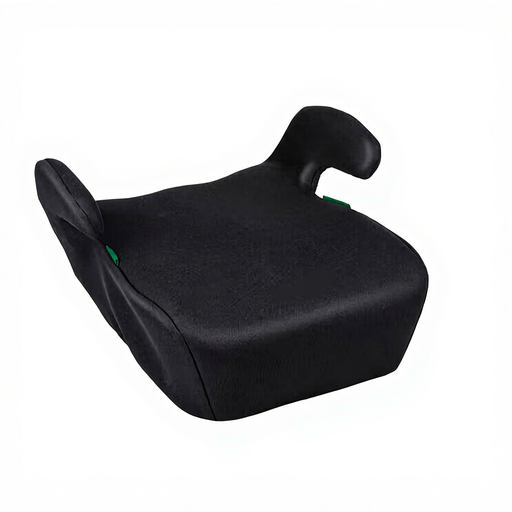
Why this product fits the profile: This compact booster seat is designed for children from 125 to 150 cm and can be easily moved between vehicles.
The height approval is clearly limited to 125–150 cm. This prevents the booster from being used too early.
ECE R129, weighs around 1 kg, removable washable cover, and use with the vehicle's three-point seatbelt.

Why this product fits the profile: Suitable for families looking for a 2-in-1 seat from around 15 months up to 150 cm, with adjustable components.
The switch between the restraint system and the vehicle seatbelt is tied to height and weight limits. The instructions must be followed at every transition.
UN R129/04, ISOFIX and Top Tether, 12-position adjustable headrest, and removable cover that can be washed at 30 °C.

Why this product fits the profile: The 360-degree rotation helps families who frequently get their child in and out of the car and value multiple seating positions.
The seat is designed for 61–105 cm; with the appropriate insert, the product details state 40–105 cm. This prevents it being used from birth without checking the accessories.
UN R129/03, integrated base, ISOFIX, support leg, 360-degree rotation and five recline positions in both directions of travel.

Why this product fits the profile: For parents looking for a seat from 40 to 105 cm with a swivel function and multiple recline positions.
Use is limited to 40–105 cm, so it's not the same as a seat that lasts until school age. Moving to the next seat group needs to be planned separately.
ECE R129/04, ISOFIX with support leg, 360-degree rotation and six adjustable recline positions.
We've put together a complete, regularly updated list of products that fully meet these strict selection criteria and the safety regulations in force in the EU.
A CYBEX car seat or Chicco car seat may have different installation and care requirements depending on the model. Even suitable accessories, such as a CYBEX cup holder, should only be attached to the models explicitly stated.
That depends on the approved height range and the condition of the seat. A model for 40–105 cm will typically be outgrown sooner than a growing car seat for 76–150 cm. After an accident or if components are damaged, the seat should not be used again.
ISOFIX reduces the chance of installation errors and makes fitting easier. However, it doesn't automatically make a seat suitable for every vehicle. What really matters is the approval, correct installation, vehicle compatibility and the right adjustment for your child.
Such a booster is intended exclusively for children within the stated height range. The three-point seatbelt must run across the shoulder and pelvis and must not touch the neck or stomach. Always check the specific use against the seat instructions and your vehicle manual.