
Lieferung heute & morgen

Qualitätsgarantie

Willkommens-Angebote freischalten: KOSTENLOSE Lieferung | Bis zu 80 % RABATT | Kostenlose 30-Tage-JoyPlus-Testphase
App herunterladen
An i-Size car seat needs to suit your child, your vehicle and your daily life. Many options look similar at first glance, but they differ significantly in size range, installation, orientation and care. If you focus only on a 360° function or a long usage period, you could end up buying a model that cannot be properly installed in your car or no longer fits your child well after a short time.
A growing car seat with a range of 40–150 cm sounds like a solution for many years. However, the individual usage phases are what really matter: newborns need a suitable insert and a proper reclining position. At later sizes, the fixing method, travel direction and harness system may change.
A model for 76–150 cm, for example, is not suitable for babies, even if it can be used up to around 12 years of age. Always check the stated height range, not just the age recommendation.
An ISOFIX car seat can usually be securely fitted in compatible vehicles. However, that doesn’t mean every ISOFIX model will fit every car. Depending on the seat, you may also need a Top Tether, a support leg or the vehicle’s seat belt.
Before buying, parents should cross-check the vehicle manual with the seat’s instruction manual. Indicators, a fully seated support leg and correctly tensioned straps are practical details that can matter more in daily use than an especially long product name.
A car seat with 360° swivel function makes it easier to get your child in and out and to buckle them up. However, the swivel feature doesn’t automatically mean every travel direction is permitted in every size phase. For babies and younger toddlers, the manufacturer’s specifications for rearward-facing use apply.
A reclining function should also not be considered in isolation. Check whether it is available in the desired travel direction and whether the seat still sits correctly against the vehicle seat afterwards.
The UN regulation ECE R129, also known as i-Size, is primarily based on the child’s height. Typical ranges are:
A rear-facing car seat is used facing backwards. With many R129 models, this orientation is mandatory for children under 15 months. The specific approval and the instruction manual for each seat remain the deciding factors.
Pay attention to the complete installation method:
A car seat with side-impact protection may have additional protective elements built into the shell, headrest or side wings. Such features should be checked against the product description and approval, not general advertising claims.
An adjustable headrest, an adjustable harness and several recline positions can improve everyday usability. Removable covers and the permitted washing temperature are equally important. With the products selected here, the cover can be washed at 30 °C, depending on the model.
Before using the seat, parents should install it without the child, check the belt routing and make sure the car door or front seat does not touch the seat. Thick winter clothing under the harness can affect the correct fit.

Why this product fits the profile: The infant carrier is designed for newborns from 40 to 87 cm and up to 13 kg. It can be installed using ISOFIX or alternatively with the three-point belt, and weighs 4.4 kg according to the product information.
The clearly defined size range prevents the false expectation that an infant carrier can cover multiple car seat phases. The installation indicators help you check the fitting.
Rearward-facing use, seven recline positions, washable cover and adapter compatibility with Hauck pushchairs.

Why this product fits the profile: The seat covers 40 to 105 cm and combines an integrated ISOFIX base with a support leg, 360° swivel mechanism and twelve headrest positions.
The usage range is clearly limited to the early childhood phase. The swivel function is combined with a specific installation base and a support leg.
Newborn insert for 40–60 cm, six times more breathable mesh according to the brand’s Plus version specification, and removable covers.
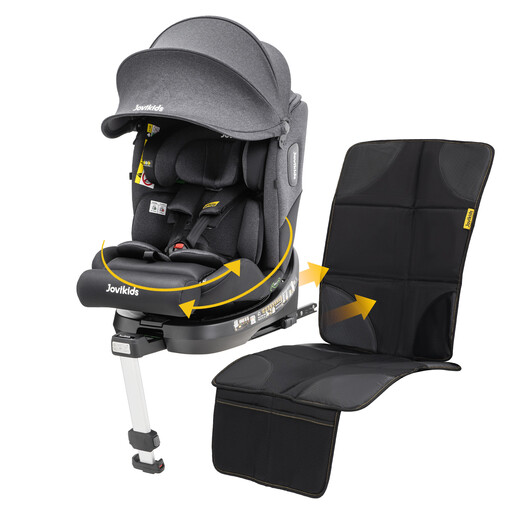
Why this product fits the profile: The seat is designed for 40–150 cm and offers 360° rotation, ISOFIX, a support leg and an adjustable headrest with twelve positions.
The individual size and installation details make it clear that the seat covers several phases with different settings. The cover is fully removable for cleaning.
Rearward-facing use from 40–105 cm, forward-facing use from 76–150 cm and UV protection 50+ on the removable sun canopy according to the product information.
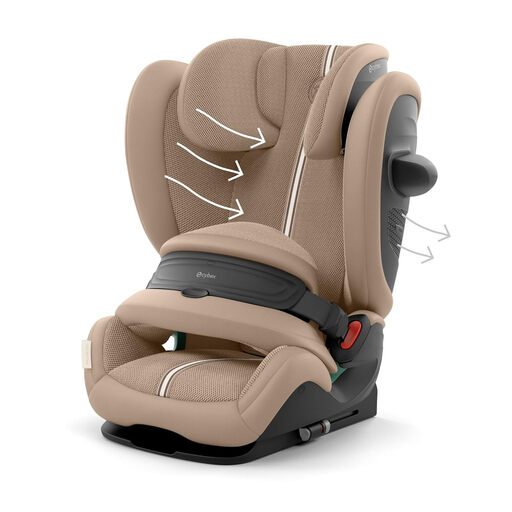
Why this product fits the profile: The 2-in-1 car seat is designed for 76–150 cm. According to the product information, the impact shield can be removed later and the three-point belt used instead.
The usage limits for the impact shield and the vehicle belt are clearly stated. This makes it possible to plan the transition between developmental phases specifically.
Twelve headrest positions, adjustable backrest, ISOFIX and Top Tether in the stated usage phase; the cover is washable at 30 °C.
We have put together a complete, regularly updated list of products that fully meet these strict selection criteria and the safety regulations in force in the EU.
That depends on the model. Infant carriers often start at 40 cm, while seats for toddlers are often approved from 76 cm. A booster seat with a backrest may, for example, be designed for 100–150 cm. The information on the seat and in the instruction manual is what matters.
No. Some models can also, or alternatively, be installed using the three-point belt. Others require ISOFIX in combination with a Top Tether or support leg. The prescribed installation method must not be altered independently.
The usage period depends on height, weight, condition and the manufacturer’s instructions. A seat for 40–105 cm is not intended for the whole of childhood. After an accident, if there is visible damage, missing parts or damaged straps, the car seat should not be used any further.