
Lieferung heute & morgen

Qualitätsgarantie

Willkommens-Angebote freischalten: KOSTENLOSE Lieferung | Bis zu 80 % RABATT | Kostenlose 30-Tage-JoyPlus-Testphase
App herunterladen
An i-Size child car seat should suit your child, your car and your family’s day-to-day life. In practice, the wrong purchase is often down to unclear information rather than a lack of features. Some seats are marketed by age, even though your child’s height is what matters. Others may fit your car but prove awkward to use or move between vehicles.
The label ‘from 15 months’ is only a guide. Under ECE R129 or UN R129, child car seats are approved primarily according to the child’s height. A child car seat may, for example, be suitable for 76 to 150 cm, while the age range will vary depending on how quickly your child grows.
Figures such as 9–36 kg child car seat or 15–36 kg child car seat should not be considered in isolation either. Always check the height range and approved installation position for the seat.
An ISOFIX child car seat can usually be attached quickly and securely to the vehicle’s designated anchor points. However, your car still needs to be suitable for that particular seat. Some models also require a Top Tether, a support leg or the vehicle’s three-point seat belt.
Before buying, compare your car’s handbook with the manufacturer’s installation instructions. If you use more than one car, check whether the base can stay fitted in one vehicle or whether you’ll need to move the whole seat regularly.
A 2-in-1 child car seat or growing child car seat can cover several stages of your child’s development. However, parents need to adjust it regularly: the headrest, backrest, impact shield and belt guides should all suit your child’s current height.
A model designed to last until around 12 years is only practical if the conversion instructions are clear and the seat is easy to use day to day. Also look for removable covers that can be washed at 30 °C, and adjustments that are easy to reach.
For toddlers from around 15 months, models from 76 cm may be suitable, provided this is covered by the relevant approval. A child car seat for children from 15 months may have an impact shield or an integrated harness system. When your child moves to the next seat group, the vehicle’s three-point seat belt is often used.
For older children around 125 to 150 cm tall, a high-back booster seat or an ISOFIX booster seat may be suitable. Backless booster seats should only be used within the height and weight ranges specifically stated by the manufacturer.
The ECE R129 or i-Size marking indicates, among other things, approval based on a child’s height and requirements for side-impact protection. It does not replace a thorough check of compatibility with your car. An approved seat must be installed correctly and used in accordance with the instructions.
Information about side-impact protection, impact shields or energy absorbers should be read objectively. Where brands give specific reduction figures, these are manufacturer claims. For example, according to the manufacturer, the L.S.P. system on certain CYBEX models reduces the forces of a side impact by a stated percentage. This does not establish the level of protection in every car or every accident.
Before buying, check:
A rotating child car seat can make it easier to get your child in and out. With this type of model, also check the approvals for rearward- and forward-facing use, as well as the correct position of the support leg.
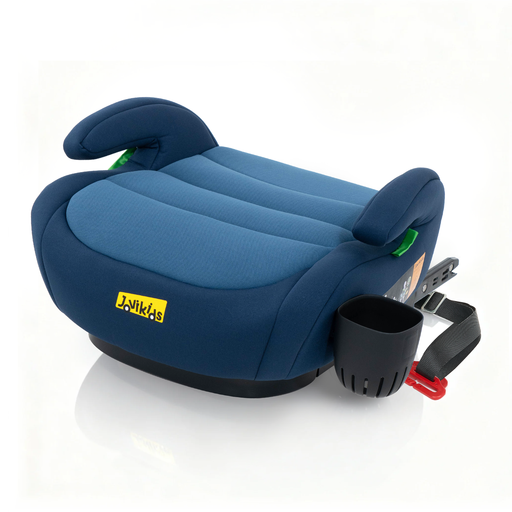
Why this product suits this profile: This compact option is for families looking for a booster seat for children between 125 and 150 cm tall, which they may occasionally need to move between cars.
The 125–150 cm height range clearly defines when the seat can be used. The ISOFIX adapters and supplied guides help make fitting straightforward.
ECE R129 approval, washable cover, weighs around 3 kg and compact dimensions of 37 × 44 × 23 cm.
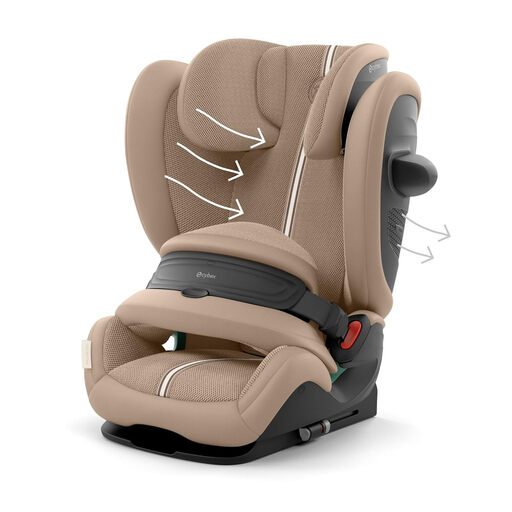
Why this product suits this profile: This 2-in-1 child car seat is designed for families looking for one option from around 15 months to approximately 12 years, or for children between 76 and 150 cm tall.
The product information sets out the transition points: an impact shield for the smaller seat stage and a three-point seat belt for older children. This means you can switch modes at clearly defined height ranges.
UN R129/03, ISOFIX and Top Tether, 12-position headrest, five recline positions and washable covers.

Why this product suits this profile: This rotating child car seat is suited to families with babies and toddlers who want to make getting their child in and out from the side easier every day.
The approved height range of 61 to 105 cm makes it clear that this is not a seat designed for use up to 12 years. The integrated base stays in the car.
360-degree rotation, ISOFIX with support leg, five recline positions in both travel directions and a 12-position headrest.
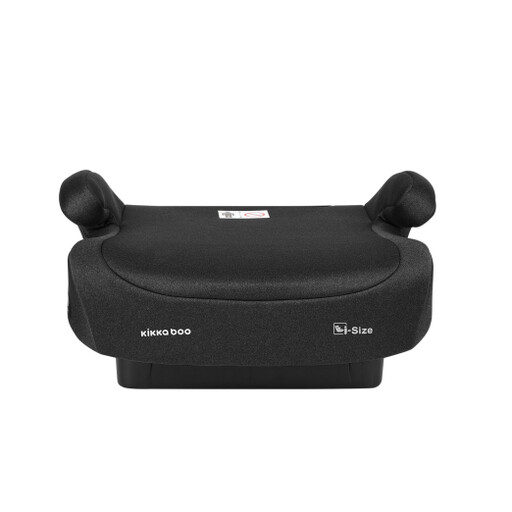
Why this product suits this profile: This compact model is designed for older children and may suit families who need a lightweight seat that can be moved between several cars.
It is designed for children between 125 and 150 cm tall and is used with the three-point seat belt. This helps prevent it being used too soon for smaller children.
Weighs around 1.28 kg, measures 36 × 43 × 22 cm, with armrests and a removable cover.
We’ve put together a comprehensive, regularly updated list of products that meet these strict selection criteria and fully comply with the safety regulations in force in the EU.
No. i-Size approval describes the seat’s safety and height range, but does not guarantee that every fitting option will work in every car. Check the ISOFIX points, Top Tether, support leg and vehicle approval.
It depends on the approved height range. Some 2-in-1 models cover around 76 to 150 cm, so they can be used until approximately 12 years of age. However, your child’s height, the manufacturer’s instructions and the correct changeover between seat modes are what matter.
A booster seat is designed for older children once they reach the stated height range. For some of the models mentioned, this starts at 125 cm. The vehicle’s seat belt must fit correctly across the shoulder and pelvis; a booster seat does not replace checking that it fits your child properly.