
Lieferung heute & morgen

Qualitätsgarantie

Willkommens-Angebote freischalten: KOSTENLOSE Lieferung | Bis zu 80 % RABATT | Kostenlose 30-Tage-JoyPlus-Testphase
App herunterladen
An i-Size child car seat must do more than simply match your child’s height. Vehicle compatibility, installation, seating direction and everyday handling all determine whether the seat remains practical in the long term. Many purchasing decisions go wrong not because features are missing, but because promises are misunderstood.
A child car seat for ages 0–12 covers a broad height range on paper. In practice, however, the needs of a newborn are very different from those of a school-age child. A seat designed for children from 40 to 150 cm must be adjustable correctly throughout several stages of development. So check the following:
A growing child car seat can be a practical choice if the adjustment steps are clearly explained and the seat is compatible with your vehicle. A dedicated seat for the first stage of life is often more compact and easier to carry, however.
A 360-degree rotating child car seat makes it easier to place your child in the seat and take them out again. Rotation alone, however, says nothing about compatibility with every vehicle. Many models require ISOFIX anchor points and a support leg. The vehicle floor must be suitable for the support leg, and a storage compartment may affect installation.
Also check whether the seat must be locked in place while driving and in which positions it can be rotated. A feature prominently highlighted in a product listing is only useful if it works safely and without restrictions in your own vehicle.
A recline function, ventilation, a sun canopy or washable covers can make everyday use easier. They do not replace the correct size, a properly routed harness or a secure installation, however. With a child car seat with recline function, check whether the recline is available in both rear-facing and forward-facing positions and whether it is approved for your child’s particular height.
The designation ECE R129 child car seat refers to a European approval regulation. With i-Size models, classification is based primarily on the child’s height. Product details also often state a maximum height and permitted weight.
Three points are particularly important for parents:
A child car seat with ISOFIX is attached to the designated anchor points. Colour indicators can show whether the connection has engaged correctly. With seats featuring a support leg, this must stand firmly on the vehicle floor. Some models also allow installation with a 3-point vehicle seat belt, while others are designed exclusively for ISOFIX.
The installation method should not be chosen simply for convenience. What matters is which type of installation the manufacturer specifies for the particular model, your child’s height and your vehicle.
A child car seat with side-impact protection may feature reinforced side elements, energy-absorbing materials or additional protective systems. Such descriptions should be read objectively: an integrated protection system is a product feature, not a blanket guarantee of a particular outcome in an accident.
A height-adjustable headrest, a correctly positioned harness and sufficient room around the shoulders and hips are equally important. Thick winter clothing under the harness can affect the fit of the seat. It is better to secure your child in normal clothing and place a blanket over them.

Why this product suits this profile: The infant carrier is designed for children from 40 to 87 cm and weighing up to 13 kg. At 4.4 kg, it is well suited to families who regularly carry the seat or want to connect it to a pushchair adapter.
The clearly defined height range prevents the mistaken expectation that an infant carrier will be suitable until school age. ISOFIX or a 3-point seat belt can be used for installation.
UN ECE R129-03, rear-facing use, height-adjustable headrest and machine-washable cover.

Why this product suits this profile: The seat is designed for children from 61 to 105 cm and weighing up to 20 kg; with the baby insert, use from 40 cm is specified. The 360-degree rotation makes fastening your child in everyday situations easier.
The specific height range makes it clear when an additional insert is required. ISOFIX, the support leg and green installation indicators help make installation easy to verify.
UN R129/03, 12 headrest positions, five recline positions and an integrated L.S.P. system.

Why this product suits this profile: According to the product information, this model is suitable for children from 40 to 125 cm. It is a good choice for families looking for a rotating seat with ISOFIX, a support leg and a longer service life up to around seven years.
The transition between rear-facing and forward-facing use is described according to height range. The 125 cm usage limit prevents unclear use beyond the approved range.
360-degree rotation, several recline positions, integrated side-impact protection and washable cover.
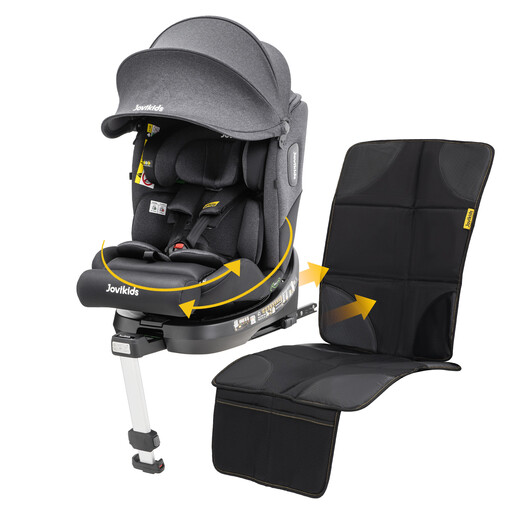
Why this product suits this profile: The stated range of 40 to 150 cm is aimed at families looking for a child car seat for babies and children with an adjustable headrest.
The 12-position headrest adjustment and removable inserts make it easier to understand how the seat adapts to different heights. Nevertheless, the details should be checked against the instruction manual.
360-degree rotation, ISOFIX, support leg, several recline positions and removable sun protection.
We have put together a complete, regularly updated list of products that fully meet these strict selection criteria and the safety regulations applicable in the EU.
i-Size refers to child restraint systems approved under UN ECE Regulation R129. Selection is based primarily on the child’s height. Depending on the model, ISOFIX, a support leg, Top Tether or a 3-point vehicle seat belt may be used. The approval and instructions for the individual seat are always decisive.
The exact duration depends on the seat and the child’s height. Children under 15 months must travel rear-facing in accordance with the R129 requirements. A rear-facing child seat may allow rear-facing use beyond this point, provided the manufacturer approves it for the stated height range.
Prices vary according to the usage range, installation system, rotation function, materials and features. A child car seat suitable from birth can be either an infant carrier or a model designed for longer use. The purchase price alone is not the deciding factor: what matters is whether the seat suits your child’s height, your vehicle and the period for which you plan to use it.