
Lieferung heute & morgen

Qualitätsgarantie

Willkommens-Angebote freischalten: KOSTENLOSE Lieferung | Bis zu 80 % RABATT | Kostenlose 30-Tage-JoyPlus-Testphase
App herunterladen
Your own ice maker promises cold drinks at the touch of a button—ideal for parties, hot summer days, or the perfect evening cocktail. But the market is flooded with appliances whose marketing promises often don't hold up in practice. Before you make a decision, it's crucial to understand the common pitfalls that can lead to a purchase you'll regret. This guide will help you correctly interpret technical specifications and find a machine that truly fits your needs.
Many buyers rely on marketing claims that quickly disappoint in everyday use. Pay close attention to these three points to make an informed choice.
To find the right appliance, you should focus on objective, measurable parameters that match your specific needs.
The daily production capacity (in kg) indicates how much ice a machine can produce under optimal conditions. For everyday use or small gatherings, a capacity of around 12 kg/day is usually sufficient. However, the capacity of the collection basket (often specified in grams or kg) is more important. A larger basket means you'll need to empty it less frequently and will always have a reserve on hand for several drinks.
Looking for flexibility? A portable ice maker isn't just defined by its compact size. Look for a low weight (ideally under 8 kg) and an integrated carrying handle. Such models are excellent as a small ice maker for the countertop, but also for use when camping or in an RV, provided a power outlet is available. Measure the intended space carefully before you buy.
A quiet ice maker is especially beneficial in open-plan living areas or offices. Pay attention to the manufacturer's specifications for noise level in decibels (dB). Values below 45 dB are considered relatively low-noise. An automatic self-cleaning function is also a key convenience feature. It flushes the system at the touch of a button, preventing the build-up of germs and limescale and significantly reducing manual cleaning effort.
Instead of making a one-size-fits-all recommendation, we have identified models tailored to specific use cases.
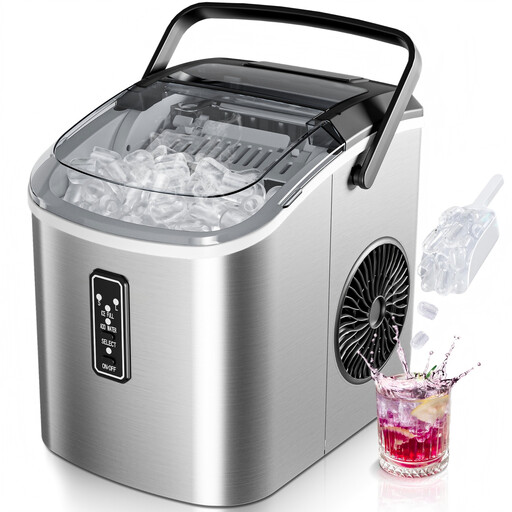
Why This Fits Their Persona: Thanks to its sturdy carrying handle and low weight of just 6.3 kg, this model is ideal for transport between the kitchen and patio, or for use as an ice maker for camping in an RV.
This unit focuses on the practical aspects of portability. Instead of just highlighting theoretical daily output, it offers a clear, convenient solution for flexible use.
The combination of compact dimensions (22.2 x 36.6 x 29.39 cm), an integrated carrying handle, and a self-cleaning function makes it a hassle-free companion.

Why This Fits Their Persona: Anyone who regularly entertains guests needs a reliable ice supply. With two selectable ice cube sizes, this machine provides the perfect foundation for cocktails, long drinks, and other cold beverages.
The machine features a true self-cleaning function that starts a 30-minute cycle at the touch of a button. This ensures hygiene—an often overlooked but critical feature.
Two selectable ice cube sizes and simple operation with level indicators for water and ice make it easy to manage, even during a party.
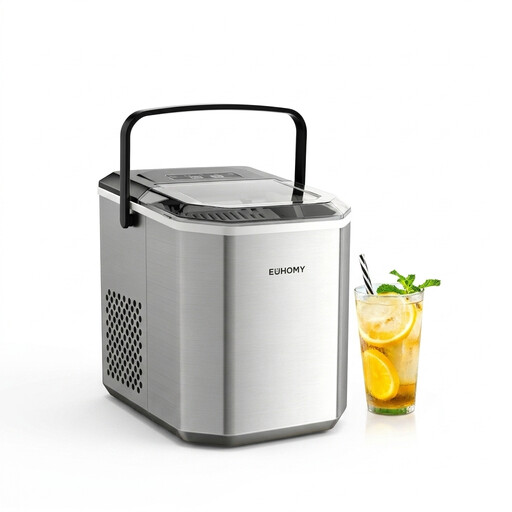
Why This Fits Their Persona: With its stainless steel front, this ice maker blends seamlessly into modern kitchen environments, combining an appealing aesthetic with high functionality for daily use.
The unit provides clear specifications on its noise level (under 45 dB, according to the manufacturer), avoiding the vague description of "quiet." It offers transparent performance for use in open-plan kitchens.
The ability to adjust the ice cube thickness ("Large" for slower melting) and the easy-to-clean stainless steel finish are clear advantages for discerning users.
We have compiled a complete, up-to-date list of products that fully meet these strict selection criteria and all relevant safety standards.
With regular use, cleaning is recommended every one to two weeks to prevent limescale and germ build-up. Models with a self-cleaning function simplify this process considerably. For these, you typically just need to fill the machine with clean water and start the corresponding program.
Yes. A home ice maker is not a freezer. The collection basket is typically not actively cooled. Therefore, any ice cubes that are not removed will slowly melt. The meltwater flows back into the water reservoir and is reused for the next production cycle. For long-term storage, you should transfer the finished ice cubes to a bag or container and keep them in your freezer.
Power consumption is relatively moderate. Most home-use models have a power draw between 100 and 150 watts, which is only consumed during the active cooling cycle. The total energy usage depends heavily on the frequency of use. Some newer models are advertised as being more energy-efficient, which can lower consumption compared to older units.